

Hey savvy shoppers! When the items in our articles catch your eye and you decide to buy through our links, we may earn a small commission at no extra cost to you. Think of it as a way of supporting us in bringing you the best content!
Most beginner eyeshadow palettes fail the same way: chalky formula that won’t budge, seventeen shades of brown with no obvious logic, or a price tag that makes you feel sick when the whole thing ends up looking patchy. I went through four palettes before I found one that actually made me feel like I wasn’t doing something wrong — and the difference wasn’t my technique. It was the formula.
That matters more than anything else here.
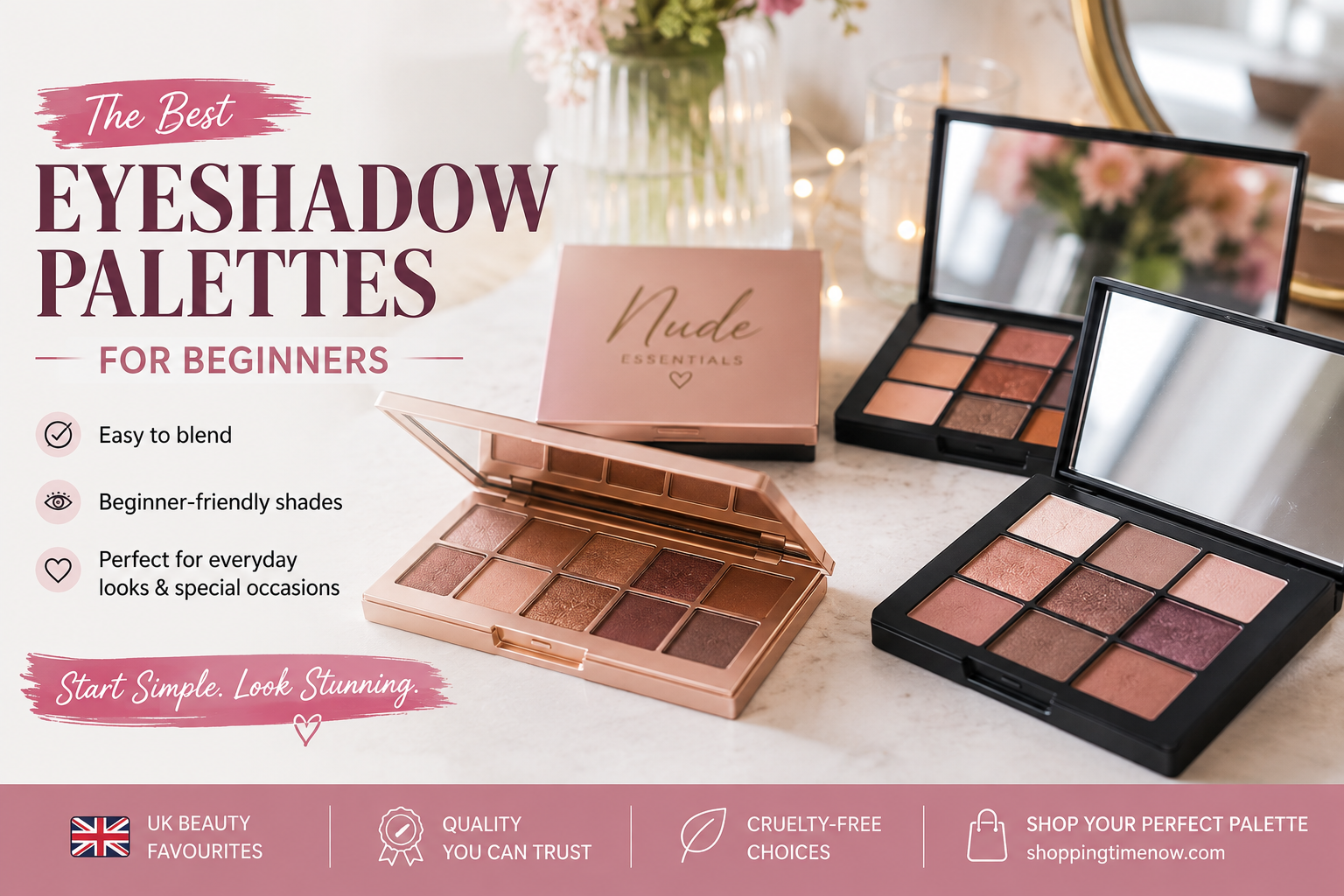
Your first eyeshadow palette doesn’t need to turn you into a makeup artist. It just needs to not make you feel stupid. The right one removes the intimidation factor entirely — you blend, it blends, you look at yourself and think “oh, that’s actually nice” instead of wiping it all off before anyone sees. Eyeshadow palettes for beginners should do that one thing above all else, and the options below were picked specifically because they do.
What actually matters when you’re buying your first palette
Shade count is where most beginners go wrong — not because they pick too few, but because they pick too many. A 50-pan palette looks impressive in a flat-lay photo and is genuinely useless when you have no idea which five shades to even start with. Five to eight shades is the sweet spot: enough variety to create different looks, few enough that you’re not spending ten minutes just deciding. You want a mix of matte shades (for blending and adding depth in the crease) and shimmer shades (for dimension on the lid or inner corner) — that combination alone gets you through most everyday looks without needing anything else.
Formula is the thing nobody talks about loudly enough. A palette with good pigmentation means you see actual colour after one or two swipes, not a faint whisper you have to layer eight times to make visible. More importantly, the shadows should blend when you move a brush through them — not stay in hard lines, not turn muddy, not kick up a cloud of dust and land all over your cheekbones. Creamy, slightly soft textures are far more forgiving than dry powdery ones when you haven’t yet figured out how much pressure to apply, which angle works best, or how fast to move the brush. That kind of forgiveness is what separates a frustrating first experience from one that makes you want to try again the next morning.
And what does all this cost? Beginner palettes don’t need to be £40. Some genuinely excellent options sit under £15, which means you can make mistakes, not love it, and try something else without feeling like you’ve thrown money away.
The affordable picks worth starting with
These three palettes all do the basics well. Different price points, slightly different vibes — but the same core thing: they work for someone who has never touched an eyeshadow brush before.

Affordable, easy-to-blend palette with complementary neutral shades perfect for first-time users
Yves Saint Laurent, Women’s Couture Mini Clutch Eyeshadow Palette £40.5 (25% OFF — was £54)
At this price point, aim for five to eight shades maximum. The best ones lead with soft browns and taupes as your matte transition shades — these are the workhorses of any eye look, the shades you blend out in the crease to add depth without drama. Then a couple of shimmer shades round things out for when you want something more. Neutrals specifically work here because they suit every skin tone without requiring you to already know your undertones or have a particular technique dialled in. (Bonus if the palette includes a brush or mirror — less you need to buy separately.)

Warm-toned beginner palette with forgiving formula for blending practice
Warm tones are genuinely easier to learn with. Golds, coppers, soft peachy browns — they blend together almost automatically, and they’re forgiving when your placement is slightly off, which it will be at first and that’s completely fine. Cool purples and silvery greys look incredible on some people but show patchy blending more harshly, so save those for later. Swatch any palette on your wrist before committing: if it feels smooth and the colour shows up cleanly, the formula is probably good. If it drags or feels almost gritty, put it back.

Versatile neutral palette with quality formula for creating multiple everyday looks
Sigma, Beauty Ambiance Eyeshadow Palette £41.64 (15% OFF — was £49)
Eight shades is a good number. You get just enough variety — a natural everyday look, something with more definition, maybe one option with a shimmer for evenings — without the whole thing feeling like homework. What to watch for: do the shades actually work together, or do they feel like a random collection? A well-curated palette shouldn’t require you to own three other palettes to fill in the gaps. The shades should flow into each other logically, dark to light, matte to shimmer, so you’re building a look rather than guessing.
Ready for something with more range?
Once the basics feel comfortable — once you’re not staring at your eyelid wondering where the crease actually is — it’s worth looking at palettes with slightly more going on. These still work for beginners, but they’ve got more shade options and a bit more personality.

Slightly larger palette with more shade variety while maintaining beginner-friendly formula and application
Sigma, Beauty Cor-De-Rosa Eyeshadow Palette £25.67 (20% OFF — was £32.1)
A 12-shade palette opens up more possibilities without tipping into overwhelming. You’ve got room for mattes in multiple depths, a few shimmers, maybe a metallic or two. The thing to check is whether the shades actually complement each other — a palette that requires you to own two other palettes to make looks work is not a good deal at any price. Look for a mix of finishes across the range: matte shades for blending and defining, shimmers for adding dimension, and one or two metallics. If you’re feeling ready to push things slightly.

Intermediate palette with popular rose gold and bronze tones for creating defined, dimensional looks
PUPA Milano, Vamp! Eyeshadow Palette eyeshadow palette 002 Gold Bronze 5.2 g £12.2
Rose gold and bronze have a quality that’s hard to explain until you try them. They’re just flattering on almost everyone, across a huge range of skin tones, in a way that more polarising shades like deep plum or forest green simply aren’t. Pair those tones with a few neutral mattes and you’ve got a palette that lets you try slightly more complex looks without the risk of ending up with something unwearable. A wash of colour across the lid, a darker shade blended into the crease, a shimmer pressed onto the inner corner: three shades, three steps, one look that actually holds together. That’s the jump from absolute beginner to someone who knows what they’re doing.

Compact palette with essential shades for on-the-go practice and travel
Lord&Berry, Unisex Nude Eyeshadow Refill Palette (12 shades) 24g in Multiple… £70
Smaller doesn’t mean lower quality. Travel-size palettes are genuinely practical for beginners specifically because you’re more likely to actually use them — on the bus, at your desk, wherever — and frequency of practice is what builds technique faster than anything else. There’s also a real argument for keeping your investment modest while you’re still figuring out what colour families you actually like. Committing £30 to a full-size palette you end up ignoring is a worse outcome than spending less on something compact that you use every day.
Brushes: the part everyone skips
Your palette is only half the equation. A bad brush turns even a great formula into a frustrating mess — streaky application, harsh edges, colour that won’t blend no matter how many times you go over it. You don’t need a full professional set. Four brushes cover everything: a flat shader for packing colour onto the lid, a fluffy dome-shaped brush for blending edges, a smaller tapered brush for crease work, and a tiny detail brush for inner corners or lower lash lines.
The fluffy blending brush is the one that saves everything. When your eyeshadow looks too harsh, too blotchy, or just slightly wrong, that brush is what fixes it — move it in small circular motions at the edges of whatever you’ve applied and watch things soften almost immediately. The flat shader packs colour with precision. Those two brushes alone get you through the vast majority of looks. You’ll want to create in the first few months of wearing eyeshadow.

High-quality blending brush with soft bristles for seamless colour diffusion
Bristle quality is genuinely worth caring about. Cheap brushes shed into your eyeshadow, skip across the lid rather than gliding, and make you apply way more pressure than you should. Which contributes to patchy results and makes you think the problem is your technique when it’s actually just the brush. A good brush picks up colour evenly from the pan and moves it across your eyelid with almost no resistance. It sounds like a small thing. It’s not.

Portable brush set with case for practicing eyeshadow techniques on the go
delilah, Precision Eyeshadow Brush for Cream and Powder £2.52
A set that comes with a case is worth choosing over loose brushes if you’re starting out. Brushes stored loose in a makeup bag get bent bristles and damaged tips faster than you’d expect, and a bent blending brush is almost useless. Having everything in one place also just makes you more likely to use them. Which sounds obvious but genuinely affects how quickly your technique improves.
Four looks you can do right now
Okay — palette in hand, brushes sorted. What do you actually do with them?
One shade, all over: Pick a shade you like. Sweep it across your entire lid with your fluffy brush. Add a touch more in the outer corner if you want. That’s it. This isn’t a cop-out; it’s an intentional, minimal look that’s very much in right now, and it teaches you. The most important skill — how much product to load onto a brush before it becomes too much.
Crease definition: Take a matte shade slightly darker than your skin tone and blend it back and forth in your crease, focusing on the outer corner. Add a lighter shade all over the lid. Your eyes immediately look more awake and defined. This is the look that makes people ask if you’ve done something different. Which is exactly the effect you want when you’re still building confidence.
The shimmer pop: Do your basic neutral look first — light shade on the lid, slightly darker in the crease — then press a small amount of shimmer onto just the inner corner or the very centre of your lid. It catches light in a way that looks deliberate and polished. The mistake most beginners make is going too heavy with shimmer on the whole lid. The pop method is actually more effective with less product.
Three-shade gradient: Light shade on the inner third of the lid, medium in the middle, dark on the outer corner. Blend where they meet using your fluffy brush. This sounds like it requires precision, but it mostly requires patience — keep blending until. You can’t see hard lines between the shades, and you’re done. It looks complex. It takes about five minutes once you’ve done it twice.
Do these on a Tuesday when you’re not going anywhere.
Do them while watching something on your laptop. The pressure of running late or needing to look perfect. It is genuinely the enemy of learning, and the more you practice without stakes, the faster things click.
The honest truth about eyeshadow palettes for beginners is that the palette matters far less than the willingness to try something that doesn’t work, wipe it off, and try again — but a good formula makes the gap between “trying” and “something that actually looks nice” much, much smaller. Start affordable, start forgiving, and go from there. You’ll know when you’re ready for something more.
Frequently Asked Questions
How many shades does a beginner eyeshadow palette actually need?
Honestly, five to eight shades is plenty. A mix of two or three matte shades for blending and definition, plus a couple of shimmers, gives you everything. You need to create multiple looks without the paralysis that comes with a 35-pan palette you don’t know how to use yet.
What makes an eyeshadow formula beginner-friendly?
Two things: pigmentation and blendability. You want to see the colour with one or two swipes, not eight. And when you blend, the edges should diffuse softly rather than turning muddy or staying in hard lines. Creamy, slightly buttery textures are far more forgiving than dry, chalky powders when you’re still figuring out pressure and technique.
Do I need expensive brushes for eyeshadow as a beginner?
Not expensive, but not rubbish either. A flat shader brush, a fluffy blending brush, and one smaller detail brush will cover every technique you need starting out. The key is soft bristles that pick up colour evenly — brushes that shed or skip across. The lid make everything harder than it needs to be.
Should beginners use eyeshadow primer?
It helps, but it’s a separate purchase you don’t need on day one. Focus on getting comfortable with your palette and brush technique first. Once your application feels more controlled, adding a primer will noticeably improve how long your eyeshadow lasts and how vivid the colours look.
Are warm or cool eyeshadow tones better for beginners?
Warm tones — golds, coppers, soft browns — are generally more forgiving. They blend together easily, look flattering on a wide range of skin tones. They are less unforgiving if your placement is slightly off. Cool purples and greys can look stunning, but they show patchy blending more obviously. Which isn’t ideal when you’re still practising.



 No products in the cart.