

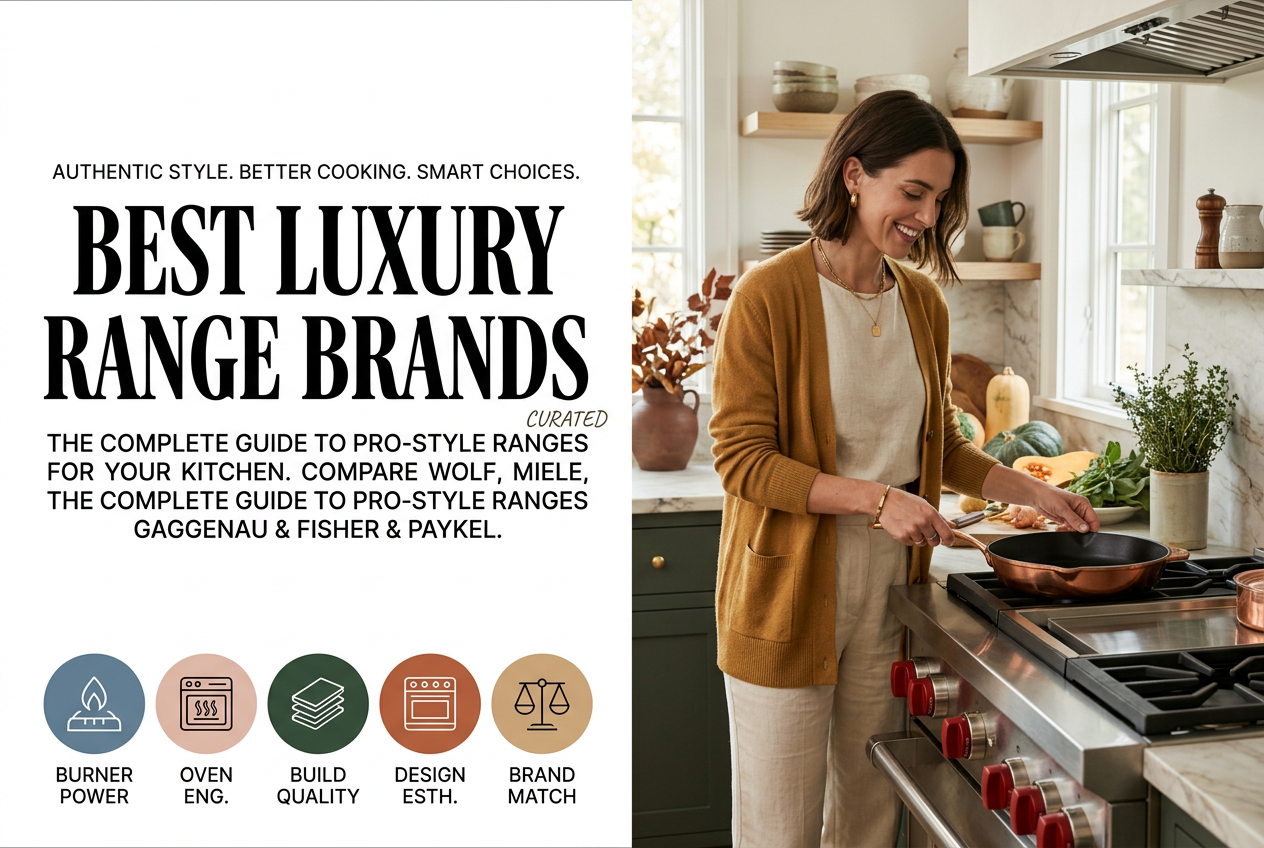
Here is something most appliance guides won’t tell you upfront: the $12,000 range is not always better than the $6,500 one. I spent weeks comparing these brands before my own kitchen renovation, and the conclusion I kept arriving at was that fit matters more than price. A Wolf that matches how you actually cook will outperform a Gaggenau you bought for the name every single time.
So before we get into brand comparisons, know this: the best luxury range is the one that matches your cooking style, your kitchen layout, and your honest budget — including installation costs that most people forget to factor in until it’s too late.
What Actually Separates a Luxury Range from Everything Else
The pro-style range market has gotten genuinely competitive over the last decade. It used to be Wolf or nothing. Now Miele, Gaggenau, Fisher & Paykel, and Sub-Zero all make real cases for themselves, which means buyers have more options and, honestly, more confusion. What you’re paying for at the $5,000–$15,000 price tier comes down to four things: burner output (typically 12,000–18,000 BTU per burner, though anything above 15,000 is more than most home cooks will ever need), oven engineering, materials and construction quality, and design. Not every brand prioritizes these equally, and that’s exactly where the differences start to matter.
A brand like Miele will spend its engineering budget on oven heat distribution and door hinge precision. Wolf spends it on cooktop power and durability. Gaggenau spends it on materials and aesthetics. None of these is wrong — they’re just different answers to the question of what luxury cooking actually means.
The market breaks into three rough price tiers. Entry luxury runs $4,000–$6,500 and gets you real pro-style performance with fewer configuration options. Mid-range luxury sits at $6,500–$10,000, where brands start differentiating on specific features — steam injection, pyrolytic cleaning, dual-fuel setups. Above $10,000, you’re paying for heritage, materials, and design as much as raw performance.
One thing worth flagging: knobs don’t need software updates. I mention this because some ranges now use full touchscreen control systems, and while they look impressive in a showroom, a traditional knob interface is more reliable over a 15-year ownership period. Think about what you’ll actually prefer at 7am on a Tuesday morning.
The Brands — What They’re Actually Good At
Wolf
Wolf has been the pro-style benchmark in American kitchens for decades, and the reputation is mostly earned. Their cooktops are powerful, the build is heavy-duty, and reliability over time is well-documented. Where Wolf falls short is design — their aesthetic feels stuck in 2005, and their oven engineering, while solid, doesn’t match what Miele or Gaggenau do at equivalent price points. Buy Wolf if high-heat cooking is your priority and you don’t lose sleep over how an appliance looks.
Miele
Miele is the German precision argument. Their ranges are quieter and more refined than Wolf, and the oven performance is genuinely superior for baking — even heat distribution, multiple true convection modes, optional steam injection for bread. The trade-off is BTU output, which lags behind Wolf on the cooktop side, and price, which tends to run higher for comparable specs. If you bake seriously or cook things that require consistent oven temperatures, Miele is the honest answer.
Actually, that’s not quite right — Miele isn’t just for bakers. Their cooktops are capable and refined. The point is more that Miele’s engineering emphasis is on the oven, and buyers who don’t bake much may be paying for something they’ll underuse.
Gaggenau
Gaggenau is for people who want the best of everything and are prepared to pay for it. Seamless stainless surfaces, integrated lighting, materials that feel different from everything else in this category — Gaggenau ranges are beautiful in a way that most appliances simply aren’t. Performance is excellent across the board. But at $9,000–$15,000+, you are paying a design and heritage premium that goes beyond pure cooking performance. Worth it for some buyers. Not necessary for great food.
Fisher & Paykel
Fisher & Paykel deserves more attention than it usually gets in these comparisons. The New Zealand brand builds ranges that feel designed for actual home cooking rather than professional kitchen aesthetics — larger oven cavities than most competitors, better ergonomics, more intuitive controls. If you cook a wide variety of things and want balance over specialization, Fisher & Paykel often makes more practical sense than brands with stronger reputations but narrower strengths.
Sub-Zero
Sub-Zero (which owns Wolf) makes ranges that sit between Wolf’s raw power and Miele’s refinement. They’re less talked about than the parent brand’s refrigerators, but they’re genuinely good — and if you’re already buying Sub-Zero refrigeration, the matched aesthetics and single service relationship are real advantages.
Which brand fits how you actually cook?
High-heat cooking — searing steaks, stir-frying, getting water to a boil fast — points toward Wolf or Fisher & Paykel. Both handle intense cooktop heat well, though Fisher & Paykel does it with a more refined feel. Serious baking points toward Miele or Gaggenau without much debate. Cooking a wide variety of things without a dominant specialty points toward Fisher & Paykel or Sub-Zero, both of which balance cooktop and oven performance without overcommitting to either. And if the range needs to anchor a kitchen design the way furniture does, Gaggenau is the only brand in this category that consistently achieves that.
The Budget Conversation Nobody Has Early Enough
Sticker shock is real in this category. But the bigger problem is that most buyers focus entirely on the range price and forget the installation costs until they’re already committed.
Budget $1,000–$3,000 for professional installation. Add $1,000–$5,000 if you need a new or upgraded ventilation hood (and with a pro-style range, you almost certainly do). Factor in another $500–$1,500 if your kitchen needs a 240V electrical upgrade. When I ran these numbers for my own project, the total cost was nearly $4,000 above the range price. That changes the math considerably on which tier makes sense.
The sweet spot for most buyers is $6,000–$8,000 for the range itself. At that price, you get genuine build quality and longevity from any of the major brands without paying the ultra-premium tier’s design surcharge. Above $10,000, you are increasingly buying design, heritage, and specific materials rather than meaningfully better cooking performance.
Luxury ranges do hold value reasonably well at resale — Wolf and Miele are names that buyers in higher-end markets recognize and respond to. That’s not a reason to buy one, but it’s worth knowing you’re not making a purely sunk-cost decision.
The honest answer
If you cook at high heat often and don’t care about aesthetics, buy Wolf. If you bake seriously, buy Miele. And if you want the most beautiful range in this category and have the budget, buy Gaggenau. If you want balance and practicality without the commercial-kitchen aesthetic, buy Fisher & Paykel.
What I’d actually recommend to most people reading this: start with your real budget including installation, then eliminate the brands outside that range, then decide based on how you cook rather than reputation. The $6,500 Fisher & Paykel that fits your cooking style will make you happier over ten years than the $11,000 Gaggenau you bought because it looked impressive in a showroom.
Some links on this page are affiliate links: if you buy through them we may earn a small commission at no extra cost to you. We only recommend products we would buy ourselves.
Frequently Asked Questions
Is Wolf still the best luxury range brand in the US?
Wolf is still the top choice for high-heat cooking — searing, stir-frying, fast boiling. But ‘best’ depends on how you cook. Miele outperforms Wolf for baking, Gaggenau wins on materials and design, and Fisher & Paykel offers better oven capacity for the price. Wolf is the safe, proven pick. It’s not automatically the right one.
What is a realistic budget for a luxury range including installation?
The range itself will run $4,500 to $15,000+. But installation adds $1,000–$3,000, a new ventilation hood can add another $1,000–$5,000, and if your kitchen needs a 240V electrical upgrade, budget another $500–$1,500. Most buyers end up spending $3,000–$6,000 more than the sticker price of the range itself.
Are Gaggenau ranges actually worth the price?
Gaggenau ranges are worth it if design and material quality genuinely matter to you. The performance is excellent, but not so far ahead of Wolf or Miele that it justifies the premium on cooking ability alone. What you’re paying for is build quality, aesthetics, and heritage — and for some buyers, that’s entirely reasonable.
Which luxury range brand is best for serious bakers?
Miele or Gaggenau. Both brands put serious engineering into oven performance — true European convection with a dedicated heating element, precise temperature calibration, and optional steam injection. If you bake bread, pastries, or anything that needs consistent, even heat, these two outperform Wolf and Fisher & Paykel in the oven.
Do luxury ranges add resale value to a home?
They can, particularly in higher-end markets where buyers expect premium appliances. Wolf and Miele are recognizable to buyers and can support a higher asking price. That said, you should not buy a $12,000 range primarily as a home investment — buy it because you will use it and get value from it over 15+ years of cooking.



 No products in the cart.