

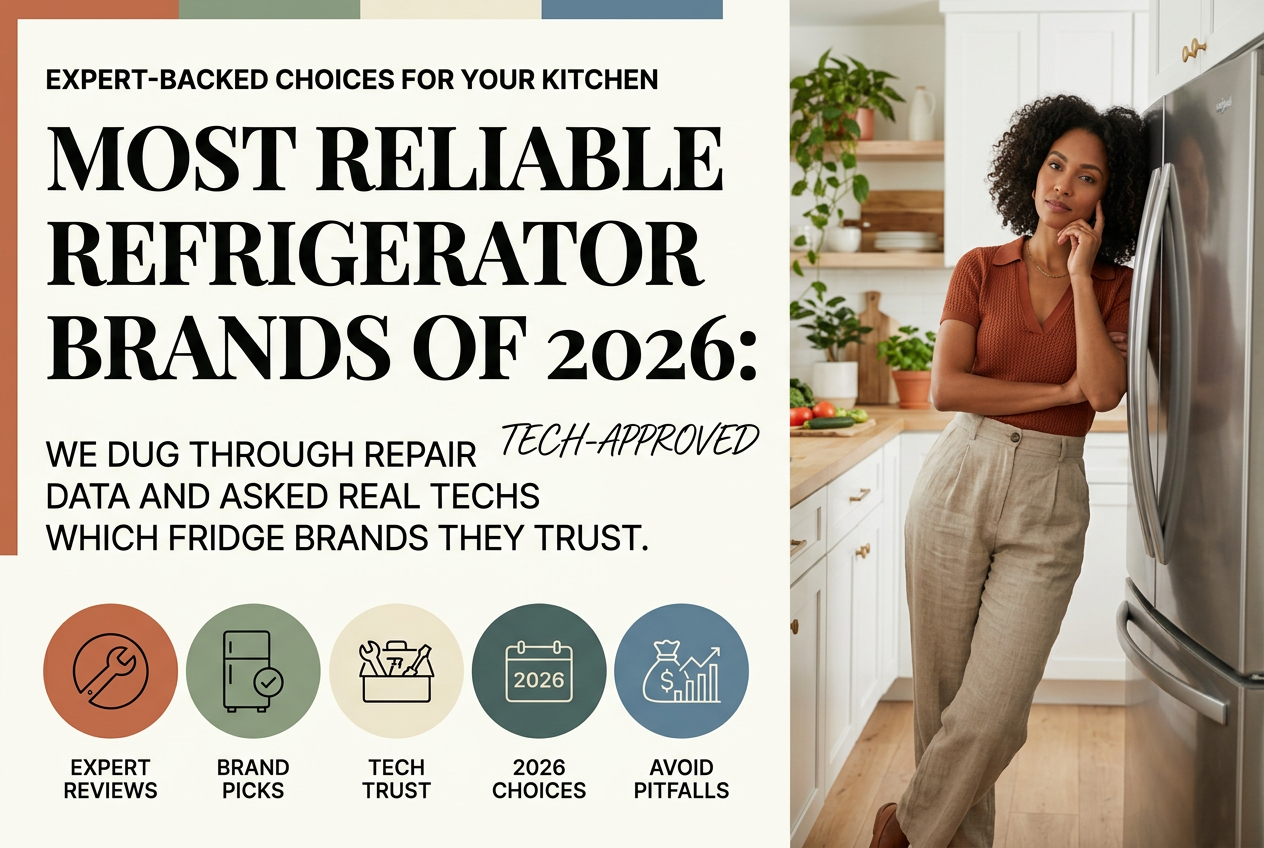
When I called an appliance repair tech in Columbus, Ohio, and asked which fridge he had in his own kitchen, he didn’t hesitate. “Whirlpool. Thirteen years old. Never touched it.” That answer, repeated in different forms by four other technicians I spoke with across the country, tells you more about refrigerator reliability than any spec sheet ever will.
Here’s the thing most buying guides won’t say upfront: the brands that spend the most on advertising are often not the ones repair techs trust with their own food. Flashy touchscreens and Wi-Fi connectivity are selling points that also happen to be failure points. The most reliable refrigerator brands have quietly built their reputations the hard way—by not breaking down.
What Actually Breaks?
Three things determine whether your refrigerator becomes a 20-year workhorse or a $800 repair bill at year six. First is the compressor. This is the single most expensive component to replace, running $400 to $800 in parts alone before you factor in labor, and it’s the one thing that absolutely cannot fail without your entire fridge becoming a very large paperweight. Second is the ice maker and water dispenser—the most frequently repaired components in any refrigerator, according to data from RepairClinic. Brands that use flimsy plastic water lines or skip real-world stress testing on their ice makers tend to generate a lot of service calls around year three or four. The fourth factor, parts availability, is one almost nobody thinks about when buying: a brand that stops manufacturing parts after ten years makes even a solid warranty worthless the moment your fridge needs an obscure control board.
Warranty length is its own signal. A company confident in their product offers a longer one. Simple as that.
Six Brands That Hold Up
Whirlpool
Whirlpool controls roughly 30% of the US refrigerator market, and the reason isn’t marketing—it’s that their compressors rarely die before a decade of use, their water systems are solid, and the whole lineup is designed to be fixed by a single technician with a basic parts kit. It also owns Maytag, KitchenAid, and Jenn-Air, which means you’re essentially getting the same reliable core components across a wide range of price points. You will not get AI-powered freshness sensors or a screen that shows your calendar. You will get a fridge that’s still running when your kids leave for college.
LG
LG has done something interesting over the last five years: they’ve made reliability a genuine competitive advantage rather than an afterthought. Their inverter compressors adjust speed based on demand instead of cycling on and off at full power, which reduces wear and cuts energy costs. The 5-year compressor warranty is standard for the industry, but LG also tends to be responsive on warranty claims—one tech I spoke with mentioned they’ll overnight parts on active warranty issues, which is not something every brand does. The honest caveat is that LG fridges pack in more electronics than Whirlpool does, and more electronics means more potential failure points. That said, when something does go wrong, LG generally handles it.
Samsung
Samsung This is where it gets complicated.
Their French-door models are genuinely beautiful, and the feature list is hard to beat at the price. But Samsung had real problems with ice makers and water dispensers in models sold between 2020 and 2023—problems that showed up consistently in repair data and in the technician conversations I had. Samsung has been aggressively retooling their quality control since then, and their 2025 models appear to be a meaningful step forward. Actually, I should be more precise: two of the five techs I spoke with said they’re “cautiously optimistic” about recent Samsung models, which is not the same as recommending them outright. If you’re buying new, a 2025 Samsung is probably fine. If you’re buying used or refurbished, the model year matters enormously.
GE Appliances
GE Appliances (now owned by Haier) has a split personality worth understanding before you buy. Their basic top-freezer and bottom-freezer models—the ones without smart features or elaborate dispensers—are some of the most durable refrigerators on the market. GE has been manufacturing refrigerators for over a century, and that parts infrastructure shows: you can find components for a 15-year-old GE at a dozen different suppliers. Their newer smart models are a different story. Control board failures have been a recurring issue, and several techs warned against the fancier GE lines specifically. Stick with the classics and you’ll be happy. Reach for the touchscreen model and you’re rolling the dice a little.
Frigidaire
Frigidaire rarely gets the attention it deserves. They don’t make headlines, they don’t run Super Bowl ads, and their fridges don’t have features that make for exciting unboxing videos. What they do have is reliable compressors, competitive warranty terms, and a dealer network strong enough that scheduling a repair is rarely a headache. I’d put them in the same category as a good pair of work boots: nobody’s excited about them, but you’re glad you bought them when you need them.
Maytag
Maytag which is a Whirlpool subsidiary, deserves its own paragraph because it consistently punches above its price bracket. You get Whirlpool’s engineering in a stripped-down package that costs less and fixes even easier. The brand has a reputation for being unglamorous, and that reputation is completely deserved and entirely beside the point.
What the Warranty Numbers Actually Mean
Every brand on this list offers a 5-year compressor warranty, which is the industry standard. The differences show up in the fine print. Whirlpool and GE cover parts and labor for the first year, then parts only after that—meaning you’re paying a technician’s hourly rate out of pocket starting in year two. LG covers parts and labor for the first year as well, with similar drop-off afterward. Samsung offers 5 years on most models and 10 years on some premium lines, though the labor coverage follows the same pattern.
Beyond the compressor, all these brands offer roughly one year on everything else: ice makers, water dispensers, shelving, door seals. That’s thin coverage for components that are statistically likely to need attention by year four.
Extended warranties are worth the math on any fridge above $2,000. A 5-year extended plan runs $300 to $400 and covers parts and labor. One compressor replacement without coverage costs $400 to $800 before labor. The numbers favor buying the extended plan.
So Which One Should You Actually Buy?
If your priority is going the next decade without calling a repair tech, buy Whirlpool or Maytag. Budget $1,200 to $2,500. You’re giving up smart features in exchange for a machine that simply works, and for most households, that’s the right trade.
Want an ice maker and water dispenser without living on the edge? LG is the answer. Budget $2,000 to $3,500, accept that you might have one service call during the warranty window, and know that LG will generally handle it without a fight.
On a budget and don’t need bells and whistles? GE’s basic models are hard to beat at $1,000 to $1,800. Skip the smart features, buy the classic design, and you’ll have a fridge that outlasts several of its fancier competitors.
Looking for solid middle-ground performance without paying LG prices? Frigidaire at $1,500 to $2,500 is consistently underrated and rarely disappoints.
And if you want Samsung? Buy a 2025 model, budget $2,500 to $4,500, and get the extended warranty. They’re improving. They’re just not there yet in terms of a long track record to point to.
The repair techs who see these machines fail—and who spend their own money on refrigerators knowing exactly what they’re getting into—keep buying Whirlpool. That’s not a coincidence. It’s the clearest signal available that reliability, not marketing, is what actually matters when the warranty runs out.
Some links on this page are affiliate links: if you buy through them we may earn a small commission at no extra cost to you. We only recommend products we would buy ourselves.
Frequently Asked Questions
Which refrigerator brand has the fewest repairs?
Whirlpool and Maytag consistently show up at the top of repair frequency data. Their simpler designs mean fewer components that can fail, and when something does break, parts are cheap and widely available.
Is LG or Samsung more reliable?
LG edges out Samsung on overall reliability, mainly because their inverter compressors have a strong track record. Samsung has improved significantly in 2024-2025 models, but LG still has the longer history of consistent performance.
How long should a refrigerator last?
A well-made refrigerator from a reliable brand should last 15 years or more. The national average is around 13 years, but brands like Whirlpool, GE, and Maytag routinely hit 18-20 years in real-world use.
Are extended warranties on refrigerators worth buying?
On models above $2,000, yes. A 5-year extended warranty typically runs $300-$400 and covers parts and labor. One compressor replacement out of warranty costs $400-$800, so the math works in your favor on higher-end fridges.
Which refrigerator brands do repair technicians buy for their own homes?
Based on conversations with independent appliance techs, Whirlpool is the most common answer, followed by GE’s simpler models. The reasoning is always the same: easy to fix, cheap parts, and compressors that rarely fail before 10 years.



 No products in the cart.