

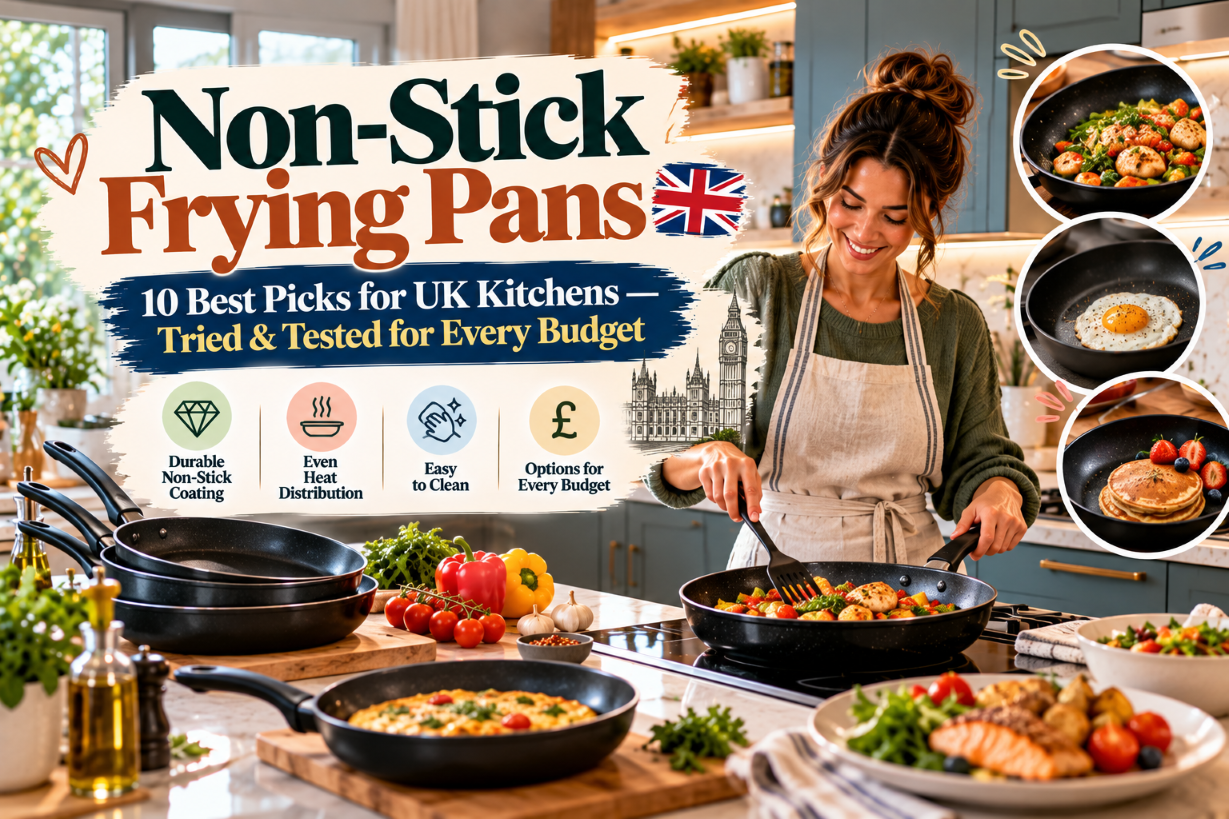
My old frying pan lasted exactly fourteen months before eggs started welding themselves to it every morning. That experience — standing at the hob, spatula in hand, watching breakfast disintegrate — is what pushed me to actually research this properly rather than just grabbing whatever was on offer.
Here’s what that research taught me: the best non-stick frying pan for most people isn’t the cheapest or the most expensive. It’s the one that matches how you cook, how often you cook, and how much you’re willing to spend on something you’ll use almost every day. I’ve put together ten options below that cover the full range — and none of them will leave you standing at the hob in despair.
Why the coating quality matters more than the price tag
A non-stick pan’s job sounds simple. But the gap between a pan that performs for three years and one that starts flaking at month eight usually comes down to coating thickness, base construction, and whether the brand has bothered to cure the surface properly before it ships. Thinner bases warp under high heat, which creates hot spots, which ruins the non-stick effect faster than almost anything else. A heavier base costs more to manufacture, which is part of why genuinely good pans tend to sit in the £45–£100 range rather than below £20. Not always — there are exceptions — but that’s the general pattern I’ve found. You also want a handle that stays cool and doesn’t wobble after six months of use, and a size that actually fits what you cook. Most people reach for a 28cm pan without thinking about it, which is fine for families, but if you’re mostly cooking solo or making omelettes, a 24cm heats faster and is easier to flip with.
Before we get into the recommendations: use silicone or wooden utensils, hand wash when you can, and never blast a non-stick pan with cooking spray (it leaves a residue that’s nearly impossible to shift and ruins the surface over time). Right. On to the pans.

Essential everyday non-stick frying pan for most UK kitchens
Le Creuset, 3-ply Stainless Steel 28cm Non-Stick Frying Pan £195
Five pans I’d actually buy again
These aren’t ranked by price. They’re ranked by how consistently they hold up in an actual kitchen rather than a lab test, which is a different thing entirely. A pan that performs beautifully for six months and then degrades isn’t worth recommending — I care more about what it’s doing at month eighteen.

Trusted French brand known for reliable non-stick performance
Circulon, Meyer Circulon Style Hard Anodised Non Stick Frying Pan/ 28Cm Black… £49.9

Modern ceramic alternative with excellent non-stick properties
de Buyer, Mineral B Black Iron Non-Stick Frying Pan 26cm £58.46

Versatile pan with higher sides for sautéing and stir-frying
Stellar, Eclipse 28cm Frying Pan Non-Stick £69.95 (30% OFF — was £100)

Complete cooking solution with lid for braising and steaming

Durable hybrid coating that tolerates metal utensils better
Le Creuset, Toughened Non-Stick 20cm Shallow Frying Pan £125
Spend less, cook just as well?
You don’t need to spend £100 on a non-stick pan. Full stop. The honest truth is that most non-stick coatings — even on expensive pans — will start showing wear after a few years of daily use, so spending a fortune on something you’ll eventually replace isn’t always rational.
That said, avoid the very cheapest options. I’ve bought a few pans in the under-£20 bracket out of curiosity, and the pattern is always the same: fine for a few months, then the coating starts bubbling near the edge or the base warps just enough to cause hot spots. The £25–£45 range is where value actually lives — you get a proper base thickness and a coating that won’t embarrass itself inside six months.

Entry-level non-stick option for everyday cooking
de Buyer, Mineral B Black Iron Non-Stick Frying Pan 24cm £48.35

Value bundle with multiple sizes for kitchen starter kits
Stellar, 7000 Profile Non-Stick 28cm Saute Pan £68.31 (47% OFF — was £129)
Spending more actually gets you something here
Premium non-stick pans are one of the few cookware categories where the price genuinely reflects longevity rather than just branding. Thicker bases, multi-layer coatings, and proper induction compatibility all cost money to engineer, and the better warranties on these pans (some covering five years or more) tell you the manufacturers are confident in what they’ve made. A pan at £100–£165 that lasts a decade costs less per year than a £35 pan you replace every two years — the maths isn’t complicated, it just requires thinking past the initial price tag.

High-end coating technology for superior durability and performance
Kuhn Rikon, Classic Induction 24 & 28cm Non-Stick Frying Pan Set £88.95 (21% OFF — was £112.95)

Premium cookware designed for serious home cooks
Stellar, 7000 Profile Non-Stick 24cm Saute Pan £74.95 (31% OFF — was £108)

Professional-quality pan with exceptional heat control
Le Creuset, Toughened Non-Stick 28cm Shallow Frying Pan £165
Four habits that kill non-stick pans early
Most non-stick pans don’t fail because they’re bad. They fail because of how they’re used.
High heat is the main culprit. Non-stick coatings don’t need high heat to work — medium is usually enough, and blasting the pan on maximum damages the coating faster than almost any physical scratch would. Dishwashers are the second. The detergents are too harsh and the temperature cycles too aggressive; a 30-second hand wash does less damage over a year than six months of dishwasher cycles. Stacking without protection scratches the cooking surface every time you reach past a pan. And cooking spray — the aerosol kind — leaves a residue that bakes onto the surface and is genuinely difficult to remove. Use a small splash of oil or a knob of butter instead.
When food starts sticking consistently despite a clean, undamaged-looking surface, that’s the coating telling you it’s done. Replace it. Cooking on a degraded non-stick surface is frustrating and pointless when a decent replacement costs less than a restaurant meal for two.
If I had to pick just one pan from this list for someone who cooks most days? The Stellar Eclipse 28cm. Good weight, solid coating, currently 30% off, and it handles everything from eggs to seared chicken without drama. That’s all most kitchens actually need.
Hey savvy shoppers! When the items in our articles catch your eye and you decide to buy through our links, we may earn a small commission at no extra cost to you. Think of it as a way of supporting us in bringing you the best content!
Frequently Asked Questions
How long should a non-stick frying pan last?
Most non-stick pans last 3–5 years with regular use. Premium options with thicker coatings can stretch to 7–10 years, especially if you hand wash them and avoid metal utensils. When food starts sticking despite a clean surface, that’s your sign to replace it.
Is it safe to use a scratched non-stick pan?
Light surface marks are generally fine, but deep scratches or flaking coating mean it’s time for a new pan. Modern PTFE coatings are considered safe even if small amounts are ingested, but a badly damaged surface won’t cook evenly anyway — reason enough to replace it.
Can I use a non-stick frying pan on an induction hob?
Not all non-stick pans work on induction — you need one with a magnetic base. Check the product listing for an induction symbol, or hold a fridge magnet to the base of your existing pan. If it sticks, you’re good. Several pans in this guide are induction-compatible, including the Kuhn Rikon set.
What size non-stick frying pan should I buy?
A 28cm pan handles most everyday cooking for two or more people — eggs, chicken breasts, stir-fries. If you mostly cook for one or want a dedicated egg pan, a 20–24cm is easier to manoeuvre and heats faster. Ideally, own both sizes if your budget allows.
Why does cooking spray ruin non-stick pans?
Aerosol cooking sprays contain propellants and emulsifiers that bond to the non-stick surface at high heat, forming a sticky residue that regular washing won’t remove. Over time this residue builds up and makes the pan stick. A small amount of butter or oil brushed on works far better.



 No products in the cart.