

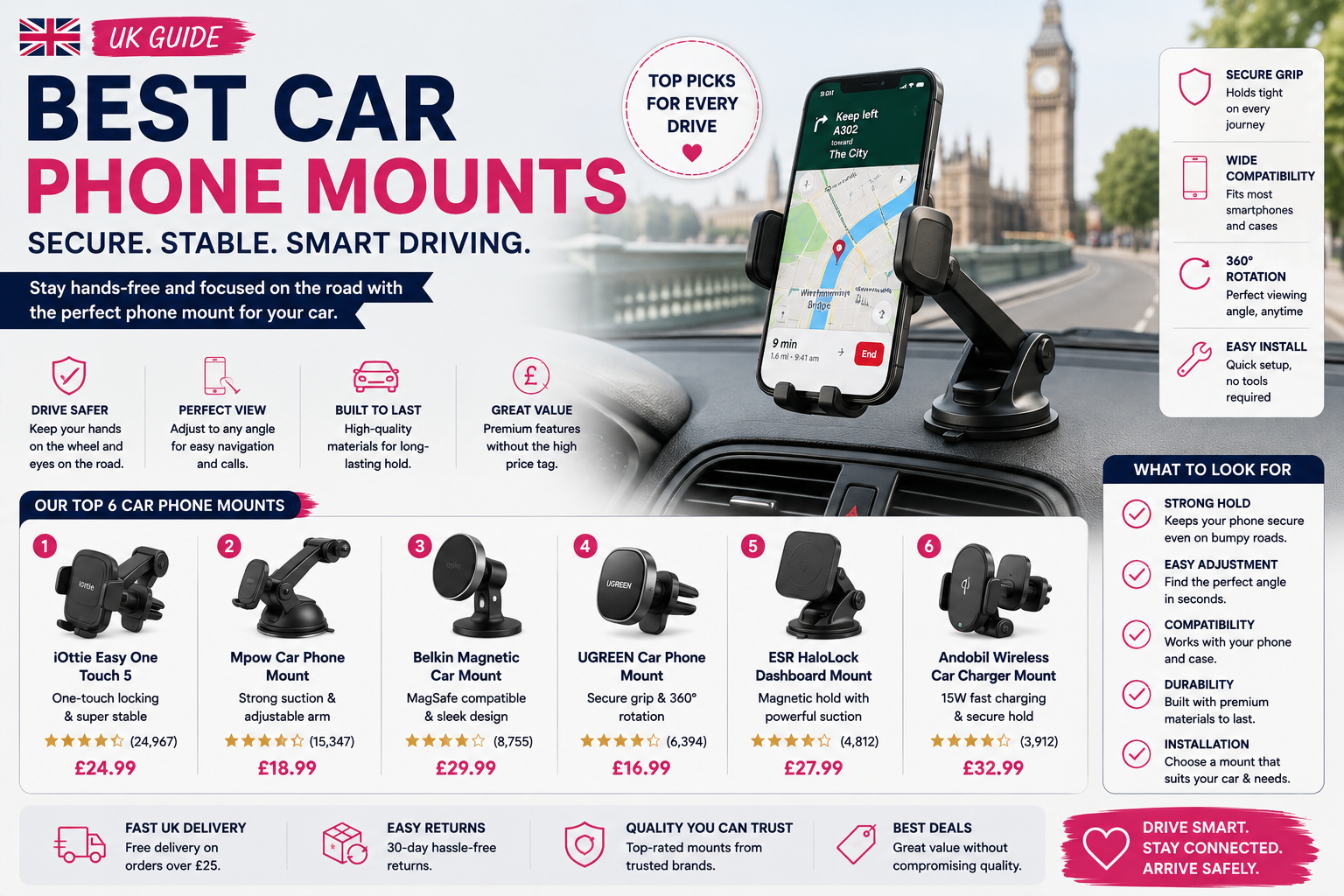
At 60 mph, looking down at your phone for five seconds means driving the length of a football pitch with your eyes closed. That’s not a dramatic statistic — it’s just physics, and it’s why the right car phone mount genuinely matters.
UK law is unambiguous here: handheld phone use while driving earns you a £200 fine and six penalty points. But the legal risk is almost secondary to what actually happens when an unsecured phone slides into your footwell at a roundabout and you instinctively reach for it. I’ve done exactly that, twice, before finally admitting I needed something better than the cup holder.
So here’s what to look for — and which mounts are actually worth buying.
What Kind of Mount Do You Actually Need?
Car phone mounts come in four main varieties, and the differences matter more than most buyers expect before they purchase the wrong one.
Magnetic mounts grip your phone via a small metal plate you stick to the back of your device or case. Fast to use, compatible with any phone size, and usually the cheapest option available. Some people worry about magnets affecting battery life — that concern is largely unfounded, though positioning the plate away from your NFC chip is worth doing.
Suction-cup mounts attach to your windscreen or dashboard with a vacuum seal. No phone modification needed, good adjustability, clean sightline. The downside: summer heat can weaken the seal, and heavier phones occasionally win the battle against cheaper cups on rough roads.
Air-vent and dashboard mounts either clip into your ventilation grille or adhere directly to your dash surface. Dashboard adhesive versions are the most stable of any type — they simply don’t move. Vent mounts are more forgiving to install and easier to remove, though some modern cars have unusual vent shapes that make compatibility a guessing game until you try.
Wireless charging mounts do double duty: hold your phone and charge it simultaneously via Qi. They cost more (typically £25–£60), but if you regularly drive for more than 45 minutes at a stretch, arriving with a full battery instead of a dead one changes your daily routine in ways that are hard to overstate.
The Best Magnetic Option
Magnetic mounts are the workhorses of this category — reliable, cheap, and genuinely quick to use once you’re set up.

Entry-level magnetic mount offering quick attachment and universal phone compatibility
The metal plate sticks to your phone or case once, and after that, attaching and removing your phone is a one-handed second. Look for neodymium magnets specifically — they hold grip on potholed British roads where cheaper ferrite versions start to wobble. Installation takes about three minutes total. Stick the base to your dashboard or windscreen, peel the backing off the metal plate, press it to your phone, done.
Suction Mounts — Still Relevant?
Yes, with caveats.

Windscreen-mounted option with adjustable arm for clear sightline
Suction mounts leave your dashboard completely clear, which some drivers strongly prefer, and the adjustable arm means you can dial in the exact angle before you set off. They cost £12–£25 for decent versions and require no permanent modification to your car at all. The failure mode — and it’s worth being honest about this — is heat. Park your car on a hot July afternoon and come back to find your phone and mount have landed in the passenger footwell. It happens. Wiping the windscreen with a clean cloth before applying the cup, and checking the seal every few weeks, prevents most of the drama. Reinforced suction mechanisms (look for ones with a locking lever) are noticeably better than twist-only designs.
The Vent Mount: Underrated

Minimalist vent-mounted holder perfect for small cars and reducing dashboard clutter
DTEKGAZ, Universal Mobile Phone Holder GPS Car Dashboard Clip-on £11.07
At £10–£18, vent mounts are the budget pick that actually works well in the right circumstances — specifically, smaller cars where dashboard space is tight and you don’t need that particular vent open at full blast in winter. The clip slides between the vent fins and holds surprisingly firm. Where they fail is in cars with round or unusually spaced vents (you’ll need to check before buying) and in situations where you genuinely need maximum airflow, since the mount does reduce it somewhat. For city driving in a small hatchback, though, these are hard to beat on value.
When You Want It Completely Immovable

Permanent dashboard installation with strong adhesive for maximum stability
Oem, Silicone Car Phone Holder Pad, Universal Dashboard Mount £37.30
Adhesive dashboard mounts are the most stable option in this entire category — full stop. Nothing vibrates, nothing slips, nothing falls into the footwell at a speed bump. The gel pad bonds to your dashboard and holds the cradle, which then grips your phone via adjustable arms. They cost £15–£30 and are particularly suited to motorway commuters who need their navigation visible for an hour at a time without fuss. The commitment is real, though: removing them often leaves adhesive residue, and some dashboard surfaces (textured plastic, soft-touch finishes) don’t take adhesive well in the first place. Measure twice, stick once.

Gravity-based vent mount requiring no adhesive or suction, auto-gripping design
Gravity mounts work on a clever mechanical principle: the weight of your phone pressing into the cradle causes the arms to tighten around it automatically. No magnets, no adhesive, no suction. They clip into your air vent and hold well for most phone sizes, and because there’s nothing permanent involved, swapping between vehicles or lending your mount to a passenger is genuinely easy. They’re £12–£22 and worth considering if you want something you can move around freely — just check your vent dimensions against the product specs first, since compatibility isn’t universal.
Wireless Charging Mounts — Worth the Extra Cost?
For regular long-distance drivers, yes. For short daily commutes, probably not.

Premium dashboard-mounted option with Qi charging for compatible phones
Place your phone in the cradle and charging begins. No cable to fumble with, no forgetting to plug in, no arriving at your destination with 4% battery left. These mounts connect to your car’s 12V socket or USB-C port via an included adapter, and they work with any phone that supports Qi — which covers all iPhones from the 8 onwards and most Android flagships from the past five years. (Actually, that’s not quite right for all budget Android phones — if yours cost under £200 new, check the specs before assuming it’s compatible.) The one honest downside: wireless charging generates more heat than wired, so your phone will run slightly warm during long journeys. It’s not harmful, but it’s noticeable.

Air-vent mounted wireless charger with fast-charge capability
DTEKGAZ, 15W Fast Charging Car Vent Wireless Phone Holder £65.73
The vent-mounted wireless option keeps your dashboard entirely clear, which is a genuine advantage in smaller cars where every inch of dash real estate is contested between your sat-nav, climate controls, and coffee. These run £30–£55, deliver the same Qi charging as dashboard versions, and install without touching your dashboard surface at all. Check vent width compatibility before ordering — and honestly check whether you need that particular vent open in winter before committing to blocking it for six months.
Wired charging alternative for phones without Qi support
AUTLEAD, Car Phone Holder 15W Fast Charging Car Vent Mount £30.73
Older phones, budget Android devices, and anyone who simply prefers wired charging are well served by a mount with an integrated USB cable. These cost £15–£35, hold your phone in a cradle while running a cable to your car’s USB port or 12V adapter, and charge reliably without any heat concerns. The cable needs routing — along the edge of your dashboard, tucked under a trim panel — which takes an extra five minutes on install but looks tidy once done. Less glamorous than wireless, but genuinely reliable.
Before You Buy: Getting the Fit Right
Three things determine whether a mount actually works in your specific car: your windscreen type, your phone weight, and where you can legally position the device without obstructing your view.
Most modern UK cars have standard laminated windscreens that suction cups handle without issue. Older vehicles occasionally have different glass treatments that reduce suction effectiveness — if you’re driving anything more than 15 years old, test before trusting. Heavier phones (think large-screen Android flagships) put more stress on any mount, so the minimum acceptable build quality goes up with phone size; a cheap £6 vent clip that handles a compact phone fine will wobble with a 200g phablet.
On positioning: the mount should sit where you can read your navigation with a glance, not a lean. Off to the side of your steering column, at roughly the same height as your instrument cluster, is the sweet spot for most cars. Never centred on the windscreen where it blocks your view of the road ahead.
Clean whatever surface you’re attaching to before installation. Windscreen — wipe with a microfiber cloth. Dashboard — same. Back of your phone — same. Thirty seconds of prep extends mount life from weeks to years. Then take a test drive around the block before committing to the motorway.
A £12 mount that stays put is infinitely more useful than a £45 mount that fell off on the A14.
Hey savvy shoppers! When the items in our articles catch your eye and you decide to buy through our links, we may earn a small commission at no extra cost to you. Think of it as a way of supporting us in bringing you the best content!
Frequently Asked Questions
Is it legal to use a phone mount while driving in the UK?
Yes — using a properly mounted phone for navigation is legal in the UK, provided you’re not touching it while driving. Handheld phone use carries a £200 fine and six penalty points. A secure mount keeps you on the right side of the law.
Will a magnetic car phone mount damage my phone?
Almost certainly not. Modern smartphones are designed to handle magnetic interference, and the magnets used in car mounts are too weak to cause damage. The one thing worth checking is that the metal plate doesn’t cover your phone’s NFC chip, which can affect contactless payments.
Which type of car phone mount is the most secure?
Adhesive dashboard mounts are generally the most stable. They don’t rely on suction or vent clips, so road vibrations are less likely to loosen them. The trade-off is that removal can leave residue. Gravity mounts are a close second and much easier to remove.
Do wireless charging mounts work with iPhone?
Yes, all iPhones from the iPhone 8 onwards support Qi wireless charging. Which is the standard used by virtually every wireless car mount. Android flagship phones from Samsung, Google, and OnePlus also support it — but budget Android phones often don’t, so check your model first.
Can a car phone mount block my view of the road?
It can if positioned badly. UK Highway Code guidance says your view shouldn’t be obstructed. Mount your phone low on the windscreen or to the side of your dashboard, never directly in your central sightline. Before driving, sit in your seat and check you can still see the road, traffic lights, and your speedometer clearly.



 No products in the cart.