

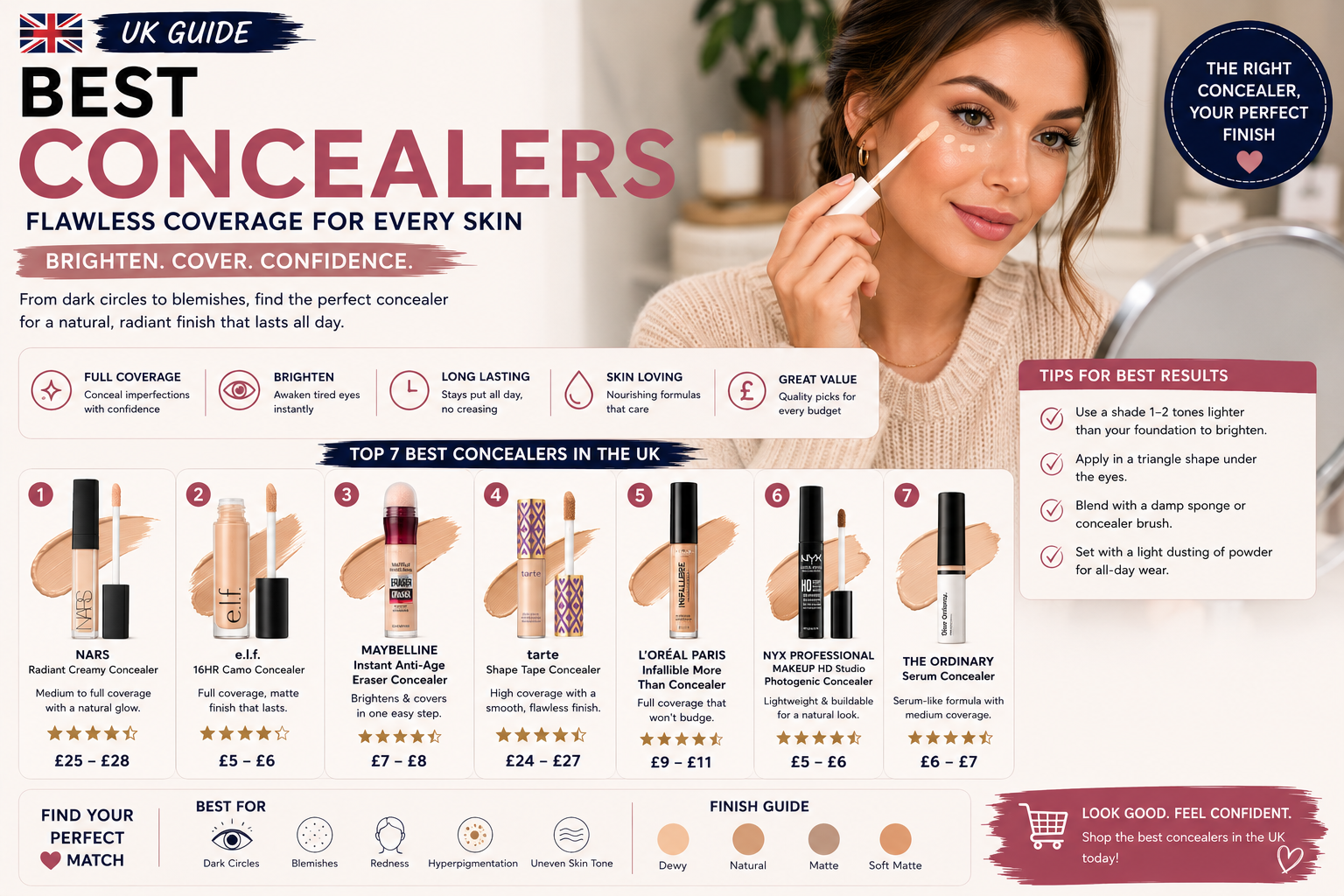
Last winter I stood in Boots for twenty minutes holding two concealers, picked the wrong one, and spent three months wondering why my under-eyes looked worse with it than without. The problem wasn’t the brand. It was that I’d grabbed a formula built for blemishes and was using it on skin that needed hydration and light — completely the wrong tool.
That’s the thing most concealer guides skip: the best concealer for you depends entirely on what you’re trying to fix. A formula that kills it on a spot will crease, settle, and look papery under your eyes by 11am. Once you understand that distinction, the whole category makes sense.
Why Targeted Coverage Beats Foundation Every Time
Concealer is more targeted than foundation. You’re not spreading product across your whole face to handle one tired patch or one angry spot — you’re applying it exactly where the problem is and blending out. Done right, the dark circle or blemish looks like it never existed. Done wrong (wrong shade, wrong formula, too much product), it draws more attention than if you’d left it alone.
Dark circles and blemishes actually need opposite things from a concealer formula, which is worth understanding before you buy anything. Dark circles aren’t really a coverage problem — they’re a colour problem. The bluish-purple tones under your eyes need to be cancelled out, usually with yellow or warm undertones, and then brightened with something that reflects light. Blemishes, on the other hand, need pigment density and staying power above everything else. Ideally a formula that won’t irritate an already-inflamed spot or slide off the moment your skin gets the slightest bit warm.
For the Under-Eyes: What Actually Works
Most people reach for their heaviest concealer on dark circles. That’s exactly backwards.
The under-eye area is thin, prone to dryness, and moves constantly — which means heavy or dry formulas will crease within the hour. What you want is something with a hydrating base, a touch of luminosity, and ideally a yellow or peach undertone to neutralise the darkness before you even think about coverage. Liquid and serum-based concealers are almost always better here than sticks or creams, because they sit on the skin rather than sitting in it.

Brightening formulas with light-reflecting particles to counteract dark circles and tired-looking eyes
Clinique, All About Eyes™ Brightening Serum Concentrate illuminating eye cream… £31.6

Hydrating liquid formulas that won’t settle into fine lines and provide a smooth, luminous finish for delicate under-eye area
BareMinerals, Unisex Original Liquid Mineral Concealer 6ml in Light Medium 2 5N… £26

Yellow or warm undertones specifically designed to neutralise blue and purple tones in dark circles
Hourglass, Vanish waterproof concealer for full coverage shade 1 Birch 1.3 ml £11.5
Blemish Coverage Is a Different Problem Entirely
Spot concealing needs grip. The formula has to sit on slightly raised or textured skin without sliding, hold through warmth and oil, and carry enough pigment to genuinely hide what’s underneath without requiring five layers. Stick and cream formats almost always outperform liquids here — they have more staying power and don’t thin out when they hit body heat.
Thickness matters too, but not in the way you’d expect. A slightly denser formula sits on top of a blemish rather than sinking around it, which sounds counterintuitive until you actually see it working. The trap is going too heavy — pile on too much product and you’ve created a cakey patch that’s arguably more visible than the original spot. One thin layer, fully blended, is almost always better than two.

Solid stick formulas with maximum coverage and long-wear properties ideal for concealing active blemishes and acne spots

Creamy, pigmented concealers that provide buildable coverage for blemishes without settling into texture
Hourglass, Vanish waterproof concealer for full coverage shade 2 Cotton 6 ml £29.5

Water-resistant formulas designed to stay put throughout the day on problem areas and active breakouts
Does Price Actually Matter?
Honestly, not always — and not in the way the beauty industry wants you to think. Some drugstore concealers are genuinely brilliant. Some £30 formulas are genuinely disappointing. The price gap tends to show up in two specific places: how the concealer holds up after six or seven hours of wear, and how many shades are available so you can actually find a proper match.
Budget options (roughly £3 to £8) often deliver fine coverage for the first few hours, then start to separate or settle into lines as the day goes on. Fine if you’re out for lunch, less fine for a full workday. Mid-range options — the £10 to £15 bracket — are where I’d start most people, because they genuinely give you most of what premium formulas offer without the premium price. Actually, that’s not quite right: what they give you is maybe 75-80% of the performance at 40% of the cost, and for most occasions that trade-off makes complete sense. Premium concealers (£15 to £35) earn their price mainly through longevity, skin-feel after hours of wear, and the kind of extensive shade ranges that mean you’re not compromising on your match.

Budget-friendly concealer options that deliver solid coverage for both dark circles and blemishes without breaking the bank

Mid-tier concealers offering excellent value with good longevity and shade selection for everyday use
Shade Matching: The Part Everyone Gets Wrong
A concealer in the wrong shade is worse than no concealer. Too light and your dark circles become a white crescent. Too dark and you’ve painted a shadow exactly where you didn’t want one.
For blemishes, match your exact skin tone — you want the spot to disappear, not swap one obvious thing for another. For under-eyes, go one shade lighter to get the brightening effect. Test on your jawline, not your inner wrist (which is usually several shades lighter than your face), and check in natural daylight before you commit. Indoor lighting in shops is notoriously flattering in all the wrong ways.
Skin type should drive your formula choice as much as anything else. Oily skin needs matte or satin finishes — anything labelled dewy or luminous will slide within a couple of hours. Dry skin needs hydration built into the formula or you’ll end up with something patchy and textured that looks worse than the original problem. Combination skin might genuinely need two concealers: a hydrating one for under-eyes and a matte one for the T-zone and spots. It sounds like overkill until you see how much better the result is when each area gets what it actually needs rather than a one-size-fits-all compromise.

Concealers available in extensive shade ranges with undertone options to match diverse skin tones accurately
Start with your main concern — dark circles or blemishes — and pick one formula that genuinely addresses that. Use it for a week. You’ll know pretty quickly whether it’s working or whether something’s off with the shade or the finish. The best concealer isn’t the most expensive one or the one your favourite creator uses. It’s the one that makes you forget you’re wearing it.
Hey savvy shoppers! When the items in our articles catch your eye and you decide to buy through our links, we may earn a small commission at no extra cost to you. Think of it as a way of supporting us in bringing you the best content!
Frequently Asked Questions
Should I use a different concealer for dark circles and blemishes?
Yes, ideally. Under-eye skin needs something hydrating and light-reflecting, while blemishes need grip, opacity, and staying power. If you have combination skin, two concealers — one for each job — will genuinely look better than one formula trying to do everything.
How do I pick the right concealer shade?
For blemishes, match your exact skin tone. For dark circles, go one shade lighter to brighten. Always test on your jawline in natural daylight — indoor lighting is famously unreliable for this. If the shade looks invisible after blending, you’ve got the right one.
Why does my concealer crease under my eyes?
Usually one of two culprits: the formula is too dry, or you’ve applied too much. Try a hydrating concealer, use a tiny amount, and let it sit for 30 seconds before blending. Setting powder applied sparingly with a damp sponge also helps stop creasing without looking cakey.
Are expensive concealers actually worth it?
Sometimes. The real advantage of premium formulas tends to be longevity and shade range, not coverage. If you’re wearing makeup for 10+ hours or have particularly sensitive under-eye skin, a £25-£35 concealer might earn its price. For shorter days or oilier skin types, a mid-range option around £10-£15 often does just as well.
What concealer formula works best for oily skin?
Look for matte or satin finishes and avoid anything labelled ‘dewy’ or ‘luminous’ on areas prone to shine. Stick and cream formulas tend to grip oily skin better than liquids. Setting with a translucent powder extends wear significantly.



 No products in the cart.