

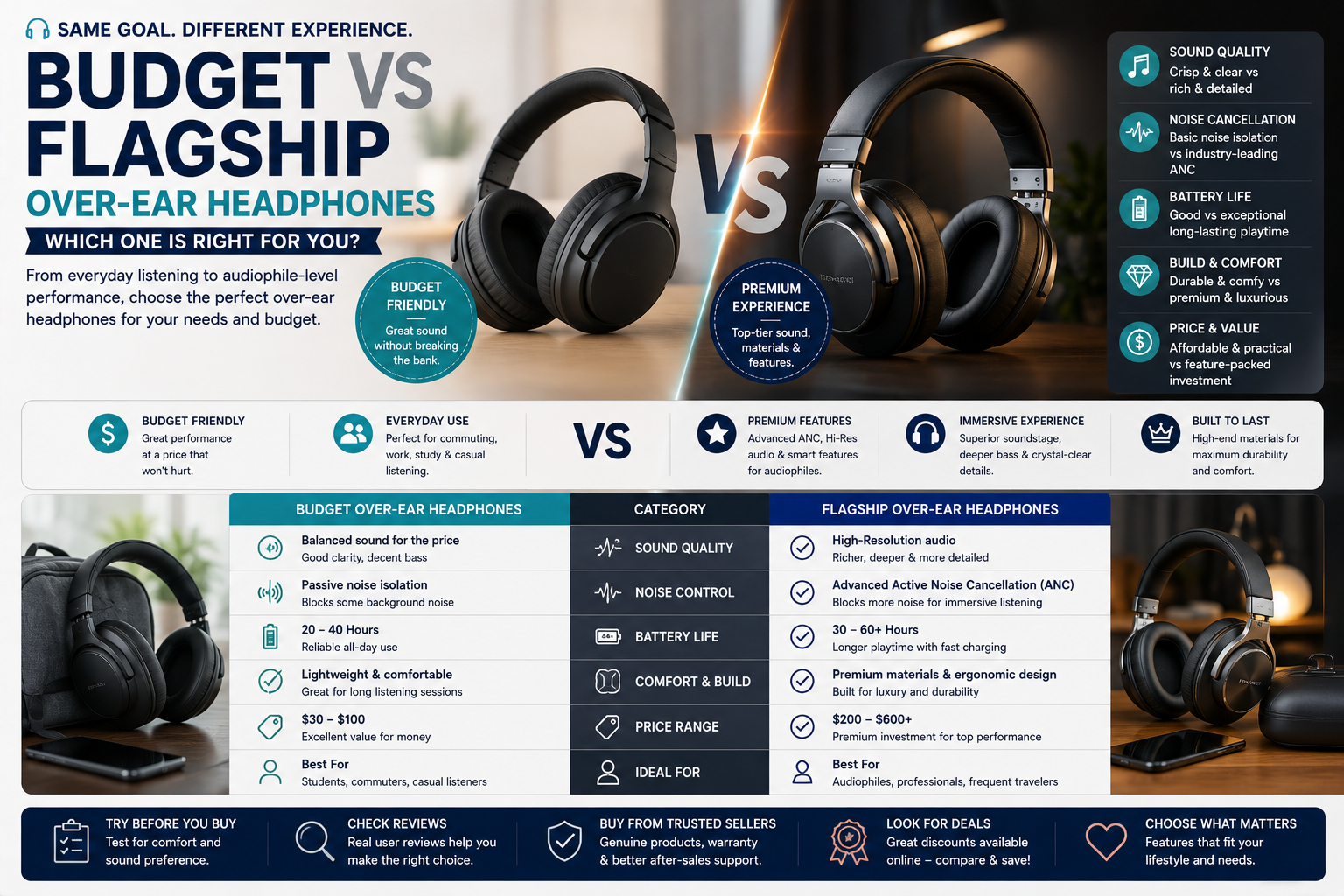
Here’s what nobody tells you upfront: the most important headphone decision you’ll make has nothing to do with sound quality. It’s about how long you’ll actually wear them in one sitting — because that single variable changes which price tier makes sense for your life more than any frequency response graph ever will.
Spending $400 feels excessive until you run the numbers. Three years of near-daily use works out to roughly 35 cents per day. But do you need to spend that much? I’ve tested enough pairs across both ends of the price spectrum to say: it genuinely depends, and anyone who gives you a simpler answer is selling something.
The gap is smaller than it used to be — but it’s real
Budget over-ear headphones have gotten legitimately good at the fundamentals. Clean mids, reasonable bass, clear highs — a $90 pair in 2024 sounds better than a $200 pair did in 2018, full stop. What you’re mostly paying for when you cross into flagship territory is refinement: tighter bass response, ear cups that don’t make your ears ache after hour four, noise cancellation that adapts rather than just blocks, and materials that don’t feel gummy two summers in. The gap used to be obvious. Now it takes a side-by-side to really hear it.
That said, there are real differences worth naming. Flagship models tend to have better soundstage (the sense of physical space around instruments), more consistent touch control behavior, and warranty support that actually functions. Budget pairs often shave corners on battery longevity or ship with touch controls that require a two-week learning curve before they feel natural. Neither category is wrong — it just depends on whether you’re listening for 90 minutes on a train or eight hours at a standing desk.
One thing comfort taught me the hard way: never cheap out on clamping force and padding. A $120 pair that digs into your ears after two hours is a worse deal than a $250 pair you’ll actually wear. I owned a highly rated budget set for about three months before I admitted it was giving me headaches and sold it. Specs don’t measure that.

Entry-level option showing what solid fundamentals look like at the lowest tier
Beats, Wireless Bluetooth Studio Pro Over-Ear Headphones $349.99

Mid-budget sweet spot where active noise cancellation becomes reliable
Under $200 — where to actually shop
The sub-$200 bracket is where manufacturers stopped cutting audio corners and started competing on features. You’re getting active noise cancellation, battery life that actually clears 25 hours, hinges that survive a backpack. The materials are still mostly plastic, and you’ll know it when you hold one next to a $350 pair. But you won’t know it when you’re listening.
What will you notice? Probably the touch controls. Budget pairs frequently ship with gesture inputs that work great in demo conditions and become annoying in real life — accidentally skipping tracks when you adjust the fit, volume jumps that don’t feel proportional. That’s not a dealbreaker, just something to read reviews about specifically before you buy.

Wireless convenience at budget pricing—the everyday workhorse tier
PRIMEPLUS, M5 Wireless Over-Ear Headphones with Bluetooth 5.3 $65.99

Budget model with ANC for commuters who don’t want to spend $300+

Compact budget option for travel and regular transport
PRIMEPLUS, M5 Wireless Over-Ear Headphones with Bluetooth 5.3 $65.99
Flagship means refined — not automatically better for you
Some people listen to music the way other people read — slowly, deliberately, with full attention. If that’s you, or if you’re doing production work where accuracy matters, crossing the $300 line starts making real sense. You get materials that age well, sound that’s more honest about what’s actually in the recording, and noise cancellation that feels less like a feature and more like physics.
Here’s the honest part, though: flagship doesn’t mean universally best. It means most refined for specific priorities. A $350 pair tuned warm won’t serve you better than a $120 pair tuned bright if crisp highs are what you actually want. Price is not a substitute for matching a headphone’s sound signature to your ears.
The durability argument is where flagships win cleanly and obviously, without any caveats. Budget hinges crack. Ear cup leatherette peels, usually right around the 18-month mark in my experience. Batteries in cheaper pairs lose meaningful capacity after 150-200 charge cycles, which is roughly a year of daily use. Flagship components are built to last 300+ cycles before you notice any degradation, and the physical construction — metal headbands, reinforced pivot points, higher-grade foam — is simply built for people who plan to keep a pair for four or five years rather than upgrade every time something better comes along at the same price point.
Top-tier option showing what professional-grade audio quality feels like
Beats, Wireless Bluetooth Studio Pro Over-Ear Headphones $349.99
Flagship with advanced features for serious listeners willing to invest
What does your money actually buy, spec by spec?
Battery claims are where I’d tell you to be most skeptical. Both a $70 pair and a $320 pair might print “40 hours” on the box. Flagship brands get scrutinized by enough reviewers that their numbers tend to hold up. Budget brands… less so. That 40-hour claim often assumes low volume, ANC off, and Bluetooth 5.0 at close range. Real-world numbers drop fast.
Sound tuning is a preference question, not a quality question. Budget over-ears typically boost bass out of the box because it makes them sound exciting in a 30-second store demo. Flagship models usually tune more neutrally, which means acoustic instruments sound accurate but pop music feels less punchy until your ears recalibrate. Actually, that’s not quite right — some flagships (Beats included) still run warm and bass-forward by design. The difference is that flagship brands tend to be more deliberate about it and give you EQ options to adjust.
ANC is the clearest place to see price at work.
Budget ANC blocks consistent, steady-frequency noise well: HVAC hum, airplane drone, train rumble. Flagship ANC does something different — it reads changing noise patterns and adjusts in real time, so the effect feels less like wearing earmuffs and more like the world simply got quieter. That distinction costs real money and is absolutely worth it if you work in variable noise environments.
Multipoint Bluetooth (connecting to two devices simultaneously) and app-based EQ customization used to be exclusive to $250+ headphones. They’re now appearing at $150-$200. That’s a genuine shift worth knowing about if you haven’t shopped this category in two or three years.

Mid-range option showing how features once reserved for flagships now appear in budget tiers
Bose, QuietComfort Wireless Noise Cancelling Over-the-Ear Bluetooth… $359
How to actually find a good deal
Tracking headphone prices taught me something counterintuitive: the best deal is the lowest price for what you specifically need, not the lowest price overall. A flagship model discounted to $200 can easily beat a $100 budget pair in long-term value if you’re going to use it for five years — and the math is even clearer if you factor in that the budget pair might need replacing at year two.
Timing has a pattern worth knowing. New flagship models typically launch in spring and fall, which pushes previous-generation flagships into steep discounts around August and February. Budget models don’t follow this cycle — their margins are already thin, so a $15-$20 drop on a budget pair is genuinely meaningful, not a rounding error.
Refurbished flagships are underrated. Seriously underrated. Manufacturer-certified refurbs usually carry identical warranties to new units, and a refurbished $300 headphone at $175 will outperform a new $130 budget model on every axis that matters for long-term ownership. I’ve bought refurbished twice and had no issues either time.

Deal-tier option showing where to find current discounts across budget and flagship ranges
My actual take
Podcast listeners and gym-goers: stop at $100. The audio quality is more than sufficient, and you’ll spend the saved money on something you’ll actually notice.
For everyone else, the honest answer is that $150-$200 is where the value-to-quality curve peaks right now — you get reliable ANC, good battery life, features that used to cost $300, and build quality that’ll survive two or three years of daily use without embarrassing itself. If you listen for more than four hours a day, work in open-plan offices, or simply care about hearing music the way it was recorded, climbing to $250-$300 is a reasonable call. What I’d skip is the $350-$400 range unless you’re doing production work or you’ve specifically auditioned the pair and fell in love with how it sounds on your ears. At that price, you’re paying for a brand name as much as anything else, and the incremental improvement over a well-chosen $250 pair is genuinely hard to hear on most recordings.
Some links on this page are affiliate links: if you buy through them we may earn a small commission at no extra cost to you. We only recommend products we would buy ourselves.
Frequently Asked Questions
Are budget over-ear headphones actually worth buying in 2024?
Yes, genuinely. The sub-$150 tier has improved dramatically over the past few years. You’ll give up some refinement in bass response and noise cancellation quality, but core audio performance at $80-$120 is solid enough that most listeners won’t feel shortchanged during normal daily use.
What do you actually get when you spend $300+ on headphones?
Mostly durability and refinement. Flagship hinges don’t crack after a year. Ear cup padding doesn’t peel. The ANC adapts to changing noise rather than just blocking steady hum. Battery holds capacity after hundreds of charge cycles. If you keep headphones for four or five years, that build quality starts to justify the price difference.
Does active noise cancellation work on budget headphones?
It works, with caveats. Budget ANC handles consistent noise well — airplane engines, office HVAC, train rumble. What it struggles with is dynamic or unpredictable noise. Flagship ANC feels almost transparent by comparison. Whether that gap matters depends entirely on where you listen.
When is a refurbished flagship better than a new budget pair?
Usually when the price gap is under $50. A refurbished $300 headphone at $175 will almost always outperform a new $130 budget model on sound quality, build, and longevity. Most manufacturer-refurbished units carry the same warranty as new, so the risk is minimal.
How much should I spend on over-ear headphones for commuting?
For a standard commute — subway, bus, light rail — you don’t need to spend more than $100-$150. The JLab JBuds Lux ANC at under $60 on sale handles commuter noise fine. Save the $250+ budget for situations where you’re wearing them six-plus hours a day and audio quality actually has time to matter.



 No products in the cart.