

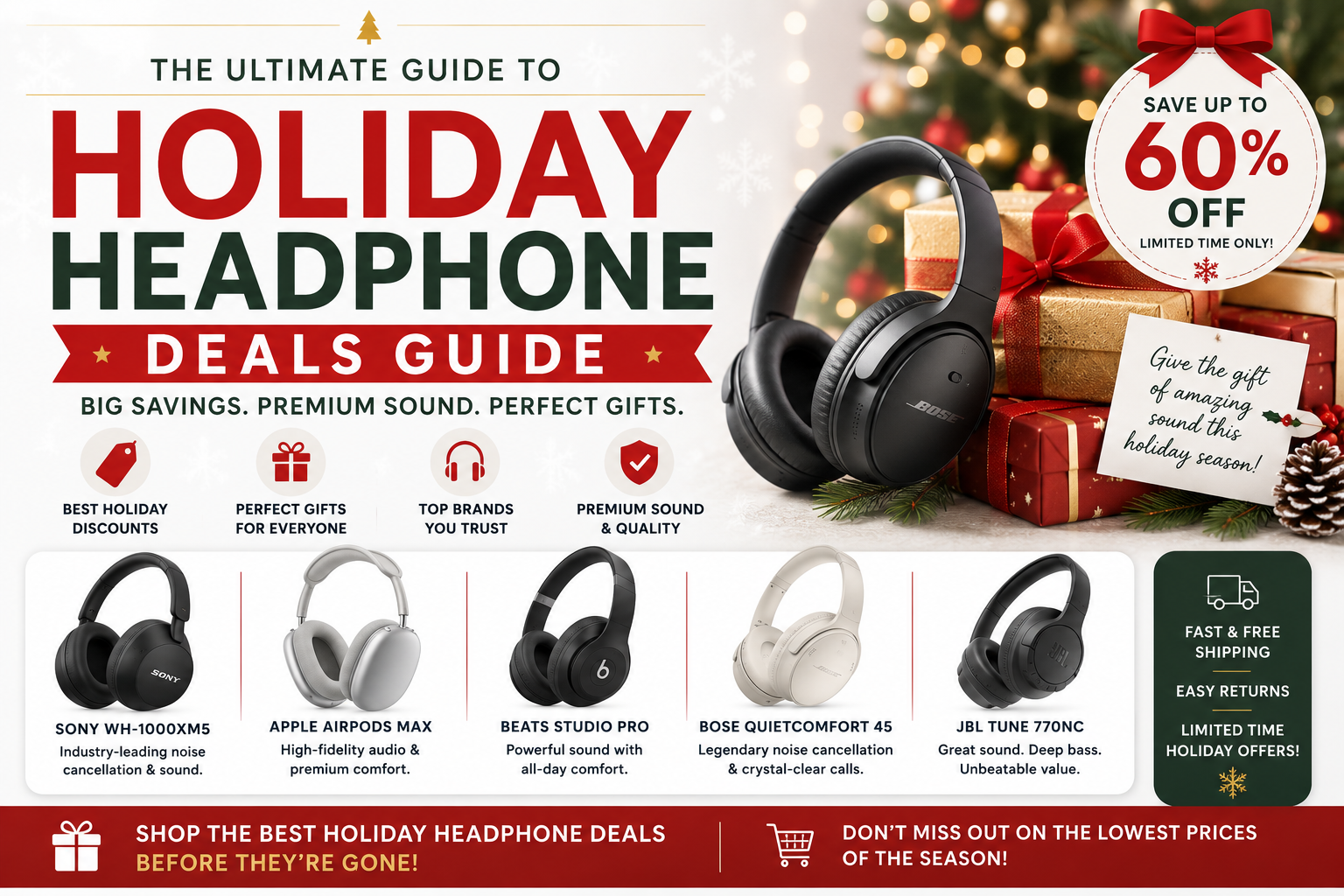
Last November I watched the Sony WH-1000XM5 drop $90 in price, bounce back up within 36 hours, then drop again right before Christmas. I almost bought at the wrong moment twice. That experience taught me more about holiday audio pricing than any deal-tracking spreadsheet — the pattern is real, but it punishes impatience.
Here’s the thing most buying guides won’t tell you upfront: the best holiday headphone deals don’t always land on Black Friday. Sometimes they hit mid-December. Sometimes Boxing Day. Knowing the shape of the whole season — not just one weekend — is what separates a genuinely good buy from an okay one.
How the Season Actually Unfolds
The holiday headphone deals calendar runs from mid-October through early January, but the intensity is wildly uneven across those months. October is mostly noise — Amazon and Best Buy test 15-25% discounts on older mid-range models and last-gen flagships, clearing shelf space before the real rush. If you spot a two-year-old model you actually want during this phase, grab it. Those early discounts rarely repeat exactly.
Then mid-November hits and everything accelerates.
Most major retailers launch Black Friday previews a full week before the actual Friday, and this pre-Thanksgiving window is often underrated. Selection is still intact, inventory hasn’t been picked over, and discounts are already hitting 30-40% on popular wireless earbuds and mid-tier over-ears. Counterintuitively, Black Friday week itself isn’t always the deepest discount window — you’re competing with peak demand, stock evaporates fast, and retailers know they don’t need to go lower to move product. The real deals sometimes require digging: limited colorways, specific bundles, models that aren’t on the front page of the sale.
Cyber Monday extends things online, typically through Wednesday, and brings bundle deals you won’t see at other points in the season — buy these earbuds, get a percentage off a charging case, that kind of thing. Prices usually match Black Friday rather than beating it, but availability can actually be better because retailers restock overnight. Then comes the stretch most people underestimate: mid-December through Christmas Eve. Some brands deliberately hold their sharpest pricing until this window to catch last-minute shoppers. Others drop aggressively to clear inventory before year-end. You’ll see 35-45% off, but the catch is that popular models have thinned out — you’re either finding bestsellers that happened to stay stocked, or niche products that didn’t move. Great window if you’re flexible on brand, frustrating if you had one specific thing in mind.
Boxing Day and early January are the forgotten chapter. Discounts ease back slightly — usually 25-35% — but they exist, and selection on over-ears in particular stays reasonable. If December got away from you, this is your real second chance.
Which Brands Actually Drop Prices?
Not all brands play this game the same way, and knowing the difference saves you from waiting for a discount that’s simply not coming.
Sony is the most aggressive major player. Their WH-1000XM5 over-ears and WF-1000XM5 earbuds routinely see 25-35% off during Black Friday and Cyber Monday, and Sony tends to hold those discounts through December. You don’t have to panic-buy in November — mid-December Sony pricing is usually still strong.
Apple won’t discount AirPods on its own site. Full stop. But Best Buy, Amazon, and Walmart typically offer 10-20% off AirPods Pro and AirPods Max during peak season. The discount is modest because demand is enormous and Apple maintains tight pricing control. If you’re waiting for a massive AirPods deal, it’s not coming — take the 15-20% when it appears.
Bose is tricky. They discount older models hard — the QuietComfort 45 regularly drops 30-40% off — but newer releases move slowly on price. The QuietComfort Ultra Headphones might only see 15-20% off during peak season. Bose also runs their own internal sales that sometimes beat what retailers are offering, so check their site directly before assuming Amazon has the best number. Beats follows similar logic to Apple (they’re owned by Apple now, which explains a lot): modest discounts through third-party retailers, 15-25% off, with the Studio Pro and Fit Pro usually seeing the deepest cuts.
JBL is where budget-hunters should be paying attention. Their Tour Pro 2 and Live Pro 2 earbuds routinely hit 40% off, and 30-50% discounts across their lineup are genuinely common during the holidays. Sennheiser sits in the middle — 20-30% off, consistent through December, less dramatic than Sony but more reliable than Apple. And Anker/Soundcore, already cheap year-round, typically sees 20-30% off during the holidays. The absolute prices stay competitive even if the percentage feels less exciting.
Earbuds: Where the Deals Move Fastest
True wireless earbuds are the category that sells out first, discounts hardest, and rewards early action the most. They’re gift-friendly, price-accessible, and retailers stock them heavily — which also means they’re gone before you realize you waited too long.
Flagship earbuds (Sony WF-1000XM5, AirPods Pro, Bose QuietComfort Ultra Earbuds) typically land at 20-35% off during peak season. A model that normally retails for $250-300 might stabilize around $150-200 from Black Friday through Cyber Monday. These deals hold relatively steady across that window, so you’re not racing the clock quite as hard.
Mid-range earbuds are where the aggression really shows. A $120 model dropping to $60-70 — 40-50% off — is common in this segment. Retailers are fighting for volume, brand loyalty is weaker, and the competitive pressure pushes prices down further than in the flagship tier. If you’re flexible on brand, this is where the genuine value hides, and these discounts tend to peak around Cyber Monday week.
Here’s where patience actually pays off: when new earbud models launch in September or October, last year’s flagships get cleared aggressively. A 2023 flagship might be 40-50% off by November. The difference between model years? Usually minor — marginally better battery, slightly improved noise canceling, maybe a new color. For most people, that gap isn’t worth the premium over a deeply discounted previous generation.
One pattern I’ve noticed repeatedly: earbud deals peak earlier than any other audio category. By mid-December, the popular models are often out of stock or drifting back toward regular pricing. If you’re targeting a specific earbud, Cyber Monday week is your window — don’t assume Christmas week will have what you want at the same price.
Over-Ears Stay on Sale Longer. Use That.
Over-ear headphones follow a different rhythm than earbuds. They’re pricier, people hold onto them longer, and retailers don’t face the same inventory pressure — which means the sales window stretches further into January and you don’t have to buy under the same time pressure.
Noise-canceling over-ears (Sony WH-1000XM5, Bose QuietComfort 45, AirPods Max) are the prestige segment. Expect 20-30% off during Black Friday and Cyber Monday, occasionally 35% off if you catch a specific retailer promotion. The AirPods Max, which launched at $549, might hit $449-479 during peak season — real money saved, but not a transformative discount. These deals hold through December because demand stays strong. Don’t expect a miracle number, but the holidays are genuinely the right time to buy.
Gaming headsets (SteelSeries, HyperX, Corsair) typically see 25-40% off because the gaming market is brutally competitive and retailers know peak buying season aligns with the holidays. A $150 headset dropping to $90-110 is common. These deals are most aggressive during Black Friday week and Cyber Monday, then ease off by mid-December.
Studio and reference over-ears from Audio-Technica, Beyerdynamic, and Sennheiser are less predictable — discounts of 15-25% appear, but they’re scattered across individual store promotions rather than coordinated holiday sales. Monitor Best Buy and Amazon separately rather than waiting for a unified event. Budget over-ears (under $100 retail) see the most dramatic percentage drops: 30-50% off, sometimes more on overstock. They’re popular gifts, retailers stock them heavily, and inventory pressure is lower than in the premium tier.
Actually, that’s not quite right about inventory pressure — budget over-ears do sell through quickly in the final week before Christmas as last-minute gift purchases spike. But they restock faster than premium models, so the risk of missing out is lower.
The bottom line on over-ears: solid discounts run through mid-January. Don’t let Black Friday urgency push you into a rushed decision on a $300 purchase. Cyber Monday and early December often have better selection at comparable prices.
Stop Refreshing Pages. Do This Instead.
Set up price alerts before you need them. CamelCamelCamel tracks Amazon pricing history, Honey covers other retailers, and Kelkoo aggregates across stores. Get alerts running by early October on any model you’re seriously considering. You’ll get notified the moment prices drop — no manual refreshing, no missing a 24-hour window because you were busy. This is how you catch deals before they sell out, not after.
Compare across at least four retailers before buying. The same headphones can cost meaningfully different amounts at Best Buy, Amazon, Walmart, and Target — sometimes $10-20 different, sometimes $50. Never assume any single retailer has the best price. Kelkoo is useful precisely because it does this comparison automatically.
Watch the bundles carefully during Cyber Monday and December. A $200 deal that includes a $30 case might be better value than a $180 standalone price — but only if you actually want the case. Don’t let bundled extras justify a purchase you wouldn’t otherwise make.
Know the return policies before you commit. Most retailers extend return windows during the holidays — often 30-60 days instead of the usual 14-30. This matters because you can buy early, test the headphones properly, and return them if something’s off. Black Friday deals sometimes come with stricter return policies, so read the fine print. A non-returnable deal at 30% off is a worse position than a fully returnable purchase at 25% off.
Stack cashback on top of the holiday discount. If you have a card with cashback or use a portal like Rakuten, that 30% off deal becomes effectively 34-35% off. On $250-300 headphones, that’s $15-30 back in your pocket for minimal effort.
When you see the exact model you want at the price you want — buy it immediately. Waiting even a few hours during Black Friday and Cyber Monday week on a popular model is genuinely risky. Out-of-stock listings don’t care about your decision-making timeline. The exception: if you’re flexible on brand or model, you can afford patience. There’s always another deal coming somewhere in the season.
Do your research now, before the deals start. Know what you actually want. Read reviews. Set a real budget. Then when November hits, you’re not making decisions under artificial urgency — you’re executing a plan you already made, which is a completely different mental state.
Some links on this page are affiliate links: if you buy through them we may earn a small commission at no extra cost to you. We only recommend products we would buy ourselves.
Frequently Asked Questions
When is the best time to buy headphones during the holiday season?
Mid-November through Cyber Monday week is generally the sweet spot. Black Friday itself is competitive and stock runs thin fast, but the days leading up to it often have strong prices with better availability. If you miss that window, mid-December is a genuine second chance — some brands actually hold their deepest discounts until then to catch last-minute shoppers.
Do Apple AirPods ever go on sale for Black Friday?
Apple won’t discount them on its own site, but third-party retailers like Best Buy, Amazon, and Walmart typically knock 10-20% off AirPods Pro and AirPods Max during Black Friday and Cyber Monday. Don’t hold out for a massive deal — Apple controls pricing tightly and a 15-20% discount is about as good as it gets.
Are Cyber Monday headphone deals better than Black Friday?
Prices are usually comparable, but Cyber Monday sometimes has better selection because retailers have restocked overnight. You also get online-exclusive bundles — things like ‘buy these earbuds, get a discount on a charging case.’ The deals typically stretch through Wednesday, which gives you breathing room to decide.
Which headphone brands discount the most during the holidays?
Sony and JBL are the most aggressive. Sony’s WH-1000XM5 and WF-1000XM5 regularly hit 25-35% off, and JBL’s mid-range earbuds sometimes drop 40-50%. Sennheiser is solid but less dramatic. Apple and Beats are the most conservative — expect 15-20% off at best through third-party retailers.
Is it worth waiting for last year’s flagship headphones to go on clearance?
Usually yes. When new models launch in September or October, the previous generation gets aggressively discounted — sometimes 40-50% off by November. The actual difference in sound quality or features between model years is typically small: slightly better battery life, marginal noise-canceling improvements, a new color or two. For most listeners, that gap isn’t worth paying full price for the new version.



 No products in the cart.