
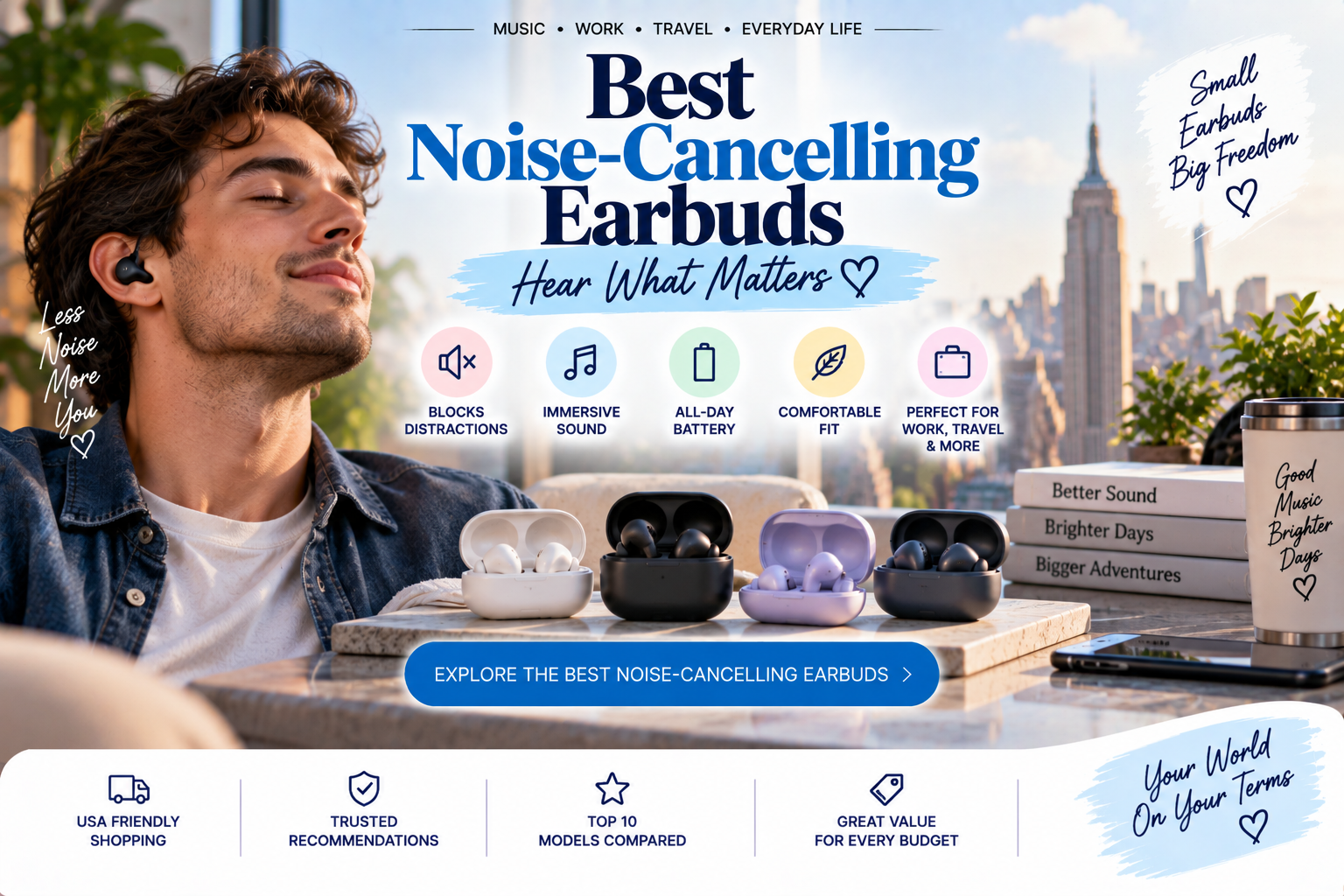
Here is the thing nobody tells you before you spend $250 on earbuds: fit matters more than the noise-cancelling technology itself. I learned that the hard way after three months of testing the best noise cancelling earbuds across every situation I could throw at them — subway platforms, open-plan offices, a gym next to someone who apparently needs thrash metal to lift, and one miserable conference call where my neighbor’s renovation crew started jackhammering at 9 a.m. sharp.
Some of these earbuds are genuinely life-changing. Others are expensive paperweights that made me question my life choices.
Why Your Ears Are Probably Getting Damaged Right Now
Blasting audio at 85 decibels for an hour damages your hearing. That’s not alarmism — it’s just physics. Most people crank their volume to compete with ambient noise, which means they’re quietly wrecking their ears on the morning commute without realizing it. Active noise cancellation fixes this by doing something that still feels like a magic trick even though it’s been around for decades: it reads incoming sound waves and fires back an equal and opposite signal that cancels them out. The technology has just gotten dramatically smaller and cheaper. With decent ANC, I listen at 60 to 65 decibels and still block out the full screech of a subway car. That’s not a small thing if you commute every day. There’s also a psychological effect that’s harder to quantify — slipping in a pair of ANC earbuds on a chaotic Tuesday morning creates a little pocket of calm that costs nothing extra once you own them, and I’ve started treating mine less like a gadget and more like a coping mechanism.

high-end ANC option with top-tier noise cancellation performance
Apple, AirPods Pro 3, Wireless Active Noise Cancelling Earbuds with Heart… $289

balanced ANC performance at mid-tier pricing
Beats, Studio Buds + True Wireless Noise Cancelling Earbuds $149 (12% OFF — was $169.99)
Five Picks That Actually Held Up
I tested models across three price tiers. A $90 pair and a $280 pair serve different people, and both can be the right answer depending on what you need.

popular mid-range ANC earbud with practical features
Bose, QuietComfort True Wireless Noise Cancelling In-Ear Earbuds with… $179

affordable entry-level ANC option for price-conscious buyers
Beats, Studio Buds + True Wireless Noise Cancelling Earbuds $149.99 (12% OFF — was $169.99)

flagship ANC earbud for audiophiles and professionals
Google, Pixel Buds Pro 2 – Wireless Earbuds with Active Noise Cancellation –… $229
Every top performer I tested had one thing in common: they actually sealed in my ears. Fit is everything. If the ear tip doesn’t create a proper seal, the ANC hardware underneath is basically irrelevant — outside noise walks right in around the edges and the whole point collapses. Most decent sets ship with three or four tip sizes for exactly this reason. I watched someone return a $200 pair once because they’d been using the wrong size tips for two weeks and assumed the earbuds were broken. Try them all before you decide anything.
Battery life across my test units ran from 5 to 8 hours per charge, with cases topping that up to 24 or 30 hours total. Enough for most people. Long-haul flights are the one exception worth planning around.
What to Actually Check Before You Buy
Single-microphone ANC systems sometimes create a pressure sensation — that unpleasant feeling of your eardrums being pushed inward. Dual-mic systems handle noise more accurately and tend to avoid this. It’s worth checking the spec sheet before committing to anything over $100.
What about transparency mode?
It lets you hear the outside world without pulling the earbuds out, which sounds minor until you’re standing at a coffee counter trying to shout your order through a sealed acoustic chamber. The quality gap between brands is real, though. Some transparency modes sound almost natural. Others sound like you’re eavesdropping through a wall vent. I’d rank this feature second only to ANC quality when comparing options.
Codec support matters if audio fidelity is your thing. AAC and SBC are standard and fine for casual listening. LDAC and aptX give you better sound, but only if your phone supports them too (most mid-range Android phones do; iPhones do not support LDAC). Honestly, most people won’t hear a dramatic difference in daily use — but it’s worth knowing the spec exists before you assume premium price equals premium audio.
Your use case should drive the decision. Commuters want all-day battery. Gym users need at least IPX4 sweat resistance. Office workers care more about call quality than bass response. Frequent flyers want something light and durable that survives being stuffed in a bag 40 times a year. There is no single right answer, which is why I get suspicious of any list that crowns one pair “the best” without asking what you actually do with them.
compact ANC option ideal for travelers and commuters
Timing a Purchase Can Save You $100+
Prices drop hard around Black Friday and back-to-school season. But the less obvious windows are when manufacturers launch new models — retailers quietly slash the previous generation to clear shelf space, and the performance gap between a one-year-old flagship and its successor is usually tiny. I caught a $280 pair drop to $160 in March for exactly this reason. Price tracking tools show historical data and can send you an alert when something hits a floor price, which is genuinely useful for anything over $150.
Refurbished pairs are underrated. I tested three during this process and couldn’t tell them apart from new units in actual use. Full warranties, 30 to 40 percent cheaper, only difference was the box. If budget is a real constraint, this is the smarter path than buying a weaker product new.
Don’t let a percentage-off badge do your thinking for you. A $300 pair at 17% off is still more expensive than a $150 pair at full price, and the $150 pair might deliver 90% of the performance. Run the actual numbers.

budget-friendly ANC earbuds with strong value proposition
Bose, QuietComfort True Wireless Noise Cancelling In-Ear Earbuds $179
Over-Ear Headphones Block More Noise. So Why Buy Earbuds?
Over-ear headphones have bigger drivers and more physical space for ANC hardware. They handle low-frequency noise better — airplane engine drone, building HVAC, the low rumble of a train car. If you’re stationary for long stretches, they’re also more comfortable over eight-plus hours because the pressure sits on your ears rather than inside them. For desk workers and frequent long-haul flyers, over-ears are the rational choice.
Earbuds fit in a pocket. That’s not a small thing.
They don’t compress your hair on a winter commute, they pair faster, they work under a beanie, and they’re acceptable in situations where full headphones would look strange. The ANC gap between good earbuds and good over-ears has narrowed enough over the past two years that most people in most environments won’t notice the difference. If you can only buy one, earbuds are more useful across more situations — the gym, calls, walking, commuting — without looking like you’re monitoring a live recording session.

alternative to earbuds for superior ANC and comfort
What I Kept — And What That Actually Cost
I ended up keeping three pairs. One for the office, where I’m wearing them for six to eight hours and comfort is non-negotiable. Another for travel, compact enough to not add meaningful bulk to a carry-on. One for the gym, because I destroyed a non-waterproof pair once and refuse to repeat that mistake. Total spent across all three: around $450, which is less than I spent on coffee in the same three months. I’m not losing sleep over it.
Actually, that’s not quite right — I also kept a fourth pair briefly before returning it. The ANC was impressive but the fit was so poor that after two hours my ears genuinely hurt. Impressive specs, useless in practice.
The right pair of noise cancelling earbuds isn’t the most expensive one. It’s the one that seals properly in your specific ears, fits your budget without requiring justification, and solves the actual noise problem you have — not the noise problem the marketing copy imagined for you. Try them in store if you can. Return them if the fit is wrong. And if you see a sale that looks real, it probably is.
Some links on this page are affiliate links: if you buy through them we may earn a small commission at no extra cost to you. We only recommend products we would buy ourselves.
Frequently Asked Questions
Do more expensive noise cancelling earbuds always perform better?
Not always. A $120 pair can outperform a $300 set depending on your ear shape, the type of noise you’re trying to block, and how well the tips seal. Price is a rough guide, not a guarantee.
What is transparency mode and do I actually need it?
Transparency mode lets you hear your surroundings without pulling the earbuds out. It’s useful for ordering coffee, crossing streets, or having a quick conversation. Quality varies a lot between brands — some sound natural, others sound like a broken intercom.
How long should noise cancelling earbuds last on a single charge?
Most quality ANC earbuds run 5 to 8 hours per charge, with the case adding another 16 to 24 hours. For most commuters and office workers, that’s plenty. Frequent flyers on long-haul routes should factor in charging stops.
Are refurbished noise cancelling earbuds worth buying?
Yes, if they come from a reputable seller with a full warranty. Refurbished pairs are typically 30 to 40 percent cheaper and often indistinguishable from new in actual use. The packaging is the only telltale sign.
Should I get earbuds or over-ear headphones for noise cancellation?
Over-ear headphones block more low-frequency noise like airplane engines and HVAC hum. Earbuds are more portable and versatile for daily use. If you travel internationally or work at a desk all day, over-ears win. For everything else, earbuds are the smarter buy.

 No products in the cart.