
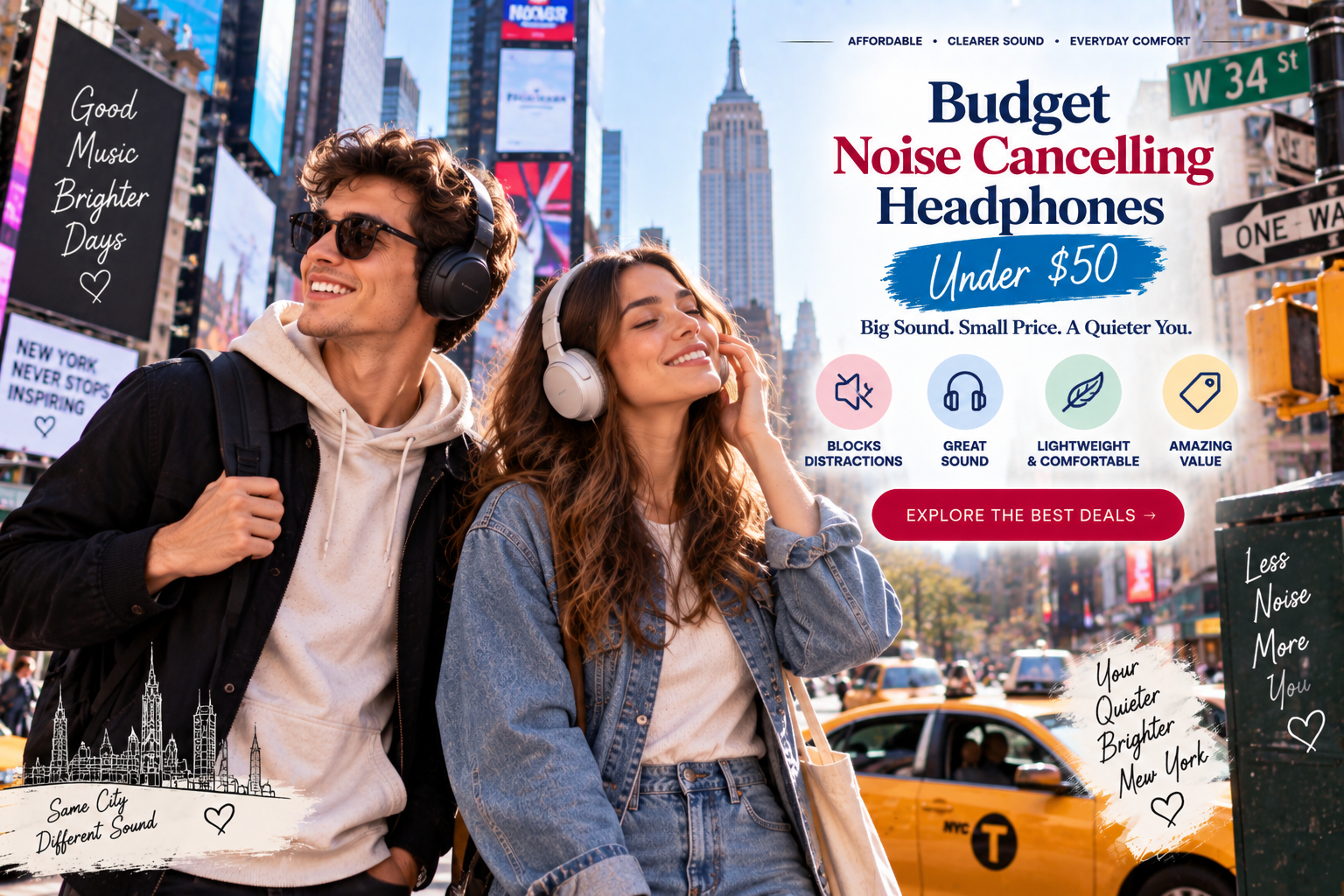
I bought a pair of budget noise cancelling headphones for $39 last year and felt genuinely betrayed by my own wallet—not because they were bad, but because I’d spent embarrassingly more than that on other pairs and couldn’t honestly say they were better for what I actually use headphones for.
Here’s what that experience taught me: the $40-50 ANC category has quietly become legitimate. Not perfect. But legitimate in a way that would’ve been laughable five years ago, when noise cancellation was the exclusive property of Sony, Bose, and Apple fans willing to drop $300 without blinking.
How Did We Get Here?
Five years ago, this conversation wouldn’t have existed. Budget noise cancelling headphones were basically a contradiction in terms—the technology was expensive, the battery components were expensive, and the licensing arrangements that let manufacturers use ANC algorithms were expensive on top of that. Then two things happened in fairly quick succession: battery miniaturization got cheap enough to pack into small consumer devices without inflating the price, and manufacturers (particularly out of China) figured out how to implement noise cancellation without paying the licensing premiums that had kept the technology locked behind a $250+ paywall. Suddenly you could buy functional ANC headphones for less than a decent dinner out, and the market responded by flooding Amazon with options—roughly 47,000 results if you search “noise cancelling headphones under $50” right now, which is either exciting or exhausting depending on how much you enjoy comparison shopping. Most of those options are garbage, I’ll be honest. But some of them are genuinely solid, and the competition between brands has pushed quality up faster than most tech categories manage.
Why does this matter for you specifically? Because it means you have real options now rather than a choice between one decent thing and a pile of junk.
What $40-50 Actually Gets You
A $40 pair will muffle most ambient noise. Not eliminate it—muffle. There’s a real difference. You’re looking at roughly 15-20 decibels of reduction, versus 25-30 on a flagship model. On a commute, you probably won’t feel that gap. In a loud open office? You will.
Battery life runs 6-10 hours with ANC on, which is enough for a workday or a transatlantic flight. Bluetooth 5.0 is standard at this price now, so connection drops are rare and pairing takes seconds. These aren’t small things—a few years ago, even $100 headphones fumbled both of those regularly.
What they won’t do is sound clean at high volumes, maintain ANC performance after 18 months of heavy daily use, or handle extreme temperature swings without getting weird. The ear cup padding compresses faster than on premium models, which means the physical noise seal degrades even if the electronics hold up. And the battery situation is worth knowing about: flagship headphones tend to hold around 80% of their original capacity after two years. Budget ANC headphones are more like 60-65%. That’s not a dealbreaker for most people, but it’s real.

entry-level ANC option for commuters and office workers
Jbl, Vibe Beam 2 True Wireless Noise Cancelling Earbuds $39.99 (38% OFF — was $64.99)

affordable full-size ANC for longer listening sessions

portable budget-friendly noise cancellation for travel
So Which Ones Should You Actually Buy?
The market is crowded enough that shopping without a framework is just stressful. When I’m looking at budget ANC options, I filter by four things: battery life listed as a specific number of hours (not “all day,” which means nothing), Bluetooth 5.0 or higher, driver size of at least 30mm for over-ear styles, and reviews from people who’ve owned the thing for more than a week.
Skip anything that won’t list exact specs. That vagueness is usually hiding something.
The options worth considering fall into two rough groups. There’s the $35-45 range where you find things like the Soundcore Q20i and JLab Studio ANC—headphones that are genuinely competent without pretending to be something they’re not. Then there’s the $45-60 range, which starts to feel like it costs more than it does, and where you’ll occasionally find something that punches well above its price. (The $28 JLab Studio ANC is the wild card here. It probably shouldn’t work as well as it does at that price. Actually, that’s not quite right—it works well for what it is, which is a starting point, not a long-term solution.)

solid mid-range option balancing price and performance
TOZO, HT3 Over Ear Wire/Wireless AI Noise Cancelling Headphone $45.99 (8% OFF — was $50)

travel-friendly ANC for frequent commuters
TOZO, HT3 Over Ear Wire/Wireless AI Noise Cancelling Headphone $45.99 (8% OFF — was $49.99)

Cheap ANC Fails at One Thing Specifically
The degradation timeline is the honest answer to “what’s actually wrong with budget noise cancelling headphones.” Sound isolation gets worse over time not just because the electronics age, but because the physical ear cups loosen and the padding compresses—and once that seal goes, the ANC algorithm is fighting a losing battle regardless of how good it is. Premium headphones maintain their physical construction better, full stop. The ANC algorithm on budget models is also less sophisticated, which creates an occasional tinny or artificial quality in certain acoustic environments, like rooms with HVAC hum. Some people never notice it. Others find it actively worse than no noise cancellation at all.
Where do they win? Low stakes.
You’re out $40 if you drop them on concrete, leave them on a plane, or decide after two weeks that over-ear headphones aren’t for you. That low-risk quality is genuinely useful for people who are still figuring out what they want from a pair of headphones—and for people who just need something functional for the commute without caring about audio quality in any deep way.

durable ANC for active use and gym sessions
Jbl, Vibe Beam 2 Noise Cancelling Earbuds with Case $41.95 (38% OFF — was $68.2)

budget option for remote work and video calls
Sony, WH-CH520 Wireless Headphone with Microphone $38 (44% OFF — was $68)
Should you just spend more?
Depends entirely on how many hours a day these things live on your head.
Two to three hours for a daily commute? A $40-50 pair will serve you fine for a year or two, and the upgrade math doesn’t work out. The gap between $40 ANC and $300 ANC in real-world use is maybe 30-40% better performance—not 7x better, which is what the price difference would suggest. That’s not nothing, but it’s not a transformation either.
Eight hours a day in a genuinely loud environment is a different calculation. Better noise cancellation, better sound, a headband that doesn’t dig into your skull by hour four—these things compound when headphones are part of your working day rather than just your commute. The sweet spot for daily power users is probably $60-100, where you get most of the flagship experience without the flagship price.

comparison point for mid-range and flagship ANC performance
JLab, GO Pop ANC True Wireless Bluetooth Earbuds with Active Noise… $31.99

feature comparison between budget and higher-end models
My honest take after buying more headphones than I can defend: budget ANC is a genuinely good entry point, and the Soundcore Q20i at $44.99 is probably the one I’d hand to someone who asked me for a recommendation without knowing much about their habits. It’s not the best headphone I’ve ever used. But it’s the best argument I’ve seen for spending less.
Some links on this page are affiliate links: if you buy through them we may earn a small commission at no extra cost to you. We only recommend products we would buy ourselves.
Frequently Asked Questions
Do budget noise cancelling headphones actually work?
Yes, but with limits. A $40 pair will cut ambient noise by roughly 15-20 decibels—enough for commuting or office work. Flagship models get closer to 25-30 dB. You’ll notice the gap in loud environments more than quiet ones.
How long do cheap ANC headphones last on a single charge?
Most budget ANC headphones deliver 6-10 hours with noise cancellation running. That covers a full workday or a long flight, though battery capacity tends to degrade faster than on premium models—expect around 60-65% of original capacity after two years of regular use.
Is Bluetooth reliable on budget noise cancelling headphones?
Surprisingly, yes. Bluetooth 5.0 is now standard even at the low end, which means pairing is quick and drops are uncommon. This is one area where cheap ANC headphones have genuinely caught up to more expensive options.
When should I spend more than $50 on noise cancelling headphones?
If you wear headphones 6+ hours a day, work in a consistently loud environment, or find small annoyances with tech genuinely frustrating, the jump to $100-150 buys noticeably better sound, build quality, and ANC performance. For occasional commuters, the $40-50 range is usually fine.
What should I look for when buying budget ANC headphones?
Check for a specific battery life listed in hours (not vague claims like ‘all day’), Bluetooth 5.0 or higher, at least 30mm drivers for over-ear styles, and reviews from people who’ve owned them for more than a month. Avoid anything that won’t list exact specs.

 No products in the cart.