

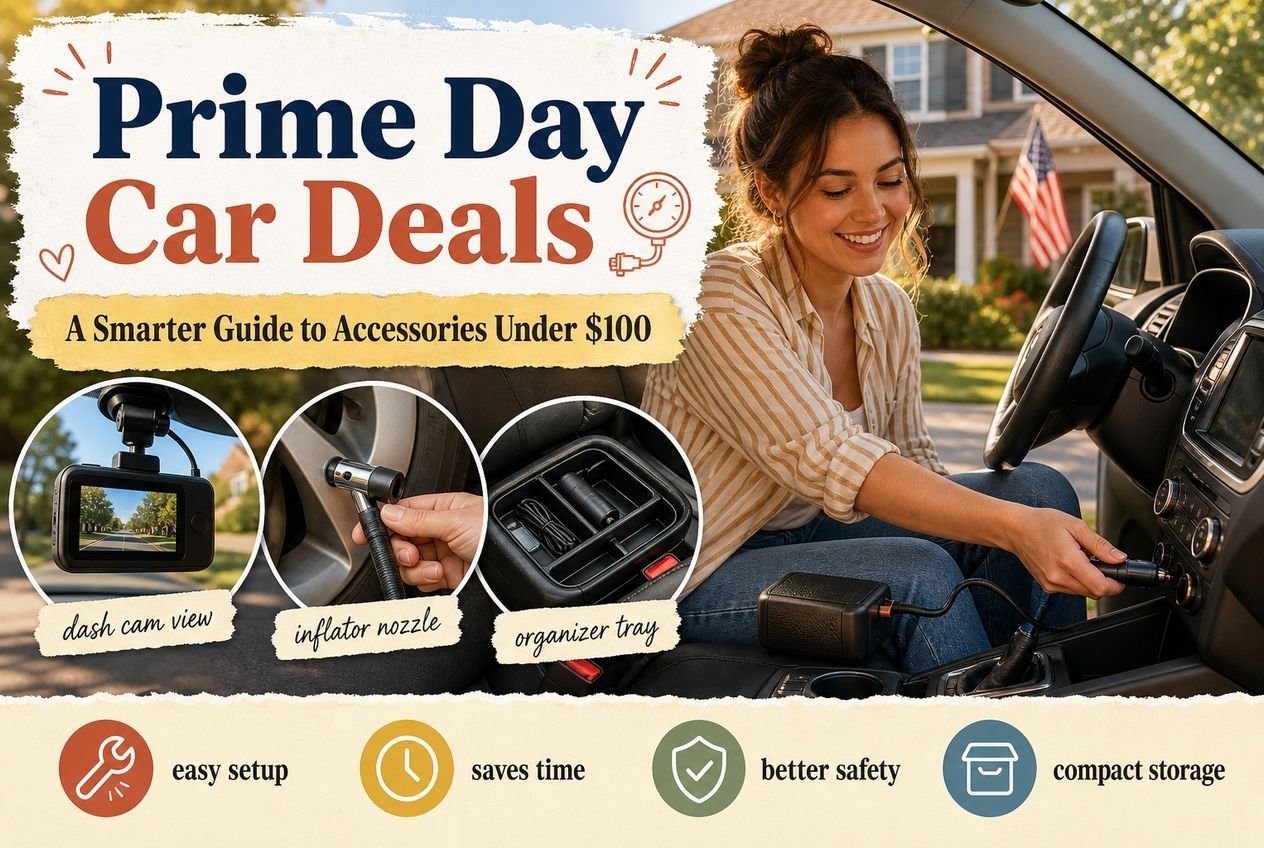
Measure your console before you shop. Seriously.
I learned that the annoying way, after ordering a slim organizer that jammed the lid of my console shut. It sat in the hallway for a week before I boxed it up again. A low price is not much comfort when the thing does not fit, needs a part you did not know about, or is a pain to use on a rainy Tuesday.
Start with the problem, not the product list
Prime day car deals make it tempting to toss a gadget into your cart between errands, especially when the listing flashes a big discount. A car accessory only earns its space if it fits your vehicle and solves a real problem. This guide is meant to help you sort useful car accessories under $100 from impulse buys, without pretending every sale is a bargain.
What is the one thing about your car that irritates you every single week?
Maybe grocery bags tip over. Maybe cables vanish into the footwell, or the evening sun hits a hazy windshield and turns it into a glare machine. Fixing one recurring annoyance beats buying a handful of gadgets you will forget about by August. Write the annoyance down, then write your vehicle’s year and model, where the accessory would sit, and any measurements you can take. A console organizer that is too wide can interfere with the lid, and a seat-back pocket may crowd rear passengers. Boring details, sure. They are also what keep a deal from turning into a return.
Prices and availability shift fast during automotive promotions. Compare the current price with the usual one, read recent buyer feedback for repeated problems, and check the return window. A discount on the wrong thing is still money spent.
For anything powered, find clear information on how it gets power and whether the cable reaches the spot where you will use it. I get wary when a listing buries compatibility in tiny print. Shopping fast means you can miss a required adapter, or find out after installation that the included cable is too short. Set a spending cap for the category too, not only for the whole sale. If the car needs a basic cleanup, a compact organizer or a simple cleaning tool may beat an electronic accessory with features you will never touch. And if nothing on your list fits, skipping the sale is a perfectly good result.
Dash cams: pick coverage you will really use
A dash cam makes sense if you drive often, park on busy streets, or want a record of what happened after a close call. When you search for a dash cam Prime Day deal, compare the practical basics before the long feature list pulls you in. Decide whether you want a front view only or both the road and the cabin, how footage is saved, and whether the camera can be installed cleanly in your car.
Check resolution and night quality in customer reviews, not just in marketing images. A camera can look crisp in bright daylight and struggle with headlight glare after dark. Loop recording overwrites older files when storage fills, while incident detection may protect clips after a sudden jolt. Neither one lets you ignore memory-card requirements, and neither means you can skip checking that recordings are actually saving.
Installation deserves a little thought. The mount should stay out of your direct line of sight, and the power cable should not hang across the dashboard. Some setups run a cable to a vehicle power outlet (the easy route), while parking monitoring may need a separate installation. That can take more time and may need a professional, so count the hassle as part of the price.
Every camera is a trade-off. More coverage means more wiring, more storage to manage, and more settings to learn. I would take a basic unit that records reliably over a feature-packed one I never finish configuring. Before you drive off, confirm the view is clear and learn how to save an important clip. Footage you cannot retrieve is useless.
Organizers that fit the cabin you have
Organizers sound simple until you try to fit one around a child seat, a full center console, or the coffee you are carrying to work. Storage is a sensible category for car accessories under $100, because you can judge many options by fit and construction instead of a complicated spec sheet. Still, measure first. Seat width, console shape, and trunk space vary more than product photos suggest.
A trunk organizer suits people who regularly haul groceries, sports gear, or roadside supplies. Look for a base that stays put and compartments that match what you actually carry. Collapsible sides help when the trunk is empty, but flimsy panels can fold under a heavier bag. Easy storage often means less structure.
For small things, a console tray or seat-back organizer can stop loose cables, tissues, and charging adapters from wandering. Check how it attaches. Does it block a seat adjustment, cup holder, air vent, or the seat belt? A tidy cabin is nice. A blocked control is not.
What really belongs within reach? Keep the driver’s area free of anything that could roll under the pedals or draw your eyes away from the road. Put the frequently used items in a stable spot and leave the rest in the trunk or a secured compartment. I organize around a few daily essentials rather than filling every pocket just because it is there.
Fabric designs are lighter and fold away easily, while rigid ones hold their shape better. Both collect dust and crumbs, so see whether the material wipes clean or comes out for washing. Sharing the car? Pick a setup that will not turn into a daily negotiation over whose stuff goes where.
Safety gear and gadgets worth a calm look
Safety gear deserves a slow comparison, not a rushed click. A portable tire inflator helps when a tire is low and you need to restore pressure somewhere suitable. With tire inflator deals, check the power source, hose length, pressure display, and whether the instructions explain safe use. Make sure the unit works with your tire valves and that its cable can reach every wheel.
Inflators have limits. They do not fix a damaged tire, and one will not make it safe to keep driving on a puncture or a tire that keeps losing pressure. Check the vehicle manual for the recommended pressure, and use the placard on the driver-side door jamb as your guide. Do not aim for the maximum pressure printed on the tire itself. A small separate gauge is handy for double-checking the reading.
Think about where you would use it. A model that plugs into a vehicle outlet needs a reachable outlet and may have cable limits, and a rechargeable one needs a charged battery on the day you need it. That is the catch. Convenience depends on preparation, so keep the inflator somewhere accessible and check it now and then, rather than waiting for a flat in cold weather.
Other emergency supplies might include reflective warning gear, a flashlight, gloves, or a first-aid kit. Pick items suited to your region and the space in your vehicle. A bulky kit buried under luggage will not help much, and a light with dead batteries is just weight. Keep the basics together where you can reach them without unloading the trunk.
With small electronics, ask whether the gadget solves a real problem or just adds another screen and cable. A phone mount should hold your phone securely without blocking your view or distracting you. Check that it attaches to a suitable surface, and that it stays clear of airbags and controls. A poor fit wobbles, and some adhesives leave residue.
Scan the return terms and seller support info before buying anything. Read recent reviews for repeated complaints about breakage, fit, or confusing instructions. One irritated review tells you little. A pattern tells you plenty. And do not let a countdown timer rush you past the basic checks.
Keep your list tied to your driving routine. Gear you can install, maintain, and use without adding clutter or distraction is the gear worth paying for, whether that is a well-matched organizer, a carefully set-up camera, or the right emergency kit. My rule is simple: if a deal does not solve something on your list, let it go and save the money for one that does.
Some links on this page are affiliate links: if you buy through them we may earn a small commission at no extra cost to you. We only recommend products we would buy ourselves.
Frequently Asked Questions
Are Prime Day car deals actually cheaper than normal prices?
Sometimes. Compare the sale price with what the item usually sells for, and read recent reviews before you trust a big percentage off.
What should I check before buying a dash cam on sale?
Look at night footage in customer reviews, memory card requirements, how it is powered, and whether the mount stays out of your line of sight.
Can a portable tire inflator fix a damaged tire?
No. It only restores pressure. A punctured tire or one that keeps losing air needs proper repair before you keep driving.
What pressure should I inflate my tires to?
Use the placard on the driver-side door jamb or your vehicle manual, not the maximum pressure printed on the tire.

 No products in the cart.