

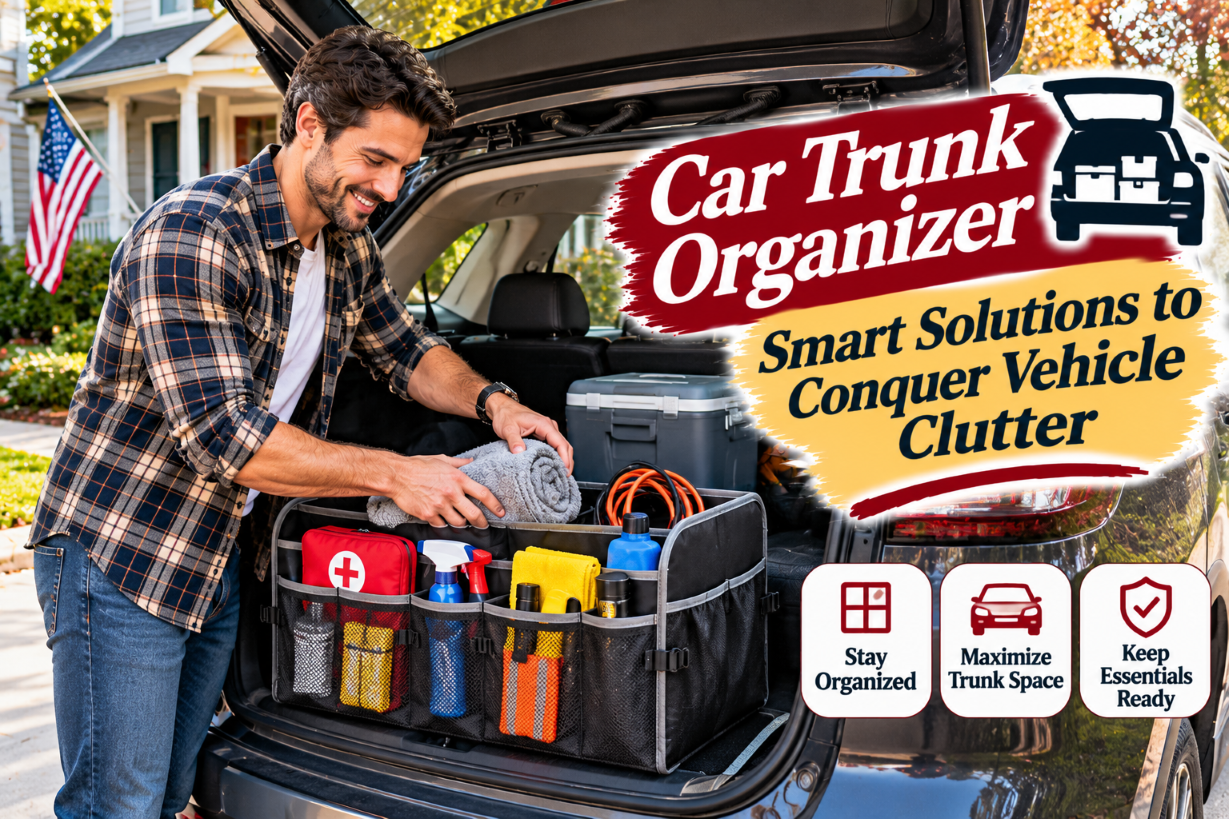
Last winter I spent ten minutes in a dark parking lot digging for jumper cables under a soccer ball, three tote bags and a half-empty jug of washer fluid.
That was the night I got serious about organizing my trunk.
Why does a messy trunk matter?
Most people think of it as a looks problem. It is not. Loose cargo slides around every time you turn or brake, and that shifts the weight in your car in ways you can feel, especially if you are carrying anything heavy. Beyond that, you waste real time hunting for things, the way you might dig through the bottom of a bag for your keys while someone waits at the door.
Your trunk itself takes a beating too. Loose items scratch the interior, and a leaking grocery bag or a tipped bottle can stain the carpet for good. An organizer puts a barrier between your cargo and the car. And yes, there is a social angle (I know, it sounds shallow). If a friend borrows your car or you are picking someone up, a tidy trunk quietly says you have things under control.
So what should you actually buy?
Five kinds of organizer, and who each one fits
The best pick depends on what you carry and how often you reach for it. There is no single winner.
Collapsible fabric organizers are the flexible choice. They fold flat when empty, weigh almost nothing, and usually come with several compartments, so they handle groceries, gym bags and odd stuff you want corralled. Heavy or sharp items are their weak spot. The fabric can tear, and it will not shield fragile cargo the way a rigid box does.
Hard plastic bins are the workhorse. They stack, they last, and they protect what is inside, so a heavy toolbox or a bag of road salt is no problem. Spills wipe right off. But they claim space even when empty, and in a small trunk, a couple of stacked bins leave little room for anything else.
Hanging organizers attach to the back of the front seats or the trunk lid. Small things like phone chargers, sunglasses and registration papers stay within reach and off the floor. Heavy gear is a no. One catch: check the clearance, because some models limit how far the lid opens.
Under-seat storage is badly underused. Low-profile organizers slide beneath the rear seats and can hold emergency supplies, cables or seasonal items without touching your trunk space. You cannot store anything tall, and reaching under a seat is clumsy compared with opening a box at eye level.
Custom trunk trays are cut to your exact vehicle. They cost more than generic options, but they use every inch. If your trunk has an awkward shape or you want something permanent, they earn their price. Just remember you are locked into one layout, and changing your mind later is a pain.
Clutter lives in the cabin too
The cup holders, door pockets and the gap between the seats fill up with receipts, cables, pens and whatever else wanders in.
Seat-gap organizers slide into the crack beside your front seats and catch everything that would otherwise fall through. They are cheap, they take about 30 seconds to install, and if you have ever fished for dropped coins down there, one will pay for itself in sanity alone.
Door pocket organizers give those shallow pockets some structure, so items stay in slots instead of sliding around. Keep them light, with a few maps, some tissues or a pair of gloves. Overload them and the door feels heavy when you swing it open.
Backseat organizers hang from the front seats and make pockets for passengers. If you drive kids around, they keep toys, tablets and snacks contained, and they cut down on the urge to toss things on the floor to roll around.
Console organizers drop into the center console and split it into compartments for sunglasses, toll passes, USB cables and that one pen that actually works. Do not stuff them. About 80 percent full is the sweet spot, because jam them tighter and you cannot get anything out.
Check these things before you buy
Measure first. Length, width and height of the trunk, then compare against the listing. A too-wide organizer will not fit, a too-tall one may keep the lid from closing, and most returns come from people who skipped this step.
Next, look at materials. Fabric models need reinforcement at the seams, handles and compartment edges. Plastic should be stiff enough to hold weight without folding, yet flexible enough to go into your trunk without cracking. Read reviews for durability complaints in particular, since several people mentioning split seams or cracked plastic is a clear warning.
Compartment layout decides how useful the thing is day to day. Too many tiny pockets and you are always hunting. Too few and everything tumbles together. If you mostly haul groceries, go for fewer, larger sections. Tools and emergency supplies call for more defined spaces.
Handles matter more than you would expect. Some are basically decoration, and they fail the moment the organizer is full. If you plan to lift it in and out of the car regularly, you want reinforced ones.
Then there is collapsibility. In a tight trunk, a design that folds away when you do not need it is a real gain. Rigid ones are sturdier and protect cargo better, but they are always there. Your habits should decide.
Setup and upkeep
Most organizers need no installation at all. Put one in the trunk and weight plus friction keep it there. A non-slip mat underneath helps if you take corners hard or brake late.
Hanging and under-seat types may need a strap secured or a bracket adjusted. Easy stuff. If one asks for tools or drilling, you are looking at a permanent install, which is fine as long as you know that going in.
Upkeep is simple. Wipe plastic with a damp cloth now and then. Spot-clean fabric with mild soap, after checking the care label. Deal with spills right away, before they stain or turn moldy. Every so often, empty it out, toss expired emergency supplies, and remove anything you have not touched in months.
One honest downside: organizers can trap moisture. In a humid area, or if the car lives outside, damp air can build up inside a closed organizer and hurt whatever is stored there. Cracking the trunk open a little on muggy days helps, and so does airing the organizer out. Not a deal-breaker, only something to watch.
Getting a decent price
Prices swing a lot. A basic collapsible model might cost $20 to $40, while mid-range plastic bins or tougher fabric ones usually sit between $40 and $80. Custom and premium versions can top $100. So where are the deals?
Big box stores often price standard organizers well. They stock a few popular models, so you can hold one up against your trunk. Selection is thin compared with online, though.
Online marketplaces offer far more variety and usually lower prices. You can filter by size, material and cost, and read reviews from people with cars like yours. You cannot touch the product, so read carefully and check the return policy.
Specialty auto retailers focus on car storage, and their staff tend to know the products. You may pay a bit extra. If you are unsure what you need, the advice is worth it.
Sales follow a pattern. Spring and early summer bring discounts as people clean out their cars, back-to-school sometimes does too, and Black Friday and Cyber Monday cover nearly everything. If you can wait, you may save 20 to 30 percent.
Look at price history before you commit. Some retailers and tracking tools show whether a price is truly a deal or just looks like one. That spares you the annoyance of paying full price and watching it drop two weeks later.
Sign up for alerts from stores you trust, too. Many email you about sales in specific categories, which is an easy way to catch a drop when you are not ready to buy yet.
A simple way to decide
Be honest about what you carry. Weekly groceries? Emergency supplies that rarely move? Sports gear? Tools? A person who needs groceries contained wants something very different from a person hauling a toolkit.
Measure the trunk. Do not guess. Write the numbers down and keep them on your phone while shopping, because an organizer that does not fit is worthless no matter how good the reviews are.
Think about how often you will open it. If you are in and out constantly, pick something easy to get into. If it mostly sits there guarding supplies you hope never to need, durability beats convenience.
Look for reviews from people with your car or something close. Someone saying it works perfectly in their Honda Civic tells you far more than a five-star rating from a driver with a totally different vehicle.
And do not overspend. This is a tool, not decoration. Find something in your budget that fixes your specific clutter problem and stop there.
Just start with the worst spot
An organizer is not glamorous, but it fixes a daily annoyance. Fabric, plastic bins or a mix of both can all work, as long as the choice matches how you really use your car.
Pick whatever bugs you most about your trunk right now, fix that, and build from there. You do not need a perfect system by Saturday. My vote is a mid-priced hard bin for the heavy stuff and a cheap collapsible one for groceries, and that pairing has worked for me ever since the night of the parking-lot cable hunt.
Some links on this page are affiliate links: if you buy through them we may earn a small commission at no extra cost to you. We only recommend products we would buy ourselves.
Frequently Asked Questions
What is the best type of car trunk organizer?
It depends on what you carry. Collapsible fabric organizers suit groceries and gym bags, hard plastic bins suit heavy tools and road salt, and custom trays suit odd-shaped trunks where you want a permanent setup.
How do I know if a car trunk organizer will fit?
Measure the length, width and height of your trunk, then compare those numbers with the product specs. Most returns happen because buyers skipped this step.
How much does a car trunk organizer cost?
Basic collapsible ones run about $20 to $40. Mid-range plastic bins or sturdier fabric models land between $40 and $80, and custom or premium options can pass $100.
When is the best time to buy a car trunk organizer?
Spring cleaning season, back-to-school, and Black Friday through Cyber Monday tend to bring the best discounts, often 20 to 30 percent off.
How do I keep moisture out of a trunk organizer?
Wipe it down, air it out now and then, and crack the trunk open on humid days if the car is parked outside. Clean spills right away so mold does not start.



 No products in the cart.