

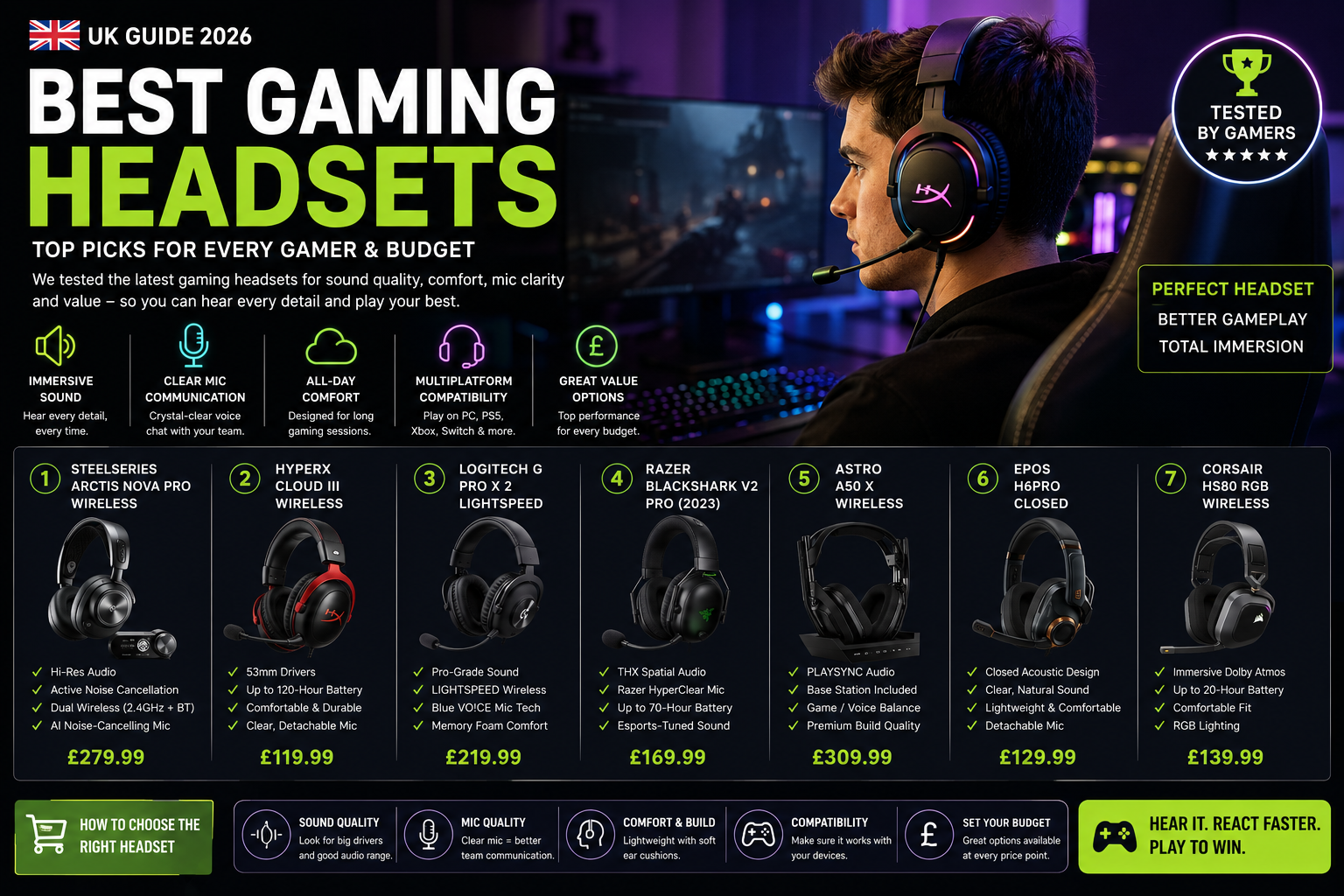
Miss a footstep in a ranked match and you know it. That half-second of silence before someone appears behind you — that’s not bad luck, that’s your headset. Finding the best gaming headsets UK retailers actually stock right now is harder than it sounds, because the market is flooded with options that look identical on spec sheets but feel completely different once you’ve had them on for three hours straight.
Here’s the thing most buying guides won’t tell you upfront: the headset you need depends almost entirely on how you play, not how much you’re willing to spend. A £25 wired headset with a solid boom mic will serve a casual co-op player better than a £150 wireless model with a built-in mic that picks up every breath. Get the use case right first, then look at the budget.
Wired or Wireless — Does It Actually Matter?
Wired headsets offer zero latency, never need charging, and tend to cost less. Full stop. If you play at a desk and the cable doesn’t bother you, a wired headset is simply more reliable. The latency argument for wired gets louder in competitive circles — some tournament players won’t touch wireless — but I’ve used both in ranked matches and honestly cannot tell the difference during gameplay. What I can tell is the difference between a dead wireless headset mid-match and one that’s been charged. Forgot to plug mine in before a Friday night session once. Never again.
Wireless gives you freedom to move, grab a drink, or answer the door without the headset yanking off your head. Battery life on modern wireless sets ranges from 20 to 30 hours, which covers even the most enthusiastic weekend sessions. The latency on 2.4GHz wireless is genuinely imperceptible now — Bluetooth is a different story and worth avoiding for anything competitive. For console gaming in particular, wireless just makes sense; you’re probably sitting further from the screen anyway, and a cable trailing across the room is an accident waiting to happen.

reliable wired option with mic for competitive gaming

lag-free wireless gaming with stable connection
Spatial Audio Is the Feature You’re Probably Underrating
Gaming headsets aren’t regular headphones. The distinction matters more than most people realise when they’re standing in a shop comparing frequency response specs.
What you actually need for gaming is directional sound — the ability to hear that a player is behind you and to your left, not just that something is making noise. Virtual 7.1 surround sound, when implemented well, creates that effect convincingly enough to give you a real positional advantage in shooters and stealth games alike. Driver size plays into this too: the 40mm to 50mm range hits a sweet spot where bass impacts feel physical without drowning out mid-range frequencies, which is where footsteps, reloads, and voice comms all live. Go too bass-heavy and you’ll hear explosions brilliantly while completely missing the subtle audio cues that actually keep you alive. Frequency tuning matters as much as raw driver size, which is why a well-tuned 40mm driver can outperform a poorly tuned 50mm one in real gaming conditions. If you also use your headset for music or films, look for something with a flatter, more balanced response rather than a set tuned purely for game audio — pure gaming headsets can sound weirdly hollow on anything that isn’t a video game.

immersive surround sound for directional gaming audio

premium immersive audio for competitive advantage
Apple, AirPods Max Wireless Over-Ear Headphones £423.99 (15% OFF — was £499.99)
Your Mic Quality Affects Everyone in the Lobby
A bad microphone is antisocial. Your teammates will mute you, and honestly, they’re right to.
The difference between a boom mic and an ear-cup mic is not subtle — a boom mic positioned near your mouth captures your voice accurately and rejects background noise in a way that built-in cup mics simply cannot match, regardless of how much noise cancellation software gets layered on top. Look for a cardioid pickup pattern, which grabs sound from in front while ignoring what’s behind and to the sides. Flip-to-mute is genuinely useful rather than a gimmick; being able to physically silence the mic while you cough, answer someone, or shout at your cat is faster and more reliable than any software toggle. The arm itself matters too — a flimsy mic that droops back out of position every ten minutes is genuinely infuriating, especially when you’re mid-match and don’t want to stop to adjust it. Sturdy, flexible gooseneck arms are what to look for. If you’re planning to stream or record, consider whether a separate USB mic might serve you better than any headset mic, regardless of price point.

clear team communication with noise-cancelling mic
Lahtiwey, Open Ear Headphones with Boom Mic £27.18 (58% OFF — was £64.8)

Six Hours In, Comfort Becomes Everything
Weight is where most people get caught out. A headset that feels fine for twenty minutes in a shop can become genuinely painful after a long session, and the culprit is usually clamping force or a headband that sits awkwardly on your skull rather than raw weight alone. Most quality headsets land between 250g and 320g, which is manageable, but the distribution matters as much as the number on the scale. Memory foam ear cups are worth paying for — they conform to your head shape rather than pressing a rigid foam pad against your ears for hours. Breathable mesh fabric on the cups helps with heat, though no closed-back headset is going to be cool after extended wear; that’s just physics.
The headband should have enough padding that it doesn’t create a pressure point at the top of your head, which is the first thing to go sore on cheaper sets. Replaceable ear pads are, in my opinion, one of the most underrated features in the whole category — all ear pads degrade eventually, and swapping them out for £10-15 beats buying a new headset entirely. Build quality is harder to assess from a spec sheet, so read long-term reviews rather than just launch-day impressions.

comfortable for extended gaming sessions

long-lasting construction for serious gamers
The Picks
Right, onto the actual headsets. These nine cover different budgets and play styles — from entry-level wired sets that punch well above their price to wireless options with battery life that’ll outlast your longest sessions.

affordable entry-level gaming headset with solid performance

balanced wireless gaming headset for everyday play

high-end gaming headset with advanced features
Fifine, RGB Gaming Headset with 7.1 Surround Sound/3-EQ/MIC,Over-ear… £26.15 (60% OFF — was £66.01)
Before you buy, check the return policy. Seriously. A headset that feels fine during a quick test can become uncomfortable fast once you’re actually gaming, and head shape varies enough that reviews from people with similar builds are more useful than aggregate scores from tech publications. Watch microphone test videos on YouTube if you care about comms quality — reading about “noise cancellation” tells you nothing compared to hearing a recording. The best gaming headsets UK shops carry right now genuinely span every price point, which means there’s no excuse for settling on something that doesn’t fit how you actually play.
My honest take: spend more on comfort and mic quality than on flashy features. RGB lighting and app ecosystems don’t make you play better. A headset you forget you’re wearing after four hours, with a mic your squad can actually hear clearly, will do more for your gaming than any spec sheet number.
Hey savvy shoppers! When the items in our articles catch your eye and you decide to buy through our links, we may earn a small commission at no extra cost to you. Think of it as a way of supporting us in bringing you the best content!
Frequently Asked Questions
Are wireless gaming headsets good enough for competitive play?
Yes, for most players. Modern 2.4GHz wireless headsets have latency so low you genuinely cannot perceive it during gameplay. Some professional esports players still prefer wired out of habit or superstition, but for the vast majority of competitive gamers, wireless is absolutely fine.
What driver size should I look for in a gaming headset?
Most gaming headsets use 40mm to 50mm drivers. That range gives you a solid balance between bass punch and vocal clarity. Bigger isn’t always better — driver tuning matters more than raw size.
How long should a gaming headset last?
A decent gaming headset should last two to four years with regular use. The parts that fail first are usually the ear pads and the headband padding. If you can buy a headset with replaceable ear pads, do it — it can extend the lifespan by years.
Is 7.1 surround sound actually useful for gaming?
It depends on the implementation. Good virtual 7.1 surround helps you locate footsteps and enemy positions more accurately in shooters and open-world games. Bad implementations can actually muddy the sound and make positioning harder. Read reviews that specifically test spatial audio before buying.
What is a cardioid microphone pattern and why does it matter for gaming?
A cardioid pattern means the mic picks up sound from directly in front of it while rejecting noise from the sides and behind. For gaming, this means your voice gets captured clearly while keyboard clicks, fan noise, and background sounds are filtered out — which your teammates will appreciate.



 No products in the cart.