

Here’s something worth knowing before you spend a penny: the single biggest mistake people make when buying an induction hob is choosing on price alone, ignoring how their actual kitchen gets used day to day. Get that wrong and even a £600 hob will frustrate you every time you cook.
Induction hobs used to be the fancy option. Now they’re fast becoming the default choice in new UK kitchens, and for good reason. They heat faster than gas, give you precise control, and the glass surface stays cool enough that spills don’t bake on. I switched from gas about two years ago and the thing I didn’t expect was how much easier the clean-up would be — I genuinely spend maybe a quarter of the time I used to on it. We’ve picked seven of the best induction hobs available in the UK right now, spanning compact two-zone models all the way up to full-width showpiece cookers, so whatever your kitchen setup or budget, there’s something concrete here for you.
Why UK Kitchens Are Ditching Gas
The technology itself is straightforward. Instead of heating the hob surface, induction creates a magnetic field that heats the pan directly — which means the glass stays relatively cool, you get instant heat adjustment, and there’s no open flame. That last point matters more than people give it credit for, especially in households with young children or anyone who’s ever left a gas ring ticking over by accident.
Energy efficiency is the other side of this. Induction hobs convert roughly 80-90% of energy into actual cooking heat, compared to around 60-70% for gas or conventional electric. That gap is real money over the course of a year. And with UK energy prices where they’ve been lately, efficiency stopped being a nice-to-have.
What’s really accelerating the shift, though, is the open-plan kitchen trend. Sleek, flush-fitting induction hobs with touch controls just look right in a modern kitchen-diner in a way that a gas hob with chunky knobs doesn’t. Style and substance, for once, pointing in the same direction.
For Smaller Kitchens
Compact footprint does not mean compromised cooking.
Two-zone and three-zone induction hobs are genuinely capable bits of kit — not just consolation prizes for people with small kitchens. If you’re cooking for one or two people most nights, a compact model will handle everything you throw at it, take up less worktop space, and often come in significantly under budget compared to a full four-zone setup. Flats, terraced houses, studio apartments: this is your territory.

Space-saving two-zone induction hob perfect for smaller UK kitchens and flats

Flexible three-zone induction cooktop for small kitchens with limited space
Neff, T36CA50X1U N30 Built In 60cm 4 Zone Induction Hob in Black Glass £349
Where Most People Should Actually Shop
The mid-range — roughly £200 to £550 — is where the best induction hob value tends to live. You get four zones, reliable brand names, sensible power output, and enough control options to handle everything from a quick weeknight pasta to a proper Sunday roast spread across multiple pans. These aren’t flashy, but they’re the hobs that quietly do their job for a decade without drama. That reliability is genuinely worth something.
What shifts as you move up through this price band? Touch controls get more responsive, power levels get higher, and you start seeing bridge functions that merge two zones for bigger pans. Also, build quality on the glass and the trim tends to noticeably improve — you can feel it when you run your hand across the surface.

Standard four-zone induction hob offering excellent value for mid-sized UK kitchens
Neff, T36FBE1L0G N30 Built In 60cm 4 Zone Induction Hob in Black Glass £499

Mid-range induction hob with bridge function for flexible cooking zones
AEG, 6000 Bridge IKX84443CB 78 Induction Hob £499

Affordable induction hob with practical features like timer and safety lock
Premium Picks Cost Real Money. Are They Worth It?
Depends entirely on how you cook.
If your kitchen sees serious use — proper dinner parties, weekly batch cooking across five or six pans, or you’re someone who actually owns a fish kettle — then yes, a premium induction hob earns its price tag. Five or more zones, slider controls instead of touch (genuinely easier to use mid-cook with wet hands), and the kind of precise low-heat simmering that keeps a béchamel smooth rather than scorched. These are the hobs that appear in those glossy kitchen renovation features, and unlike a lot of aspirational products, they actually perform as well as they look.

High-end five-zone induction hob with premium features for serious cooks
Rangemaster, Elise ELS110EISS 110cm wide Electric Range Cooker with Induction Hob £3504
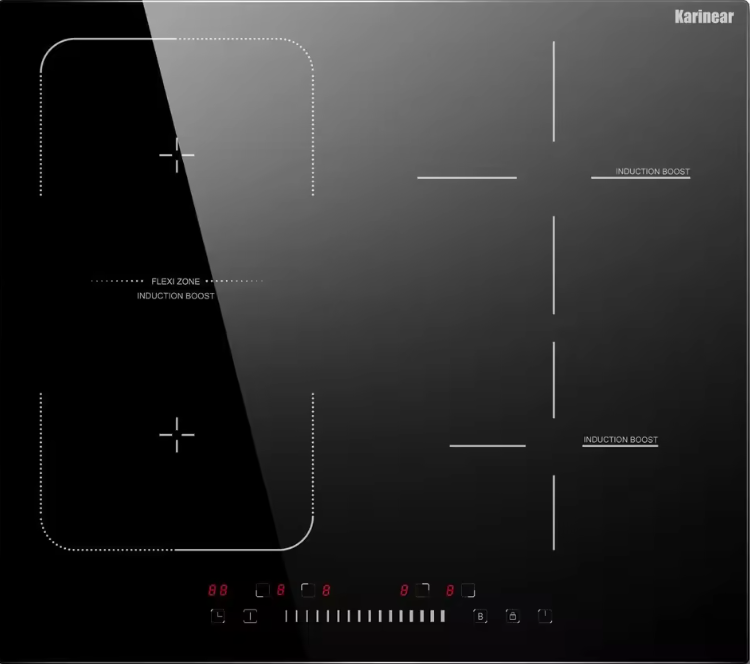
Premium induction hob with slider controls and advanced cooking zones for open-plan kitchens
Karinear, Built-in 4-Burner Induction Cooktop £216.99 (68% OFF — was £688.61)
What to Actually Check Before You Buy
Zone count is obvious. Less obvious: check the individual zone sizes, not just how many there are. Some hobs cram four zones into a 60cm width and the back-left zone ends up too small for anything larger than a milk pan. Look at the zone diameter measurements before you commit.
Power output matters at both ends of the scale. You want enough wattage to boil water fast (most decent four-zone hobs sit around 7,000-7,400W total), but equally important is how low the lowest setting goes — for chocolate, hollandaise, or keeping something warm without it bubbling away. Residual heat indicators, child locks, and auto-shutoff aren’t box-ticking features. They’re things you’ll actually use or be grateful for.
Pan compatibility is the one thing people forget to check until it’s too late. Induction needs ferrous metal — cast iron works brilliantly, as does stainless steel with a magnetic base. Aluminium and copper are out unless there’s a magnetic layer bonded to the bottom. If you’ve got a set of pans you love, hold a fridge magnet to the base before you buy anything. Actually, that’s not quite right — hold it to the outside base specifically, since some pans have a stainless base plate bonded onto aluminium. If it sticks firmly, you’re fine.
What does your cooking actually look like most evenings?
That question matters more than any spec sheet. Someone cooking for one three nights a week and ordering takeaway the rest has completely different needs from someone doing a weekly meal prep session across every burner simultaneously. A four-zone mid-range hob from Neff or AEG will outperform an overspecified premium model that never gets used to its potential. Buy for your real kitchen, not the aspirational one.
My honest take: for most UK households, the £350-£500 range is genuinely the sweet spot. You get reliability, enough zones, and brands that actually honour their warranties. The budget options can surprise you, but the premium end is really for people who cook at a level where those extra features get regular use. Spend in the middle and put the difference towards better pans — they’ll make more difference to your cooking than an extra zone ever will.
Hey savvy shoppers! When the items in our articles catch your eye and you decide to buy through our links, we may earn a small commission at no extra cost to you. Think of it as a way of supporting us in bringing you the best content!
Frequently Asked Questions
Do I need special pans for an induction hob?
Yes. Induction only works with cookware that has a magnetic base — cast iron, most stainless steel, and pans with a magnetic layer added to the bottom. Aluminium, copper, and ceramic won’t work unless they’re specifically labelled ‘induction compatible’. If you’re unsure, hold a fridge magnet to the base of your pan. Sticks? You’re good.
Are induction hobs cheaper to run than gas?
Generally yes. Induction transfers around 80-90% of energy directly into the pan, versus 60-70% for gas. That gap adds up over a year of cooking. Exact savings depend on your energy tariff, but most households notice a reduction in energy use after switching.
What does a bridge zone do on an induction hob?
A bridge function merges two adjacent zones into one large cooking area. It’s useful for big griddle pans, fish kettles, or roasting pans that span more than one burner. Not every hob has it, but it’s worth paying for if you regularly use oversized cookware.
How many zones do I actually need?
Four zones covers most households comfortably. If you batch-cook, regularly host dinner parties, or cook multiple dishes simultaneously, five or six zones gives you real flexibility. For a one or two-person household, a two-zone or three-zone model is often perfectly sufficient and saves counter space.
Is an induction hob safe around children?
Induction hobs are among the safest options available. The glass surface doesn’t heat up on its own — only the pan gets hot — so accidental contact with the hob itself is far less dangerous than gas or traditional electric. Most models also include child locks that disable the controls until a PIN sequence is entered.




 No products in the cart.