

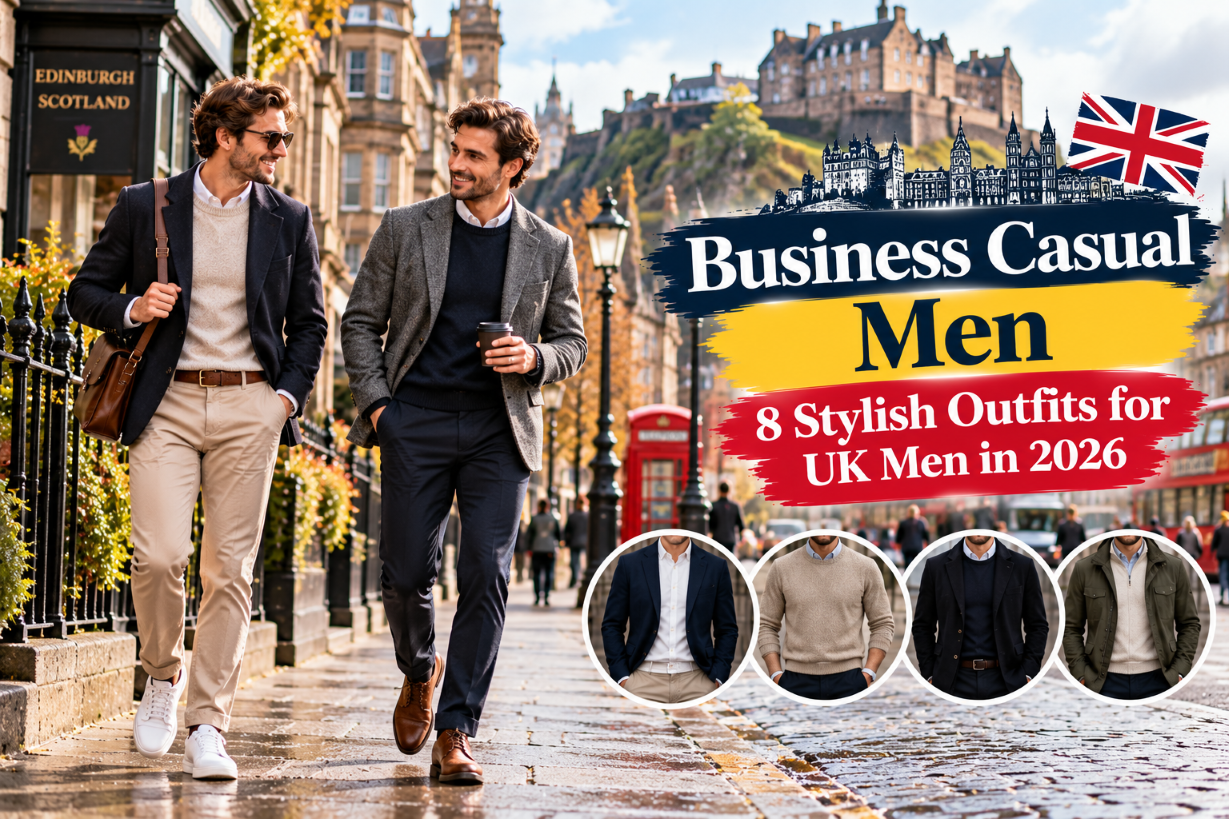
Here’s what nobody tells you about business casual: the guys who get it right aren’t following a rulebook. They’ve just stopped overthinking it.
That said, most men still get this wrong in 2026 — and it’s almost always in the same two directions. Either they show up in a full suit with a tie and look like they’ve wandered in from a different decade, or they arrive in rumpled chinos and a shirt that last saw an iron sometime during the previous government. The sweet spot sits in the middle, and once you find it, you’ll never stress about getting dressed for work again.
Whether you’re in the office three days a week, working from a shared space, or navigating a workplace that’s finally loosened its collar, here are eight outfit combinations that actually work — plus the pieces worth buying to build them.
What Does Business Casual Even Mean Anymore?
It varies. A lot.
A tech startup’s idea of business casual looks nothing like a financial services firm’s version, and neither of them matches what a mid-size marketing agency considers acceptable on a Thursday. But there are some constants across almost every workplace: no graphic tees, no trainers that look like they’ve done a 5k, no visible creases in your shirt from where it’s been sitting in a ball at the bottom of your bag.
What business casual actually means, at its core, is structured pieces worn in a way that reads as intentional rather than accidental. Trousers with a proper shape to them. Shirts that fit your body instead of hanging off it. Footwear that suggests you thought about it for at least thirty seconds. You’re not wearing a tie unless someone asks you to, and you’re not wearing a hoodie unless your CEO wears one unironically (and even then, maybe don’t).
The best way to decode your specific workplace is to watch the people you actually respect — not the CEO who wears full Savile Row to a standing meeting, and not the person who’s clearly testing what they can get away with. Find the senior people who seem comfortable and confident. They’re your benchmark. I spent my first three weeks at a new job doing exactly this before I bought a single new piece of clothing, and it saved me from buying the wrong things entirely.

The foundation of most business casual outfits—quality chinos in navy, grey, and stone are non-negotiable

A crisp oxford cloth shirt is the workhorse of business casual—versatile enough to pair with almost anything

For days when you need to look sharper, wool trousers offer structure and a polished finish
Infinity Leather, Men’s Wool Blend Tweed Trousers £59.99 (22% OFF — was £76.99)
Blazers, Trousers, Shirts — Getting the Basics Right
Start with the blazer, because it does more work than any other piece in a business casual wardrobe.
A single-breasted blazer in navy, charcoal, or a subtle check can lift almost any combination underneath it. But the fit has to be right — shoulders sitting exactly at the edge of your shoulder bone, sleeves ending at the wrist bone, length hitting roughly mid-hip. An expensive blazer that doesn’t fit properly looks worse than a £90 high-street option that does. This is not a small thing. I’ve watched people in genuinely beautiful jackets look sloppy because the shoulders were half an inch too wide, and it undermines everything else they’re wearing.
Trousers split into two useful categories here. Chinos are the casual end: comfortable, available in a range of colours, forgiving on fit. Wool trousers sit above them — they hold a crease, they read as more considered, and grey wool trousers with a white shirt and a navy blazer is honestly one of the cleanest combinations in men’s dressing. Full stop.
Shirts are where most men quietly go wrong. Too tight across the chest, too much fabric pooling at the sides, sleeves at the wrong length. The fabric should lie flat against your chest without pulling at the buttons, your arms should move freely, and when you reach for something on a high shelf the shirt shouldn’t ride up. Oxford cloth works. Poplin works. A lightweight wool works in cooler months. What doesn’t work is wearing any of them with visible creases.

The foundation piece—a well-fitted navy blazer works with almost every business casual combination

A white dress shirt is the ultimate neutral that pairs with blazers, trousers, and chinos
M&S, Slim Fit Luxury Cotton Double Cuffed Dress Shirt White male £45

Navy chinos are the workhorse trouser—versatile, comfortable, and appropriate for most business casual settings

A charcoal blazer offers more visual interest than navy while remaining completely professional
Shoes Are Not an Afterthought
People notice your shoes. Maybe not consciously, but they do — and worn-out or mismatched footwear quietly undermines everything above the ankle.
For business casual men, the reliable options are Oxford shoes (the classic closed-lacing style), Derby shoes (slightly more relaxed, with the lacing sitting on top), and leather loafers. Clean Chelsea boots work too, depending on your industry. What doesn’t work: trainers that look like you’ve just come from the gym, anything visibly scuffed, anything with obvious logos or neon detailing. Slip-ons and boat shoes occupy a grey area — they can work in genuinely casual environments, but they’re a gamble if your workplace is even slightly traditional.
Colour-wise, black, brown, tan, and dark burgundy cover almost every combination you’ll encounter. Black is formal and clean. Brown and tan feel warmer and slightly more relaxed. Burgundy (actually, that’s not quite right — it’s closer to oxblood, a deep reddish-brown) is the bolder choice, but it works well with grey and navy. Avoid anything too fashion-forward unless you genuinely know what you’re doing.
Buy a tin of polish. Use it.

The classic choice for business casual—black leather oxfords pair with almost any outfit

A more relaxed option that still reads as professional—perfect for less formal business casual environments
Clarks, Men’s Banstead Lo Tan Leather Loafers £63 (30% OFF — was £90)

Slightly more relaxed than oxfords but still completely professional—brown leather works with almost everything
Accessories Are Where Personality Lives
A proper leather belt that matches your shoe colour (or at least sits in the same colour family) is not optional. Everything else — watch, pocket square, socks — is where you get to make the outfit yours without anyone being able to complain about it.
Watches are worth mentioning because a lot of men either skip them entirely or go too sporty. A simple watch with a clean dial and a leather or plain metal strap adds something to an outfit that’s genuinely hard to explain until you see it. It makes the whole thing look considered rather than assembled. You don’t need to spend a lot — a clean, unfussy design at any price point does the job far better than something oversized or heavily branded.
What about socks? Wear interesting ones. Nobody else will see them, but you’ll know they’re there, and that kind of small private detail does something good for how you carry yourself. A colour that picks up something in your shirt, or a subtle pattern against plain trousers — it’s a low-stakes way to have a bit of fun with an otherwise serious outfit.

A simple, clean watch instantly elevates any business casual look and adds intentionality
8 Outfits That Actually Work
Enough setup. Here are eight combinations you can build right now, treat as templates, and adjust based on what you own and how formal your office actually is.
Outfit 1: The Classic Navy
Navy blazer + white Oxford shirt + grey chinos + black leather oxfords + brown leather belt. This is the safest play in business casual men’s dressing, and it earns that reputation honestly — it works every single time, in almost every office environment, without looking like you tried too hard or not hard enough. When in doubt, this is the one to reach for.
Outfit 2: The Charcoal Smart
Charcoal blazer + light blue shirt + navy chinos + tan loafers + tan leather belt. Light blue does just enough to break up the darker tones without becoming the point of the outfit. The tan loafers nudge it slightly away from formal, which is exactly right for workplaces that lean relaxed without being sloppy.
Outfit 3: Monochrome Grey
Grey wool blazer + white shirt + grey wool trousers + black oxfords + black leather belt. Sharper than it sounds. Matching grey pieces read as intentional rather than accidental, especially when the fabrics are different enough to create subtle contrast. Add a pocket square in a warm tone if you want to stop it feeling too cold.
Outfit 4: The Textured Mix
Navy blazer + textured knit shirt (waffle or herringbone weave, not a pattern) + stone chinos + brown leather oxfords + tan belt. Texture does the work that colour and pattern usually do, which makes this a smart move for anyone who finds patterned shirts a bit much. Works particularly well in creative industries.
Outfit 5: No Blazer Required
Cream knit jumper over a white shirt (collar showing) + charcoal wool trousers + brown oxfords + brown belt. A good quality knit jumper worn over a collared shirt is one of the most underrated combinations in business casual men’s dressing, especially from October onwards when offices get cold and everyone else is reaching for their worst cardigan.
Outfit 6: Subtle Pattern
Navy blazer + small-check shirt + navy chinos + tan loafers + tan belt. The navy-on-navy pulls the whole thing together and stops the check feeling busy. Keep the check small and the colours muted — this is not the outfit for your loudest shirt.
Outfit 7: The Warmer Palette
Camel blazer + cream shirt + chocolate brown chinos + tan oxfords + tan belt. This combination works brilliantly if you have warm skin undertones, and it reads as genuinely approachable rather than corporate, which matters more than people admit in certain client-facing roles.
Outfit 8: Contemporary Minimal
Navy blazer + plain white t-shirt + grey chinos + clean minimal trainers (not gym shoes) + brown belt. Yes, really. In a genuinely casual workplace, this works — the blazer carries enough weight to make the t-shirt feel like a choice rather than a default, and clean minimal trainers feel contemporary in a way that oxfords sometimes don’t. This is the 2026 version of smart casual rather than strict business casual, so read the room before trying it on a day that matters.
These eight outfits are frameworks, not instructions. Swap colours based on what you already own, adjust formality based on your specific office, and get things altered if they’re close but not quite right. The only non-negotiable is fit.
A Formula Beats a Wardrobe Full of Mistakes
Two blazers, four pairs of trousers in neutral tones, six shirts, two pairs of shoes. That’s a business casual wardrobe that covers almost every situation you’ll face. It’s not about volume — it’s about pieces that work together without requiring much thought on a Tuesday morning when you’ve got forty minutes before you need to leave.
Get the fit right on each piece. Keep your shoes clean and polished. Iron your shirts or hang them in the bathroom when you shower (this actually works). Those three things alone will put you ahead of most men in most offices, which is a depressingly low bar but also genuinely encouraging news if you’re starting from scratch.
Business casual men’s style isn’t about dressing to impress anyone in particular. It’s about removing the friction from getting dressed and showing up looking like someone who has, at minimum, thought about it for five minutes. That’s genuinely all it takes — and once the wardrobe is built, those five minutes become two.
Hey savvy shoppers! When the items in our articles catch your eye and you decide to buy through our links, we may earn a small commission at no extra cost to you. Think of it as a way of supporting us in bringing you the best content!
Frequently Asked Questions
Can men wear jeans for business casual in 2026?
It depends entirely on the company. Dark, well-fitted jeans with no distressing can pass in genuinely relaxed workplaces, but chinos are a safer bet if you’re unsure. When in doubt, ask or observe what senior colleagues wear on a regular Tuesday.
Do you need a blazer for business casual?
No. A quality knit jumper over a collared shirt with wool trousers reads as completely professional. The blazer helps, but it’s not a requirement. What matters more is that your clothes fit properly and look intentional.
What shoes work best for business casual men?
Oxford shoes, Derby shoes, leather loafers, and clean Chelsea boots all work well. The condition of the shoe matters as much as the style — scuffed or unpolished shoes will undermine an otherwise good outfit. Stick to black, brown, or tan leather.
How should a business casual blazer fit?
The shoulder seam should sit right at the edge of your shoulder bone — not hanging over, not pulling inward. Sleeves should end at your wrist bone. The hem should hit roughly mid-hip. If even one of these is off, get it altered. A £100 blazer that fits well beats a £400 one that doesn’t.
Is a white t-shirt acceptable in a business casual office?
In a genuinely casual workplace, yes — especially under a blazer. The blazer does the heavy lifting. Without one, a plain white tee usually crosses into too casual for most offices. Read your room before trying this.



 No products in the cart.