

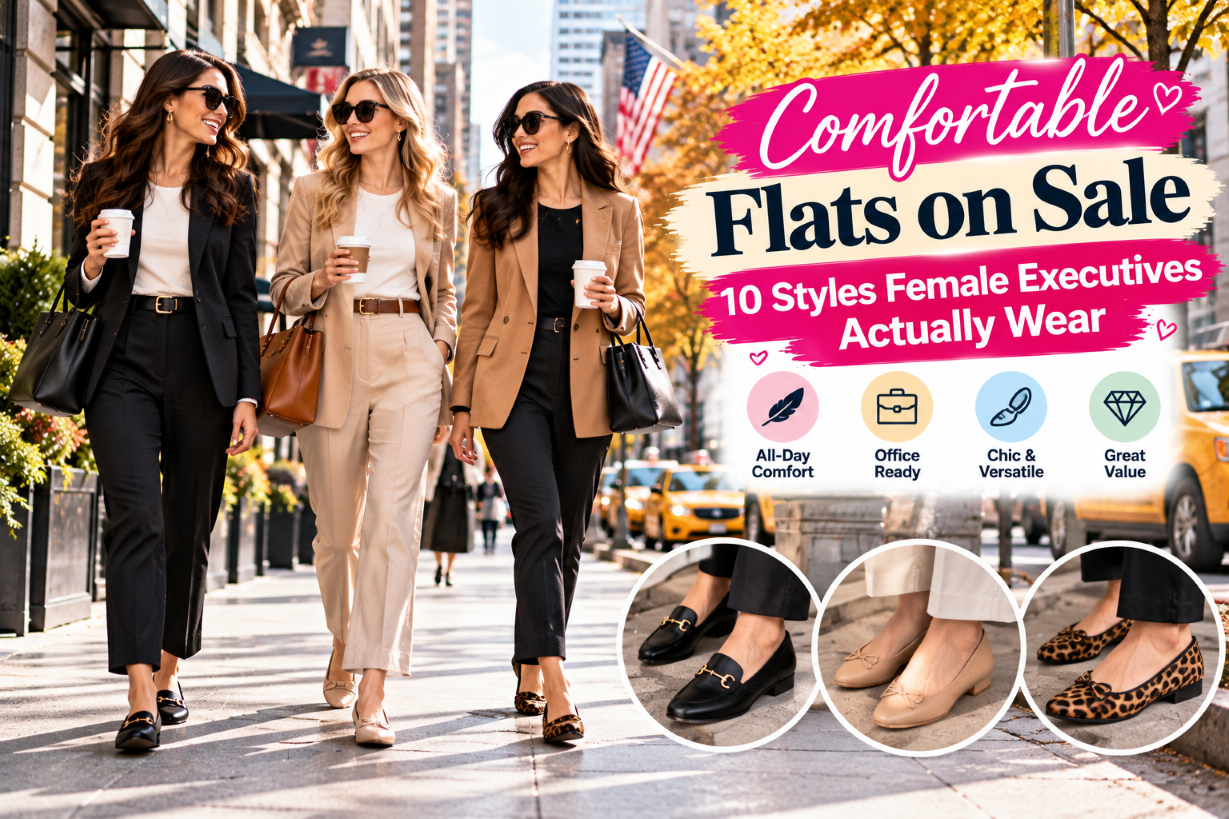
Last Tuesday I watched a senior partner at a major law firm move through a full day of client meetings in what looked like ballet flats. By 5 p.m. she was still standing tall, not wincing. Not shifting her weight every thirty seconds. I’ve thought about those shoes ever since.
Here’s the thing most shoe guides won’t say upfront: the flat market has genuinely changed. Options exist now that deliver real arch support, quality construction, and the kind of understated look that reads competent in a boardroom—and right now, a lot of them are discounted between 20 and 40 percent. That combination doesn’t come around constantly.
Why Your Feet Are Doing Real Work
Nobody warns you about this when you take your first office job. A woman logging a standard eight-hour workday—moving between meetings, walking to lunch, doing a site visit—covers somewhere between 8,000 and 10,000 steps. That’s conservative. Your shoes aren’t just accessories at that point; they’re load-bearing equipment, and when they fail you, everything else starts failing too: your posture goes first, then your focus, and by mid-afternoon you’re not thinking about Q3 projections, you’re thinking about whether you have a bandage in your desk drawer. A flat with actual structure and real arch support changes that equation entirely. You can concentrate on the work instead of your feet.
The executives I’ve spoken with all land on the same conclusion: one pair that holds up for two years beats cycling through cheap replacements every season. And when those quality pairs go on sale? That’s the moment to move.
Five Picks That Keep Showing Up in Real Closets
These aren’t styled for a catalog shoot. They’ve been worn through actual workdays.

Classic ballet flat with arch support for all-day office wear
Aerosoles, Bell Women’s Ballet Flats $62.99 (20% OFF — was $79)
The ballet flat is the baseline—and I mean that as a compliment. What separates a good one from a painful one is almost entirely the insole: you want actual padding, not a thin layer of fabric stretched over a hard shell, plus a leather upper that will gradually shape itself to your foot. Black works twelve months a year with trousers, dresses, and everything in between. The versions worth buying also have a reinforced heel counter so the back doesn’t collapse into a sad little slouch by month four.

Structured loafer with all-day support for executive wardrobes
Andrea, Women’s Professional Leather Moccasins Ultra Comfort Work Shoes white… $104
Loafers have quietly become the most reliable shoe in professional dressing. They look intentional without announcing themselves, they’re comfortable enough that you stop thinking about your feet after the first hour, and they work across industries—law, finance, tech, nonprofits—without reading as either too casual or too stuffy. The material detail that matters most here is the insole: genuine leather, not a flimsy synthetic lining. Your feet can tell the difference, and so can the shoe’s lifespan.

Modern pointed flat for sophisticated office style
More polish than a loafer, more edge than a ballet flat. That’s the pointed-toe flat’s whole value proposition, and honestly it delivers—the silhouette elongates the leg, reads as intentional rather than thrown-together, and works equally well with slim trousers, pencil skirts, and midi dresses. Because the shape is inherently tailored, even mid-range versions tend to look more expensive than they are. Memory foam insoles have become common in better pointed-toe styles, and they’re worth seeking out specifically.

Soft suede flat with arch support for all-day comfort
Birkenstock, Women’s Oswego Suede Leather Slip On Shoes beige EU 42 female $111 (23% OFF — was $145)
Suede is forgiving in a way leather isn’t, at least not right away. It molds faster, feels softer from the first wear, and in neutral tones—tan, warm gray, navy—it functions as a more interesting alternative to basic black without reading as a statement piece. Yes, suede needs a brush and occasional weather-proofing spray. Most people who wear suede flats regularly say that maintenance takes about four minutes every few weeks and is completely worth it. I’d agree.
Not every day calls for the same shoe. Sometimes you need something that works for a board presentation and a client dinner without a wardrobe change in between—an embellished flat with a subtle chain detail or restrained metallic threading handles that transition without veering into costume territory.
Want More Range? Start Here.
Once you have a black flat and a loafer sorted, the useful next question isn’t “what else do I need?” It’s “what situations am I not covered for?”

Gold or silver flat for polished workwear versatility
A metallic flat sounds like a gamble. It isn’t. Gold pairs with jewel tones, earth tones, and warm neutrals in a way that feels elevated rather than flashy. Silver works with pastels, cool grays, and anything in the blue family. The silhouette stays clean—the finish is doing the work, not the shape—so both read as professional in client-facing situations rather than like something borrowed from an evening bag.

Subtle pattern flat for personality within professional dress codes
Luna Selene, Women’s Garland Burgundy Red Patent Leather Croc Print Loafer Flat… $298
If your office has any room in the dress code, a patterned flat is one of the smarter investments you can make—not because it’s flashy, but because it multiplies outfits. A refined animal print or classic geometric against a neutral wardrobe can feel like four or five different looks depending on what you pair it with. Keep the pattern restrained (we’re talking subtle, not souvenir-shop) and let it breathe against simpler pieces.

Structured oxford flat for contemporary office style
Oxford-style flats are the right call for creative industries, tech, and companies where traditional workwear feels stiff. The laced-up detail looks deliberate without being fussy. In more conservative settings, black or navy versions still pass—it’s mainly the neon colorways you’d want to avoid if the office skews formal.
What to Actually Check Before You Buy
Comfort is personal. A flat that works perfectly for your colleague might wreck your feet in an hour, and the reverse is equally true. Here’s what I look at now, after going through more pairs than I care to count before landing on the right ones.
Arch support beats cushioning. More padding doesn’t automatically mean more comfort—a contoured insole that follows the natural curve of your foot will feel better at hour seven than a squishy flat with no structure underneath. Look for “contoured insole,” “memory foam with arch support,” or “orthopedic design” in the product description. If the insole is just a thin foam sheet glued to a hard base, skip it.
Check the heel cup. It should feel snug without squeezing. A well-designed heel cup stops your foot from sliding forward, which is what causes the toe-box blisters most people blame on the shoe being too small. This matters especially if you have narrow heels.
Flex it at the right place. Hold the flat at the toe and the heel and bend it. It should flex at the ball of the foot, not in the middle of the sole. A sole that folds completely in half is too thin to support you through a full day; a completely rigid sole will make your foot work overtime to walk naturally. You want flex where your foot actually bends and structure everywhere else—that is the balance worth paying for.
Try them on in the afternoon. Feet swell over the course of the day, so morning shoe shopping can mislead you into buying a pair that fits at 9 a.m. and pinches by 2 p.m. Walk around the store for at least five minutes in both shoes. If there’s any question about comfort in the store, that question will become a certainty at work.
Getting the Price Right
Sale season peaks twice a year: late winter and late summer. But deals surface in between if you know where to watch.
Department stores run flash sales and early-access markdowns throughout the year—signing up for their emails is genuinely worth it, annoying as that sounds. Outlet sections of premium brands sometimes offer real value, though selection varies wildly and you may need to check back repeatedly before finding your size in a style you actually want.

Quality work flats at accessible price points
Price and comfort don’t have a clean relationship. A $200 flat with poor construction will feel worse than an $80 flat with a thoughtfully designed insole. That said, longevity tends to track with price. Do the math on cost-per-wear rather than sticker shock: a $120 flat worn 200 times a year for two years costs $0.30 per wear. A $50 flat that gives out after six months costs more per wear despite the lower upfront number. Investing more upfront usually wins the calculation.
The flat worth owning is the one you stop noticing. You’ve been on your feet for six hours, you’ve run between three buildings, and somewhere around 4 p.m. you realize your feet feel fine. That’s not an accident—that’s a well-made shoe doing its job. Start with a black ballet flat and a structured loafer, get those right, and build from there. Everything else is optional. Those two will cover you most days, and when they go on sale, buy two pairs.
Some links on this page are affiliate links: if you buy through them we may earn a small commission at no extra cost to you. We only recommend products we would buy ourselves.
Frequently Asked Questions
What makes a flat actually comfortable for a full workday?
Genuine arch support matters more than thick padding. Look for a contoured insole, a snug heel cup that stops your foot from sliding forward, and a sole that bends at the ball of your foot—not in the middle. Leather or suede uppers also help because they breathe and mold to your foot over time.
When is the best time to buy comfortable flats on sale?
The deepest discounts typically hit twice a year: late winter (January through February) and late summer (August through September). Department store loyalty programs and email lists will alert you to flash sales in between those windows.
Are expensive flats actually more comfortable than budget ones?
Not automatically—but they tend to last longer. A $120 flat worn 400 times over two years costs about $0.30 per wear. A $50 flat that falls apart in six months costs more per wear. Think cost-per-wear, not sticker price.
What flat styles work across the most professional settings?
A black leather ballet flat and a structured loafer in a neutral tone will cover the majority of professional environments, from law firms to tech offices. Pointed-toe flats add polish without much extra effort, and a metallic flat can do serious work in client-facing situations.
Should I size up when buying flats?
Try them on in the afternoon when your feet are at their largest—feet swell throughout the day, and a pair that fits perfectly at 9 a.m. can pinch by 3 p.m. Walk around for at least five minutes in the store. If they’re uncomfortable before you leave, they won’t improve at work.



 No products in the cart.