

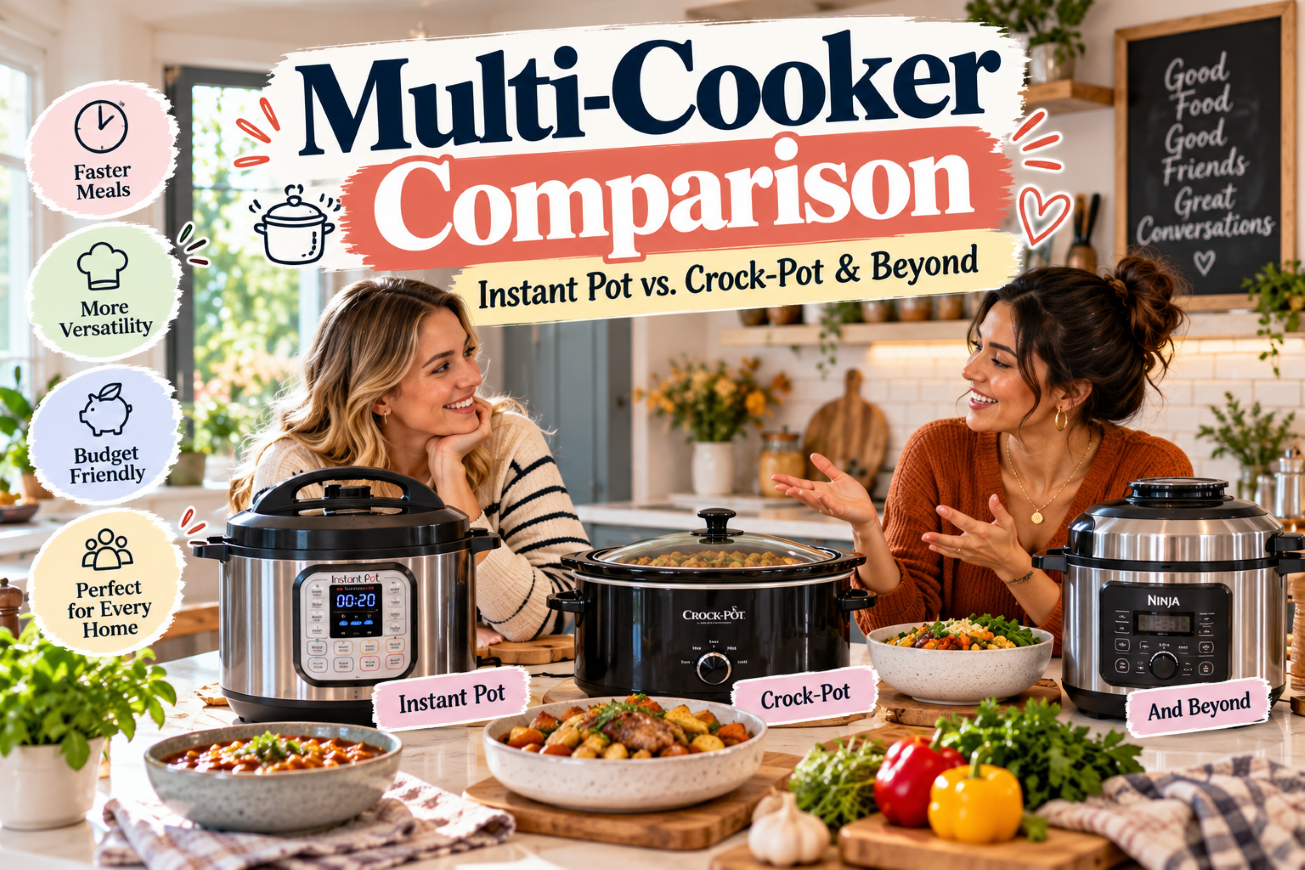
Three months. Four appliances. One kitchen that smelled like pot roast for most of January.
Here’s what I learned before testing a single recipe: the Instant Pot vs. Crock-Pot debate is mostly the wrong question. The right question is whether you’re a plan-ahead cook or a forgot-to-defrost-again cook, because that single habit predicts which appliance you’ll actually reach for at 5:30 p.m. on a Wednesday. Everything else — price, features, brand — is secondary to that.
I own four multi-cookers now, which my partner considers a problem and I consider research.
So What Even Is a Multi-Cooker?
Think of it as a pressure cooker, slow cooker, rice cooker, and steamer crammed into one metal pot and told to get along. Most models let you toggle between methods — high-pressure cooking for speed, slow cooking for flavor, steaming for vegetables, sautéing when you want to brown something before sealing the lid. The pitch is one appliance that handles Sunday pot roasts, Tuesday pasta, and weekend meal prep without requiring a cabinet full of single-purpose gadgets.
But here’s the honest part: you don’t actually need one. I know people who cook incredible food with nothing but a Dutch oven and some patience, and their dinners are better than anything I’ve made under pressure. A multi-cooker is a convenience tool — designed for the person who wants to load chicken and salsa at 7 a.m. and eat tacos at 6 p.m., or for anyone managing a household where someone works late, someone else has practice, and dinner needs to happen anyway. If you already have a cooking routine that works, a multi-cooker is a nice addition. If your evenings are chaos, it might actually change things.
Instant Pot vs. Crock-Pot: What the Fight Is Really About
These two aren’t really competing products. They solve different problems. But everyone compares them, so here’s the honest breakdown.
The Instant Pot made pressure cooking approachable by wrapping it in digital controls and about seven redundant safety features. Traditional stovetop pressure cookers had a reputation — not entirely undeserved — for being stressful to operate. The Instant Pot changed that by adding locking lids that physically can’t open under pressure, automatic steam-release vents, and preset programs that take the guesswork out of timing.
A pot roast that takes three hours in a slow cooker takes around 45 minutes under pressure. Dried beans go from a two-hour project to 30 minutes. That matters on a Tuesday when you forgot to plan. The tradeoff is a real learning curve: you need to understand quick release versus natural release, minimum liquid requirements, and the fact that pressure-cooked meat — while tender — has a slightly different texture than slow-cooked meat. Some people love it. Others find it a touch rubbery if they go even five minutes over.
The Crock-Pot does one thing.
It does that one thing extremely well. Low, steady heat over 6-10 hours breaks down connective tissue in ways that high-pressure cooking can’t quite replicate — pot roasts that fall apart with a spoon, chili with actual depth, ribs that don’t need a knife. The texture is genuinely superior for braises and stews. And the interface is simple enough that there’s almost nothing to learn. You put food in. You turn it on. You come back later. The downside is time: if you forgot to prep this morning, you’re not eating slow-cooked anything tonight. Classic Crock-Pot models also don’t sauté, which means you’re either pre-browning meat in a separate pan (worth it) or skipping that step (you’ll notice).
My actual take: buy an Instant Pot if your schedule is unpredictable and you need dinner fast. Buy a Crock-Pot if you’re a morning person who preps before work and cares more about texture than speed. If you can only have one and you genuinely don’t know which camp you’re in, go with the Instant Pot — it can slow-cook too, just not quite as well as a dedicated slow cooker.

Instant Pot-style pressure cooker for fast weeknight cooking
Instant, Duo Plus Aluminum/Stainless Steel Digital Pressure Cooker 8 qt… $159.99

Crock-Pot-style slow cooker for all-day cooking
MOOSOO, Digital Programmable Slow Cooker $109.99 (45% OFF — was $199.99)
Size Matters More Than the Specs Sheet Suggests
I made the mistake of buying a 3-quart pressure cooker first. Looked compact on the website. In practice, I couldn’t fit a whole chicken in it, which is the first thing I wanted to make. Size is the spec people research last and regret most.
One or two people: A 3-quart model heats fast and keeps portions reasonable. You won’t be eating the same chili for nine days. The constraint is that batch cooking becomes difficult, and some recipes simply won’t scale down.

Smaller multi-cooker ideal for individuals and couples
Families of three to five: Six quarts is the sweet spot — big enough for dinner plus leftovers, small enough to pressurize quickly and not dominate the counter. This is the size that actually gets used regularly because it fits real-world meals without being absurd.

Versatile mid-size multi-cooker for typical family meals
Larger families and meal preppers: Eight quarts or above. You’ll wait longer for it to pressurize and you’ll need counter real estate, but cooking for six people or prepping a full week of lunches in one go genuinely requires the space. Don’t try to cram a family of seven into a 6-quart — it ends with the lid struggling and uneven cooking.
Large capacity multi-cooker for big families and meal prep
Instant, Duo Plus Stainless Steel Digital Pressure Cooker 6 qt Black/Silver $139.99
Which Features Are Actually Worth Paying For?
Multi-cooker spec sheets are written to impress, not to inform. Here’s what I’d actually look for, and what I’d ignore.
Cooking modes: Pressure cooking and slow cooking are the two that get used. Sautéing is genuinely useful — browning meat directly in the pot before sealing the lid takes five minutes and makes a real difference in flavor. Beyond those three, the extras (yogurt mode, sous vide, air frying attachments) mostly go untouched after the first novelty week. I’ve made yogurt exactly once.
Pressure settings: Two levels — high and low — is enough. High pressure (around 15 PSI) cooks fast; low pressure (5 to 8 PSI) is gentler for fish, eggs, and delicate vegetables. Some models advertise four or five pressure settings. You will never use four or five pressure settings.
Controls: Digital displays show you exactly what’s happening and allow precise timing. Mechanical dials are simpler and have fewer components to fail — I’ve seen enough posts about Instant Pot control panels dying after two years to think about this. Actually, that’s not quite right: most digital units last well beyond two years, but it does happen more than the manufacturer would like you to know. If reliability over a decade matters more to you than precision, dial wins.
Inner pot material: Stainless steel. Non-stick coatings chip, and nobody wants that in their soup. Ceramic looks nice and chips easier. Stainless steel is boring and correct.
Safety features: Any pressure cooker worth buying will have a locking lid, multiple pressure release valves, and an overpressure vent. These should be standard. If they’re not listed in the product specs, move on.
Warranty: One year minimum on parts and labor. Read what’s actually covered — some warranties quietly exclude the inner pot and lid, which are the parts most likely to need replacing.

Feature-rich multi-cooker with essential safety and control features
User-friendly slow cooker with convenient dishwasher-safe components
Crock-Pot, 8 qt Black/Silver Stainless Steel Programmable Slow Cooker $69.99 (12% OFF — was $79.99)
The Tricks That Actually Change Your Results
Getting a multi-cooker is step one. Learning to use it without ruining dinner three times first is step two. These are the things I wish someone had told me.
Liquid ratios trip everyone up at first.
Pressure cookers need liquid to generate steam — at minimum, 1 cup for the first 5 minutes of cooking time, plus half a cup for every 5 minutes beyond that. Too little and the cooker never pressurizes properly. Too much and you end up with waterlogged chicken that tastes like warm sadness. If your first few meals come out soupy, cut the liquid by a third and try again.
Natural release vs. quick release:
Quick release means opening the pressure valve immediately after cooking, which stops everything fast — good for vegetables or pasta that overcook in minutes. Natural release means leaving the valve closed and letting the pressure drop on its own over 10-20 minutes, which lets the food keep cooking gently and develops more flavor in stews and braises. Most recipes tell you which to use. If yours doesn’t, default to natural release.
Brown the meat first.
Always. The sauté function exists for this. Five extra minutes of browning before you seal the lid produces a depth of flavor that no amount of cooking time under pressure can compensate for. This step separates meals that taste like something from meals that taste like convenience food.
What happens if you overfill it? Nothing good. The max fill line is there because overfilling prevents proper pressurization and can push liquid through the release valve when you open it. Fill to the line. That’s the whole rule.
Frozen meat:
Add roughly 50% to the listed cook time. So a recipe calling for 15 minutes with fresh chicken needs about 22-23 minutes from frozen. It’s not exact, but it’s close enough that dinner will actually be cooked through.

Useful accessories to expand multi-cooker capabilities
Kuhn Rikon, 2-in-1 Steamer For Duromatic Pressure Cooker $34.95 (20% OFF — was $43.69)
Buy the One You’ll Actually Use
A $300 pressure cooker sitting on the highest shelf because the learning curve felt like too much on a weeknight is a worse purchase than a $60 slow cooker you use four times a week. I’ve watched people buy the most spec-loaded model available and then default back to pasta because the Instant Pot felt intimidating. That’s not a failure of the appliance — it’s a mismatch between the product and the person.
If your evenings are unpredictable and you regularly eat dinner late because you forgot to plan, get a pressure cooker. If you’re organized enough to prep in the morning and you care about the kind of texture that only comes from eight hours of low heat, get a slow cooker. If you can’t decide, the 6-quart Instant Pot Duo is the most forgiving entry point — it slow-cooks adequately, pressure-cooks well, and the learning curve flattens out after about four uses.
Most people end up using one or two functions heavily and ignoring the rest. That’s fine. The appliance is still earning its counter space.
Some links on this page are affiliate links: if you buy through them we may earn a small commission at no extra cost to you. We only recommend products we would buy ourselves.
Frequently Asked Questions
Is an Instant Pot the same as a multi-cooker?
Not exactly. Instant Pot is a brand of multi-cooker that focuses on pressure cooking. Multi-cooker is the broader category, which includes slow cookers, rice cookers, and hybrid models. All Instant Pots are multi-cookers, but not all multi-cookers are Instant Pots.
Can a slow cooker replace a pressure cooker?
They’re not interchangeable. A slow cooker takes 6-10 hours and produces better texture for braises and stews. A pressure cooker takes 30-60 minutes but requires more attention. Which one ‘replaces’ the other depends entirely on how you cook and what your schedule looks like.
What size multi-cooker do I need for a family of four?
A 6-quart model is the right size for most families of three to five. It handles a full dinner plus leftovers without taking over your counter. Go up to 8 quarts if you meal prep regularly or cook for six or more people.
How much liquid does a pressure cooker need?
At minimum, 1 cup of liquid for the first 5 minutes of cook time, plus half a cup more for every additional 5 minutes. Too little and it won’t pressurize. Too much and your food comes out waterlogged. This is the single most common beginner mistake.
Are multi-cookers actually safe?
Modern multi-cookers have multiple redundant safety valves, locking lids that physically cannot open under pressure, and automatic pressure-release vents. They’re far safer than the stovetop pressure cookers your grandparents used. As long as you don’t block the vent and you don’t overfill past the max line, you’re fine.



 No products in the cart.