

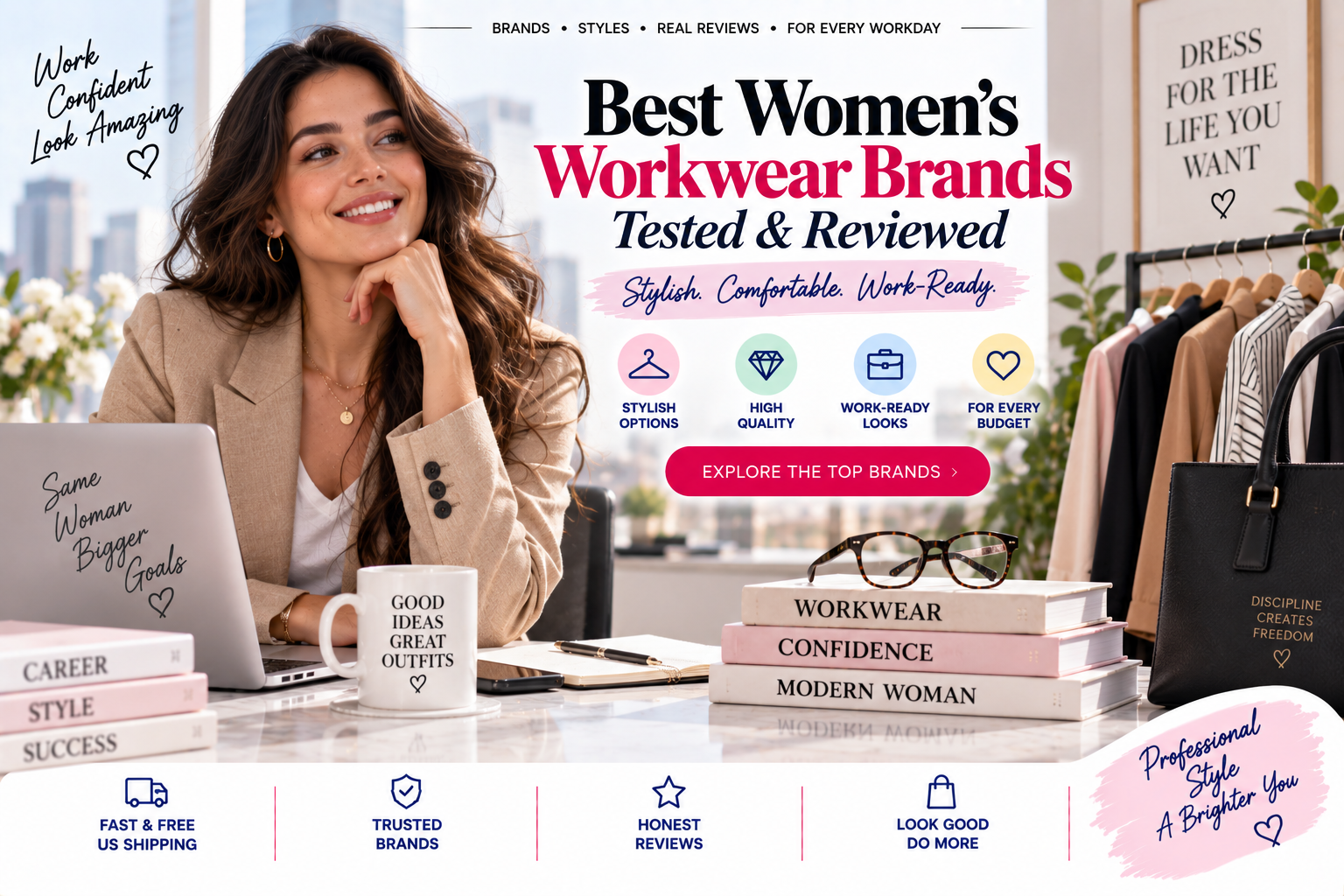
I own exactly two pairs of pants that actually fit my body. Both are from brands I’ve tested over the past five years, and I’d genuinely panic if they got discontinued. That’s the thing about women’s workwear brands that work — once you find something that doesn’t gap at the waist or ride up the second you sit down, you hold on for dear life.
Here’s what we’ve learned after enough time in conference rooms, coffee meetings, and four-hour workshops: the difference between a wearable work outfit and a costume that folds by 2 p.m. almost never shows up in a fitting room. It shows up on Tuesday afternoon when you’ve been sitting for three hours and you realize you’re either fine or you’re counting down to the moment you can change. We’ve tested everything from $40 blazers to $300 trousers, and the opinions below are the ones that survived contact with actual workdays.
How We Actually Test This Stuff
Does the fabric wrinkle the moment you sit? Do seams hold after three months of regular washing? And honestly — does it feel comfortable, or are you just tolerating it?
We also track price history, because there’s nothing worse than buying a so-called professional staple at full price and watching it drop 40% two weeks later. We know which brands have reliable seasonal discounts. We’ve learned which retailers actually honor returns when something doesn’t pan out. The pieces we’re recommending here cover different price points, different body types, and different work environments — some are investments built for three years of heavy rotation, others are the grab-it-now options when you need something fast and don’t want to overthink it. All of them have been worn by at least two people on our team through real workdays, not just tried on once under good lighting.

Essential tailored work pants that form the foundation of a professional wardrobe

Investment-quality blazer that works across multiple outfit combinations
Modenaire, Women’s Blue Belted Denim Blazer With Structured Waist And Patch… $152
Five Brands That Earn Repeat Purchases
Everlane makes trousers that fit an actual human body — the waistband doesn’t dig in, inseam length comes in real increments rather than one-size-fits-most nonsense, and you’re not paying for branding markup. Around $78 for trousers. They last longer than a season.
J.Crew Factory is our secret weapon for blazers. Full disclosure: they’re not perfect. The fabric can feel stiff fresh out of the package, sizing runs inconsistent enough that you really do need to try things on before committing, and I once ordered two of the same style in the same size and they fit noticeably differently. But their structured blazers hold their shape after a year of regular wear, and they go on sale constantly — we’ve bought them at $60-80 when full price is $158, which is honestly when they make sense and not a dollar before.
Why do Banana Republic trousers get recommended by people who’ve actually worn them for years and not just styled them once for a photo? Because they have enough stretch that you’re not fighting the fabric all day, and their button-ups don’t pull across the chest the way cheaper options inevitably do.
Uniqlo earns its spot because their basics are genuinely good basics. Rayon blend trousers that wrinkle less than you’d expect. White button-ups that don’t go see-through. At $30-40 per piece, they’re the thing you buy to round out what you already own, not the anchor of a look.
Loft is where we go when we need something that walks the line between current and timeless. Their petite sizing is functional rather than an afterthought, and their clearance section turns up genuinely good finds if you’re patient enough to check it regularly. Prices run $60-100.

Reliable button-up that forms the foundation of multiple outfit combinations
Columbia, Women’s Columbia Holly Hideaway Breezy Shirt Top Black Cotton Button… $60

Classic pencil skirt for professional settings and business casual environments
STK, Cotton Stretch High Waist Pencil Cut Knee Length Women’s Skirt… $199 (38% OFF — was $321)
Spend More Here. Save There.
Not every piece needs to be an investment. The trick is knowing which category something falls into before you buy it.
Investment territory means pieces you’ll wear at least twice a week for the next two years: a well-fitting blazer ($150-250), quality trousers ($100-150), a structured bag that won’t fall apart ($200+). These are the items where fabric quality actually shows up in wear, where construction matters, and where you’ll feel the difference between spending $60 and spending $200 after about six weeks of real use. Budget territory is your workhorses — the white button-ups you buy in multiples because accidents happen, the trousers you wear when you’re not precious about them, the cardigans you keep at your desk because the office HVAC has never made sense. Expecting those to last five years is setting yourself up for disappointment; expecting them to look professional and survive a wash cycle is completely reasonable.
The mistake is treating everything the same. Wear something four days a week? Spend accordingly. Wear it once a week? Don’t.

Layering piece for temperature control and professional styling flexibility
Helly Hansen, Women’s Adore Lightweight Puffy Parka Navy XS $345

Versatile work dress that transitions easily from office to after-work settings
Kasper, Women’s V Neck Knee Length Wrap Dress blue Small female $39 (56% OFF — was $89)
Your Closet Should Be a System, Not a Pile
You’ve got the trousers. You’ve got a blazer. Now what do you actually do with them?
Treat your workwear like a system rather than a set of individual outfits. Every time you’re considering buying something new, the first question should be: how many things I already own does this work with? If the honest answer is one or two, it probably isn’t worth buying, no matter how good it looks on its own. Your basics — neutral trousers, white button-ups, blazers in colors that play well with others — need to function as building blocks, not standalone statements.
Accessories do more work than most people give them credit for. Swapping sneakers for loafers, adding a silk scarf, carrying a bag that doesn’t scream “I grabbed whatever was closest” — these things shift the same basic outfit from default to deliberate. And that feeling matters more than it probably should. When you feel like you made a choice rather than just grabbed something clean off the floor, you show up differently.
Also worth having: at least two pieces that move comfortably between your office and wherever you go after — a structured blazer that doesn’t read as purely corporate, flats that work on pavement, a bag that holds your laptop without looking like a laptop bag. These are the items that quietly make your whole week easier.

Professional footwear that works across multiple workwear outfits

Versatile work bag that holds essentials and complements professional attire
PAHAJIM, Women’s Large Tote Bag $56.99 (17% OFF — was $68.99)
Stop Paying Full Price
Most major retailers run on predictable sale cycles, and once you know them, paying full price starts to feel genuinely optional. Banana Republic and J.Crew Factory go deep in January and July. Everlane’s “choose what you pay” events are less predictable but happen several times a year, which is reason enough to be on their list. Loft’s clearance section updates weekly and is worth a quick scroll before you buy anything new from them at full price.
Sign up for emails from the brands you actually like. Yes, it’s a lot of email. But most brands offer 15-20% off your first purchase, early sale access tends to go to email subscribers first, and you’ll know immediately when something you’ve been watching drops. Check the clearance section before buying anything at full price — we’ve found current-season pieces marked down 50% simply because a color ran long or a size didn’t move as well as expected.
Patience, genuinely, pays off.

Comfortable stretch trousers that balance professional appearance with all-day wearability
Building a workwear foundation takes actual time — trying things, wearing them through days that don’t go as planned, occasionally discovering that a $200 piece works no better than a $60 one. But once you know which brands fit your body and which sale windows to watch for, getting dressed for work stops being a minor daily irritation. That’s not a small thing. I’d rather spend thirty minutes researching a trouser than spend six months quietly resenting it every time I put it on.
Some links on this page are affiliate links: if you buy through them we may earn a small commission at no extra cost to you. We only recommend products we would buy ourselves.
Frequently Asked Questions
Which women’s workwear brands are best for petite sizing?
Loft is our strongest recommendation for petite sizing — their petite line is actually designed with proportional cuts, not just hemmed-down versions of regular sizes. Everlane also offers specific inseam lengths rather than a single universal fit, which makes a real difference for shorter frames.
How do I know when to invest vs. buy budget workwear?
Track how often you’ll actually wear the piece. Anything you’re putting on four or more days a week justifies a higher spend — you’re spreading that cost across hundreds of wears. White button-ups you might spill coffee on, cardigans for the perpetually freezing office, backup trousers — those can be $30-40 and no one needs to feel guilty about it.
What are the best times of year to buy women’s workwear on sale?
January and July are the two most reliable windows. Banana Republic and J.Crew Factory both run their deepest discounts then. Everlane’s ‘choose what you pay’ events happen several times a year with little warning, so being on their email list is genuinely worth the inbox clutter.
Do expensive work trousers actually last longer than cheap ones?
Usually, yes — but only past a certain threshold. There’s a meaningful quality difference between $40 trousers and $120 trousers. Above $150, you’re often paying for branding more than construction. The sweet spot for most people is $80-130 for trousers they’ll wear regularly.
How do I build a work wardrobe that doesn’t look repetitive?
Buy neutrals first, then add one or two pieces with personality. The test before buying anything new: does this work with at least three things I already own? If not, pass. Swapping accessories — a different bag, loafers instead of heels — does more to vary an outfit than most people realize.
 No products in the cart.