

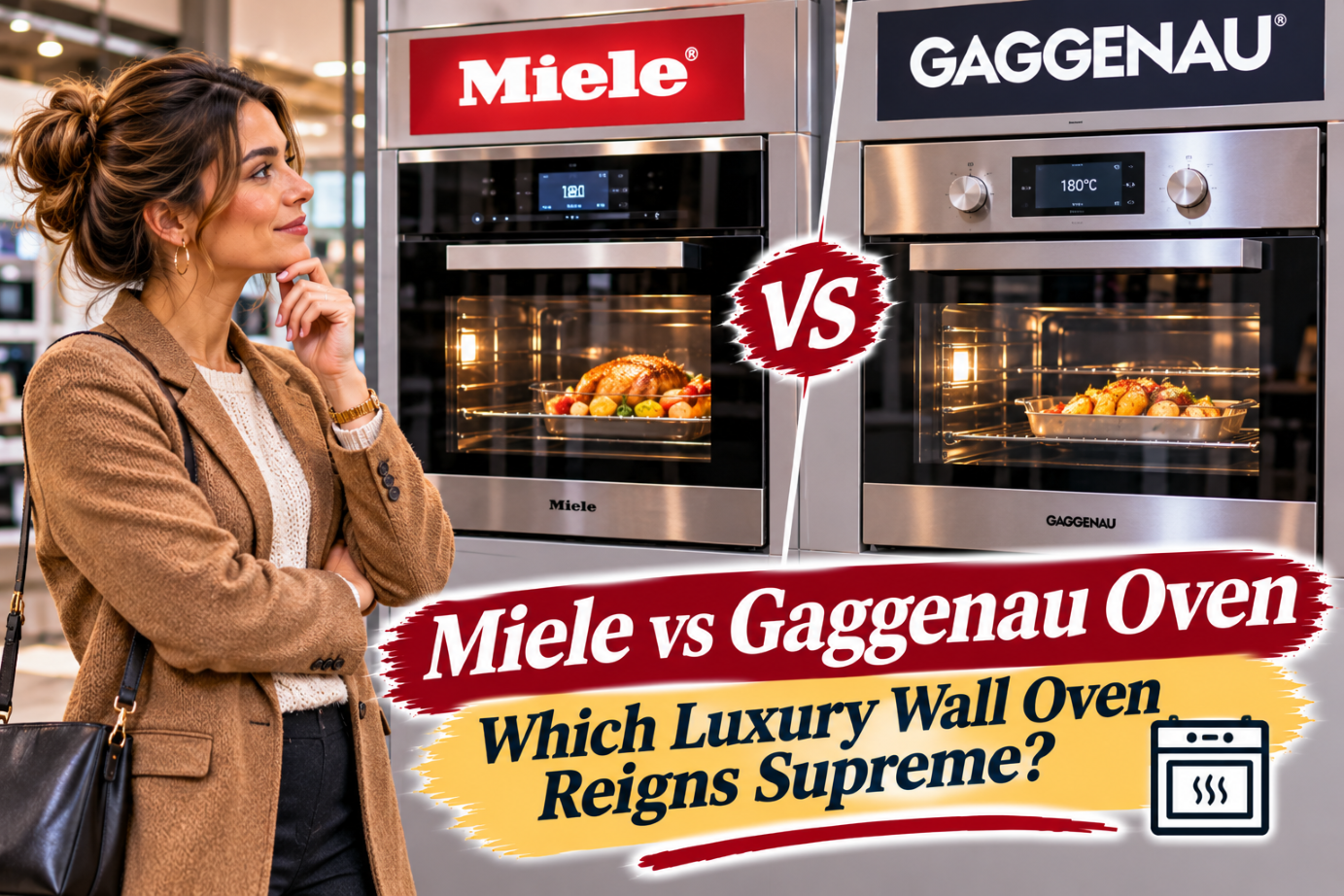
Here is the thing nobody tells you at the start of this research: by the time you’re seriously comparing Miele and Gaggenau, you’ve already made the hard decision. You’re spending real money. Both brands will outlast your mortgage. The question isn’t which one is better — it’s which one is better for you, and that answer is actually pretty simple once you know where to look.
I went through six weeks of spec sheets, owner forums, and conversations with two kitchen designers before I felt like I actually understood the difference. What I found kept coming back to one fault line: Miele is engineered around the cook, and Gaggenau is engineered around the cooking.
Two German Brands, Two Very Different Philosophies
Both Miele and Gaggenau are built in Germany, priced in the $3,500–$7,000+ range, and designed to last decades. Miele has been making ovens since 1927 and has spent nearly a century refining the same core obsession: make it work, make it last, make it easy. Gaggenau’s history is older (the company dates to the 1680s, originally making metal goods), but its identity as a precision cooking brand is a much more recent project — one that leans hard into technology, design innovation, and a kind of culinary seriousness that borders on theatrical. They’re not competing for the same customer, even though they occupy the same shelf at the showroom.
What Actually Happens When You Cook With Each One
Miele’s PerfectClimate system circulates heat so evenly that uneven browning basically stops being a problem — something I noticed immediately when reading through baker-heavy forums where people track this stuff obsessively. Their TwinPower convection and built-in temperature probe handle most of what serious home cooks need, and the interface is physical dials and buttons, not a tablet strapped to your cabinet door. Temperature holds within about ±10°F, which sounds imprecise until you realize that most home ovens swing ±25°F and nobody complains.
Gaggenau is doing something different. Their Vario Cooking System uses multiple heating elements to create distinct zones within a single cavity, so you can legitimately roast a chicken on one shelf while finishing a tart on another at a lower temperature. That’s not a gimmick for most serious cooks — it’s the whole point. Temperature precision runs around ±5°F. Their premium lines include WiFi monitoring, app controls, and a minimalist touch interface that looks like it belongs in an architecture firm. Actually, that’s not quite right — it looks like it was designed by an architecture firm, which is more or less what happened.
Does that 5°F difference in temperature precision matter? For roasting a chicken, no. For laminated pastry dough or high-hydration sourdough where oven spring depends on precise heat in the first four minutes of the bake, yes, it matters quite a bit.
The Aesthetic Question
Walk into a kitchen with a Miele oven and you might not immediately notice it. That’s intentional. The handles integrate cleanly into the door, the stainless finish is classic rather than statement-making, and the control panel reads like something designed to be used rather than admired. Miele ovens belong in a kitchen the way a good knife block belongs on a counter — present, functional, not shouting.
Gaggenau shouts, quietly.
The doors have more visual weight, the touch controls are more architectural, and the overall impression is that this appliance has opinions about your kitchen. Modern and design-forward spaces tend to respond well to this. Traditional or transitional kitchens can feel slightly at odds with it — not wrong, just a little loud.
Reliability — What Do Owners Actually Report?
Miele owners in the US have been running these ovens for 20+ years and documenting it. The failure patterns are predictable: a heating element here, a door seal there, both cheap to fix and easy to source. Miele’s service network in the US is well-established, parts are stocked, and repair technicians are familiar with the hardware. When I asked a kitchen designer in Chicago what she recommends to clients who want to stop thinking about their oven, she said Miele without pausing. Gaggenau, she said, is for clients who want to talk about their oven.
Gaggenau’s track record in American homes is shorter, though European data suggests similar durability. The real risk is in the electronics — more complex systems mean more potential failure points, and when something does go wrong, parts and labor run higher. Some owners on premium Gaggenau models report WiFi connectivity issues that are annoying rather than catastrophic. The service network is expanding but still thinner than Miele’s outside major metros.
So Which One Should You Actually Buy?
Buy Miele if you bake often, hate dealing with technology for its own sake, plan to stay in this kitchen for 20 years, or just want an oven that disappears into your life and works every single time you turn it on. The $3,500–$5,500 price range for a solid Miele single oven is also slightly more accessible than comparable Gaggenau configurations.
Buy Gaggenau if you cook multiple dishes at different temperatures simultaneously, care deeply about kitchen aesthetics, want smart features that actually function at a high level, or are building a kitchen where the appliances are part of the design statement. Budget at least $4,500 for entry-level Gaggenau, and realistically $6,000+ if you want the features that make the brand worth choosing over Miele.
One last thing worth saying: if you already own appliances from one of these brands, stay in the family. Mixing them isn’t a disaster, but Gaggenau’s sculptural finish next to Miele’s quieter stainless can feel slightly disjointed in a kitchen where every detail matters — and if you’re spending this much, every detail probably matters.
My honest take? Miele is the better oven for most people reading this. Gaggenau is the better oven for a specific kind of cook who will actually use what they’re paying for. Know which one you are before you walk into the showroom.
Some links on this page are affiliate links: if you buy through them we may earn a small commission at no extra cost to you. We only recommend products we would buy ourselves.
Frequently Asked Questions
Is Gaggenau really worth the extra cost over Miele?
It depends on what you cook. Gaggenau’s temperature precision and multi-zone cooking are genuinely useful for serious bakers and cooks who run multiple dishes simultaneously. If you mostly roast and reheat, the premium is harder to justify.
Which brand has better reliability long-term?
Miele has the longer track record in American kitchens, with owners regularly reporting 20+ years of trouble-free use. Gaggenau appears similarly durable, but its more complex electronics mean repairs cost more when they do happen.
Can I mix Miele and Gaggenau appliances in the same kitchen?
Yes, but the design languages differ enough that it can feel slightly mismatched. Both use stainless steel, but Gaggenau’s finish is more sculptural while Miele’s is more understated. Most people won’t notice, but design-forward kitchens might.
Does Miele make a smart oven with WiFi connectivity?
Some newer Miele models include app connectivity, but it’s not their focus. Gaggenau leans much harder into smart features and app-based monitoring across their premium lines.
What price range should I expect for each brand?
Miele single wall ovens typically run $3,500–$5,500. Comparable Gaggenau models start around $4,500 and climb past $7,000 for premium configurations. Both are significantly more expensive than Wolf or Thermador at similar sizes.



 No products in the cart.