

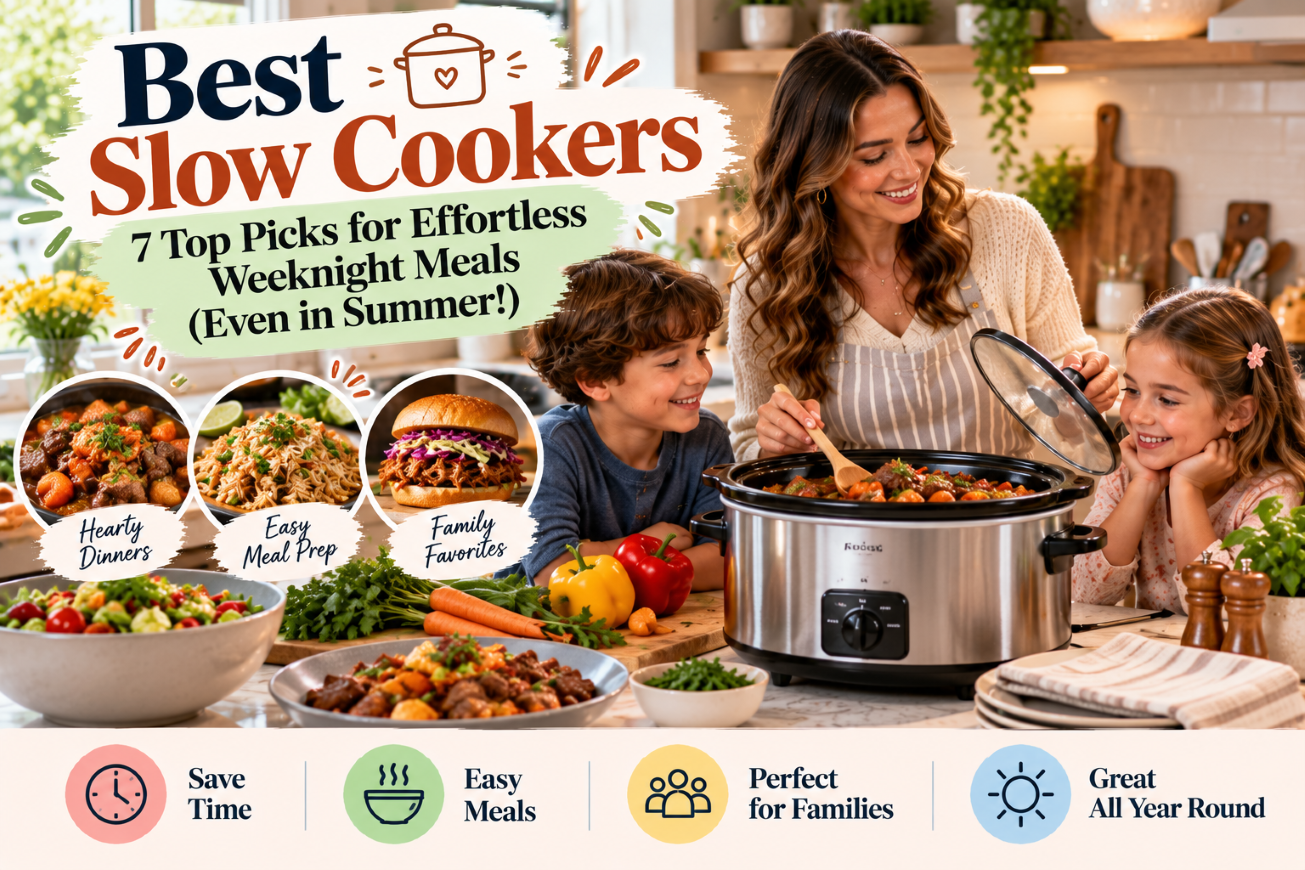
Last Tuesday at 3 p.m., I realized I hadn’t thought about dinner once. The slow cooker had sorted it out at 7 a.m.
That’s the thing nobody tells you upfront: the best slow cookers don’t just make food, they give you back your evenings. No standing over the stove, no 6 p.m. panic spiral, no takeout guilt. You load it in the morning, go live your life, and walk through the door to a kitchen that already smells like dinner. It’s the closest thing to having a personal chef that costs under a hundred dollars.
And before you assume this is purely a winter appliance — slow cooking in summer is genuinely good. Lighter broths, coconut milk curries, tomato-braised fish, pulled chicken for grain bowls. The low heat doesn’t blast delicate flavors into oblivion the way a hot oven does, and it produces about a quarter of the ambient heat. Your AC bill will survive.
Why slow cookers actually work
The honest answer is chemistry and time. Collagen in tougher cuts of meat breaks down into gelatin over several hours, which is what makes braised beef taste silky rather than chewy. High heat can’t do this — it tightens muscle fibers before they have a chance to relax. Eight hours on low does what no amount of high-heat cooking can replicate, and it does it while you’re sitting in a meeting or running errands or, frankly, doing nothing at all, which is its own valid use of time. Flavor compounds also develop more completely at low temperatures, which is why slow cooker meals often taste more “cooked” than food that spent the same number of hours under high heat. That’s not magic — it’s just physics being patient.
The picks

Essential baseline model for families or batch cooking; digital control and programmable settings for reliability
Hamilton Beach, Programmable Defrost 6-Quart Slow Cooker with Temperature Probe $74.99
This is the one most people should buy. Six quarts handles four people comfortably with enough left over for lunch the next day, and the digital display actually tells you what temperature you’ve selected rather than making you guess between vague dial positions. The delay-start function is where the real value is — set it before you leave the house and it starts cooking on its own schedule, not yours.

Ideal for couples, small families, or apartment living; efficient size that heats evenly and stores easily
Not everyone is feeding a family. If you cook for one or two people, a smaller model heats more evenly for smaller portions and won’t leave you swimming in soup for a week. Stainless steel exterior holds up better over years of use than plastic-heavy designs, and it doesn’t collect scratches the same way.

Smart features for busy schedules; programmable timer automatically switches to warm setting after cooking time ends
Crock-Pot, 8 qt Black/Silver Stainless Steel Programmable Slow Cooker $69.99 (12% OFF — was $79.99)
The automatic warm setting is what separates a good programmable slow cooker from an annoying one. Load it before an eight-hour workday, and when the cook time ends it drops to a holding temperature rather than continuing to cook your food into something dry and sad. Some models in this range also let you sequence heat levels — start on high for an hour, then finish on low — which is genuinely useful for recipes that need an initial burst of heat to get going.
Practical design for serving and cleanup; removable insert works as a serving dish and simplifies washing
Hamilton Beach, 10-qt. Oval Slow Cooker $74.95 (29% OFF — was $104.99)
Oval shapes fit whole cuts of meat — a pork shoulder, a full chicken — that a round cooker would struggle with. The removable ceramic insert on this one goes straight to the table, which I actually tested at a potluck last fall and it looked completely intentional rather than “I brought my kitchen appliance.” Soaking the insert separately after dinner is far easier than dealing with a fixed pot you can’t fully submerge.

Safety and visibility features; secure locking lid prevents spills during transport, glass cover allows monitoring without lifting
Glass lids sound like a minor detail. They’re not. Being able to see what’s happening without lifting the lid and bleeding off heat is useful every single time you cook — and if you’ve ever added 20 minutes to a recipe because you couldn’t stop peeking, you already know this. The locking lid is worth having if you transport food anywhere, or if you have a dog with ambitions.
Premium build quality; brushed stainless steel exterior resists fingerprints and looks professional on kitchen counters
Hamilton Beach, 6 qt Silver Stainless Steel Slow Cooker $59.99
Brushed stainless steel hides fingerprints where polished steel collects them. If your slow cooker lives on the counter full-time (most do), this matters more than it sounds.
What actually matters when you’re buying one
Ignore the marketing language. Four things determine whether a slow cooker is worth owning.
Actual temperature range: Low should run around 190°F, high around 280°F. If a manufacturer won’t publish these numbers, that’s information. You need predictable temperatures for food safety and recipe accuracy, especially with poultry.
Capacity versus your real cooking habits: A 6-quart seems oversized until you’re feeding four people and discover you have exactly one serving left for someone’s lunch. A 4-quart is genuinely better for one or two people — it heats more evenly at smaller volumes and doesn’t take up as much storage space. Think about your actual household size, not your aspirational one.
Removable inserts: Non-removable pots are miserable to clean. Full stop. Removable ceramic or stainless steel inserts are worth the price premium, and some are oven-safe, which opens up finishing options you don’t get otherwise.
Warranty length: One year means they expect it to fail soon. Three years or more means they don’t. This is the simplest quality signal on the spec sheet.
Tips that will actually change your results
Brown the meat. Ten minutes. Hot pan. It creates flavor compounds that eight hours of moist heat cannot build on its own — this is the one step most beginners skip and the one that makes the biggest difference in the finished dish.
Use less liquid than any recipe written for stovetop cooking suggests. Slow cookers trap moisture rather than evaporating it, so you need roughly 60% of the liquid called for. Ignoring this produces thin, watery broth when you wanted something rich.
Layer by density: root vegetables and hard items on the bottom where heat is most direct, proteins and tender vegetables above. Carrots that are still crunchy while chicken is falling apart is a layering problem, not a timing problem.
Hold fresh herbs until the last 30 minutes. Dried herbs can go in at the start. Basil, cilantro, and parsley added too early turn brown and bitter — add them late and they stay bright.
Don’t lift the lid constantly.
Five weeknight recipes worth making
Salsa Chicken: Chicken breasts, a jar of salsa, a can of black beans. Six hours on low, then shred. Works in tacos, rice bowls, nachos, or salads. This is the recipe that converts people who think slow cookers are too much effort.
Tomato Braised Fish: Thin white fish (cod works well, halibut is better), crushed tomatoes, garlic, olives. Three to four hours on low. Serve over pasta or with bread. Tastes like a much longer project than it is.
Classic Beef Stew: Brown the beef first (see above). Layer with potatoes, carrots, celery, and beef broth. Eight hours on low. Fresh thyme in the last 30 minutes. This is the recipe that made me stop thinking about dinner at 3 p.m.
Pulled Pork: Pork shoulder, barbecue sauce, eight hours on low. Shred it and use across four or five different meals through the week. The effort-to-output ratio on this one is absurd in the best way.
Summer Vegetable Curry: Coconut milk, curry paste, zucchini, bell peppers, chickpeas. Four hours on low, over rice. This one exists specifically to argue against the idea that slow cookers are only for cold-weather meat dishes.
The honest bottom line
Get a 6-quart with programmable settings if you cook for a family or do any meal prep at all. Get a 4-quart if you’re cooking for yourself or one other person and storage space is limited. Either way, prioritize a removable insert, readable temperature controls, and a warranty that signals the company expects the thing to last. The slow cooker that lives on your counter and gets used three times a week is worth more than the premium model gathering dust in a cabinet — so buy the one that actually fits how you cook, not the one with the longest feature list.
Some links on this page are affiliate links: if you buy through them we may earn a small commission at no extra cost to you. We only recommend products we would buy ourselves.
Frequently Asked Questions
What size slow cooker is best for a family of four?
A 6-quart model hits the sweet spot for four people — enough for a full meal plus leftovers without taking over your entire counter. Go smaller only if you rarely cook in bulk or have very limited storage space.
Can you really use a slow cooker in summer without heating up your kitchen?
Yes, and it’s one of the most underrated things about slow cookers. They produce roughly a quarter of the ambient heat that a conventional oven does, and they use less electricity too. Summer soups, braised fish, and curries all work beautifully on the low setting.
Is it safe to leave a slow cooker on while you’re at work?
Generally yes, provided your slow cooker is in good working condition, positioned away from anything flammable, and set correctly. Models with an automatic warm setting are safer for long absences because they drop to a holding temperature once the cook time ends, preventing overcooking or drying out.
Do I really need to brown meat before putting it in the slow cooker?
You don’t have to, but you’ll notice the difference if you do. A quick sear creates flavor compounds that low-and-slow heat just cannot replicate. Ten minutes in a hot pan before loading the cooker is the single biggest upgrade you can make to most slow cooker recipes.
What should I look for in a slow cooker under $80?
Focus on four things: a removable ceramic or stainless steel insert (non-removable pots are a cleaning nightmare), at least low and high heat settings with clear temperature labeling, a tight-fitting lid, and a warranty of at least two years. Digital displays are nice but not essential at this price point.



 No products in the cart.