

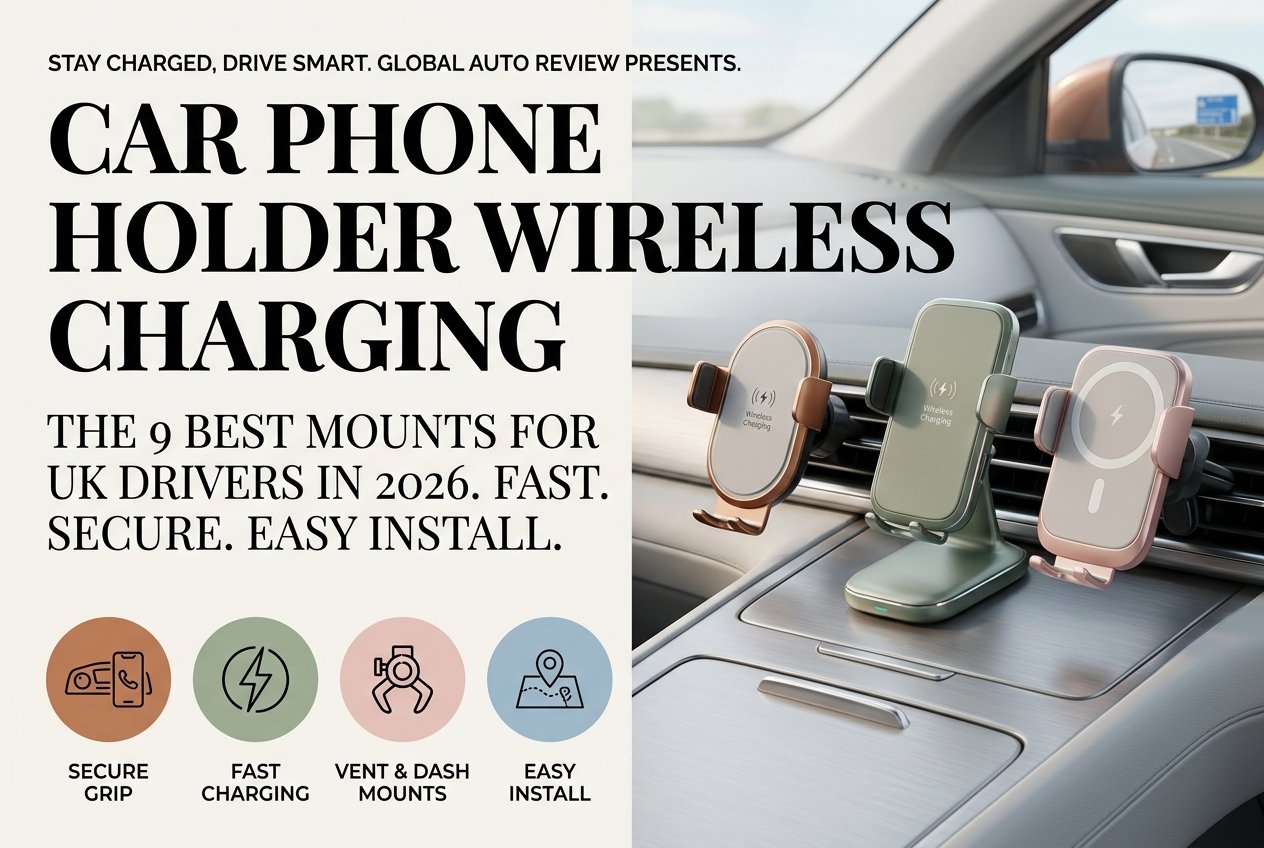
Somewhere around junction 14 of the M25, my phone hit 4% and Google Maps started its death rattle. I had a charging cable in the glovebox, obviously, but fishing for it one-handed while doing 70mph in the middle lane is not the move. That single awful moment is why I now consider a car phone holder wireless charging mount non-negotiable kit — not a nice-to-have, but something that should have been in the car from day one.
Here’s the thing most people don’t realise until it’s too late: running navigation, streaming music, and keeping the screen on simultaneously can drain 40–60% of your battery on a three-hour motorway run. A wireless charging mount doesn’t just hold your phone in view — it fights that drain in real time, so you arrive with a full battery instead of a dead one. That’s the whole value proposition, and it’s a good one.
Why bother at all?
Your phone is your copilot now. GPS, hands-free calls, Spotify, the occasional podcast about true crime — it’s doing a lot of work. And it’s punished for that work with a battery percentage that falls faster than it should. A wireless charging mount solves this without adding anything fiddly to your routine: you slot the phone in when you get in the car, and it charges. No cable to connect, no port to fumble with while you’re already moving. Both hands stay on the wheel. The phone stays visible. Done.
There’s a safety argument here too, and it’s not a minor one. The Highway Code is unambiguous about handheld phone use, and even briefly reaching for a device that’s slid into a cup holder counts as a distraction. A proper mount eliminates that entirely.

Top-rated wireless charging mount for dashboard installation
AUTLEAD, New Car Wireless Charging Phone Holder 15w Fast Charging Car Air Vent… £41.02

Wireless charging mount designed for air vent placement
Nine picks worth your money
We’ve pulled together nine options that hold up across charging speed, build quality, and daily usability for UK drivers. All of them work with current iPhones and Android handsets, and none of them require you to remove your case — with one caveat I’ll get to in a moment.

Premium automatic-grip wireless charging phone mount
Magnetic car phone mount with wireless charging capability

Windscreen-mounted wireless charging phone holder
DTEKGAZ, New Car Wireless Charging Phone Holder 15w Fast Charging Car Vent… £64.47
Compact CD slot wireless charging phone mount for older cars
AUTLEAD, New Car Wireless Charging Phone Holder 15w Fast Charging Car Vent… £29.47

Gravity-locking wireless charging car phone mount
DTEKGAZ, S19 New 15w Gravity Car Wireless Charging Holder For Phones £67
What actually matters when you’re choosing one
Charging speed first. Go for 10W minimum, 15W if you can — that’s the threshold where the mount actively adds charge rather than just slowing the drain. Below that, a heavy navigation session will still eat your battery faster than the mount can replenish it, which defeats the whole point.
Mount type is where people get it wrong most often, because they pick based on looks rather than their specific car. Air vent mounts are the most stable day-to-day option and don’t obscure your sightlines, but they reduce airflow through that vent noticeably — annoying in summer. Dashboard suction mounts give you more placement flexibility and are easier to reposition, though I’ve had one slide loose on a particularly brutal August afternoon on the A303, so clean the suction cup and the glass properly before you commit. CD slot mounts are a good shout if your car has a slot going unused, since they don’t interact with temperature at all and feel genuinely solid once clipped in — but they’re becoming less common in newer cars built after about 2020.
Build quality is harder to judge online. Cheap mounts flex. You’ll feel it the first time you hit a speed bump and your phone wobbles like it’s auditioning for a dashboard ornament. Anything in the £30–60 bracket from a known brand should have reinforced plastic or a metal armature, with rubberised grips that hold the phone without scuffing it.
About those thick cases: most mounts handle cases up to around 5mm without issue. Thicker than that — I’m looking at you, Otterbox Defender — and the charging coils sometimes struggle to align. It doesn’t mean the mount won’t work, but it’s worth testing before you install everything permanently. Buy from somewhere with a decent returns window just in case.
High-speed 15W wireless charging car phone mount
AUTLEAD, New Car Wireless Charging Phone Holder 15w Fast Charging Car Air Vent… £41.02
Getting it installed without swearing at it
Five minutes, tops. That’s genuinely how long this takes if you don’t skip the prep.
Suction cup mounts: Wipe the windscreen or dashboard surface with a damp cloth and let it dry fully — not just mostly dry, fully dry. Dust and any trace of moisture kill suction. Press the cup flat against the surface and hold it for a good 30 seconds. If it won’t grip after that, the glass might be too textured or the cup might be worn out. Heavily tinted or reinforced glass (common in older German cars) is a real problem for suction; swap to a vent or CD slot mount if that’s your situation.
Air vent mounts: Clip onto the sturdy horizontal slats, not the thin directional fins at the front. The fins look like the obvious anchor point but they’re not built to carry weight — I’ve seen people snap them off and then have a very bad conversation with a main dealer. Give the mount a gentle tug before you trust it with your phone.
Routing the cable: The mount still needs power via USB or 12V, so you’ve got a cable to deal with. Run it along the underside of the dash trim rather than across the top — it keeps your eyeline clear and stops it catching on things. Most mounts include adhesive cable clips; actually use them.
Keeping it working
Wipe the charging surface monthly. Dust between the mount and your phone’s back is probably the most common reason people think their mount has stopped working — it hasn’t, it’s just dirty. A lint-free cloth on both surfaces sorts it immediately.
If you park outside through a British winter, take the suction mount off. Glass contracts in the cold and suction cups lose grip; you’ll come back to find your phone on the passenger seat mat. Vent and CD slot mounts don’t have this problem, which is one genuine advantage they hold over suction in the UK climate.
One thing that surprised me: phone software updates sometimes improve wireless charging efficiency. If your mount seems to be losing the battle against your navigation drain, check you’re not sitting two iOS or Android versions behind. It’s a small thing, but it can make a real difference on older handsets.
Check the cable every few months too. USB cables in cars flex constantly — every time you get in and out, every bump in the road — and they degrade faster than cables at home. If charging becomes intermittent, swap the cable before you blame the mount. Standard connectors mean any replacement cable from a phone shop will work fine.
The honest verdict
A car phone holder with wireless charging is one of those purchases you make once, wonder briefly if it was worth it, and then never think about again because it just works every single day. No cables to connect. No battery anxiety. No reaching for your phone at a roundabout.
Which option is right for you comes down to two things: your car’s layout and your case thickness. Get those two variables right and any of the picks above will serve you well. Personally, I’d take an air vent mount at 15W over a suction cup at 10W every time — stability and speed both matter, and the airflow trade-off is worth it.
Hey savvy shoppers! When the items in our articles catch your eye and you decide to buy through our links, we may earn a small commission at no extra cost to you. Think of it as a way of supporting us in bringing you the best content!
Frequently Asked Questions
Will a wireless charging car mount work with my phone case on?
Most do, yes — but case thickness matters. Anything over 5mm, like a chunky Otterbox, can interrupt the charging connection. If your mount’s light doesn’t come on, try removing the case first to see if that’s the issue.
How fast do wireless charging car mounts actually charge?
Look for 10W or 15W models. At 15W you’ll comfortably offset the drain from sat nav and audio streaming on a long drive. Older 5W mounts often can’t keep pace with navigation apps running flat out.
Air vent mount or dashboard suction mount — which is better?
Depends on your car. Air vent mounts are rock-solid and don’t clutter your windscreen, but they cut airflow. Suction mounts give you more positioning freedom but can lose grip on hot days or heavily textured glass.
Do I need a special cable to power the wireless charging mount?
No — most mounts come with a standard USB cable that plugs into your car’s USB port or 12V socket. The wireless charging is only between the mount and your phone; the mount itself still needs a wired power source.
Are these mounts legal to use while driving in the UK?
Using a properly mounted holder is legal. What’s illegal is holding your phone in your hand. A secure mount that keeps your phone visible and your hands free is exactly what the Highway Code recommends.



 No products in the cart.