

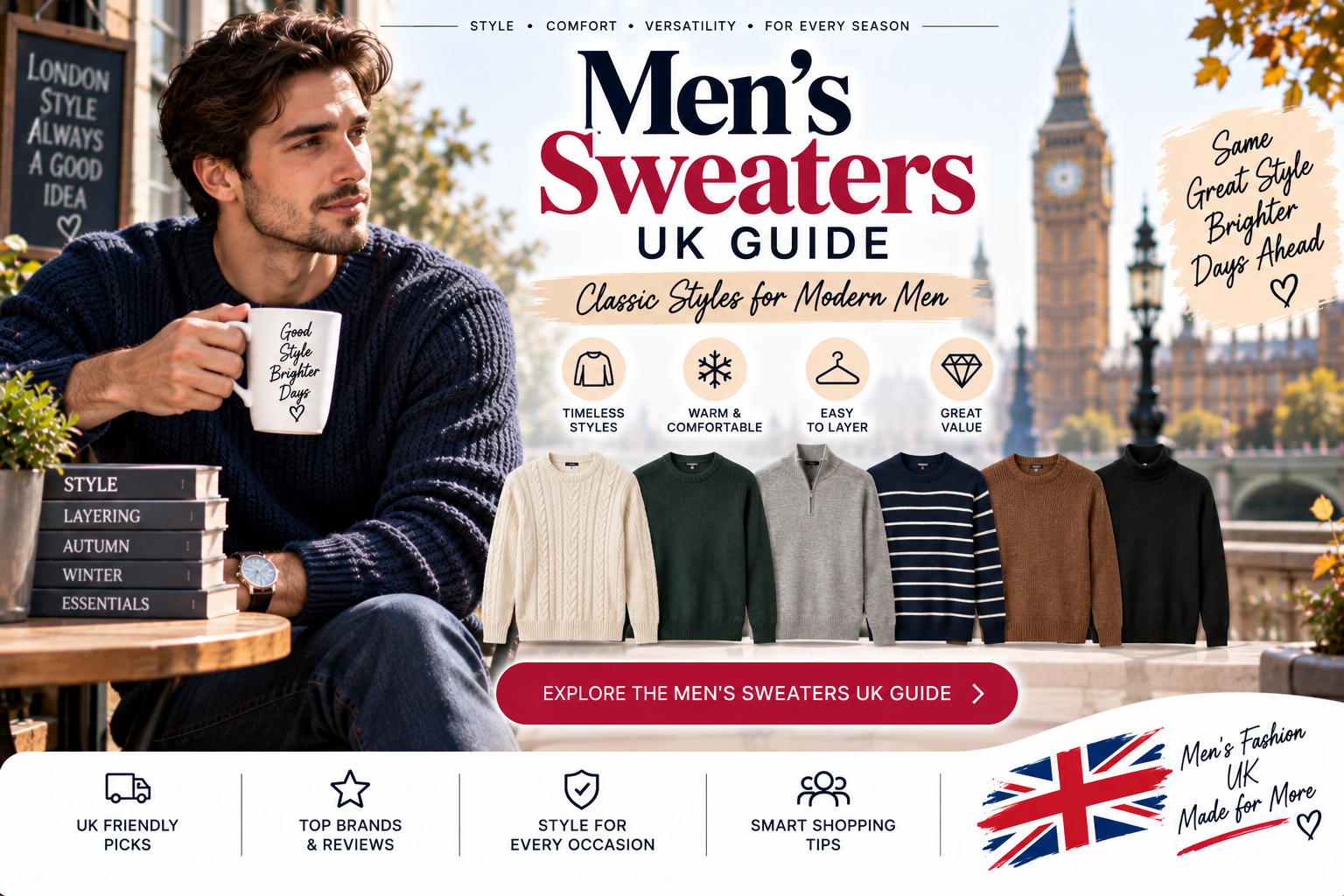
Here’s what most style advice gets completely wrong about men’s sweaters: the idea that you only need them for four months of the year is the reason most blokes end up with a drawer full of mediocre knitwear they half-heartedly reach for in November. A well-chosen sweater is genuinely one of the hardest-working pieces in a wardrobe — it pulls a commute outfit together, rescues you in over-air-conditioned offices in July, and does the heavy lifting on those Saturdays when you can’t face constructing an actual look.
Get the sweater right and everything else gets easier.
The problem is that most blokes assume a sweater is a sweater. It isn’t. There’s a world of difference between a chunky wool knit that has you sweating through Bank station in October and a breathable cotton-linen blend that’s genuinely comfortable on a warm May afternoon. Neckline matters too — crew neck, v-neck, half-zip, roll neck, cardigan — each one changes your silhouette and what it works with. This guide covers 20 styles worth knowing about, ranging from a £14 boohooMAN basic to a £1,100 Brunello Cucinelli cashmere, because the right answer genuinely depends on what you actually need.
Why Your Sweater Wardrobe Is Probably Broken
I spent years buying cheap crew necks in bulk, convinced I was being sensible. Two winters later I had a pile of pilled, shapeless cotton that I was embarrassed to wear anywhere that wasn’t my kitchen. That changed everything. Once I bought one genuinely good merino wool piece, I stopped replacing sweaters every eighteen months and started thinking about them the way I think about shoes — worth spending on, worth maintaining, worth choosing carefully.
The seasonal thing is worth unpacking too. Spring needs lightweight sweaters for moody 16-degree days. Summer needs them for air conditioning and evening layering. Autumn is when the heavier stuff earns its place, and by winter you want something that actually insulates rather than just sitting on top of you looking cosy. The trick is matching material and weight to the time of year, which sounds obvious until you realise how many people wear thick merino in September and complain they’re sweating.

The foundation piece — a neutral, versatile crew neck that works year-round
Lacoste, Men’s Lacoste Mens Organic Cotton Crew Neck Sweater £78

Slightly dressier than crew neck, perfect for layering or wearing solo over a shirt

The comfort pick — great for weekends and that effortlessly put-together vibe
boohooMAN, Mens Essential Oversized Boxy Fit Raglan Sleeve Sweater £14.79 (8% OFF — was £16)

Adds visual interest and function — you can adjust warmth without fully undressing
When the Weather’s Warm — What Actually Works?
Cotton, linen blends, and open-knit weaves are the answer from May through August, not abandoning knitwear entirely. The British summer is unreliable enough that having a lightweight layer makes sense on most days, and a well-chosen cotton sweater handles air-conditioned offices, cool evenings, and unpredictable Bank Holiday weekends without making you feel like you’re wearing a duvet.
Spring is the tricky one. Eighteen degrees and drizzling one day, twenty-two and sunny the next. A lighter knit solves this without any faff — it’s not bulky, it doesn’t trap heat, and you can actually tie it round your waist if needed without looking like you’ve stepped out of a 2003 lads’ holiday photo.
For summer, texture and breathability matter more than weight. Look for cotton-rich fabrics, looser open knits that let air move through, and colours in the cream, stone, and soft grey range that won’t betray you if you get warm. Heavy merino and thick wool blends should stay in the wardrobe until September at the earliest.

Pure breathability — perfect for layering in spring or wearing solo when it’s mild
Paul James Knitwear, Neutrals Mens Lightweight Cotton Allen Striped Breton Sweater £70

Summer essential — linen keeps you cool, and a knit shirt bridges the gap between t-shirt and sweater
Hugo Boss, Cotton and Linen Knit Polo Shirt £70 (50% OFF — was £140)

Lightweight and textured — lets air flow through while adding subtle visual interest
Wool, Cashmere, and the Good Stuff
Autumn and winter are when men’s sweaters UK really justify the space they take up. This is when material stops being a background detail and starts being the whole point — merino wool, cashmere blends, chunky cable knits that actually hold warmth rather than just looking like they should.
Wool is the workhorse. Merino is wool’s better-behaved younger sibling: it doesn’t itch the way traditional wool does, it regulates temperature more effectively, and it holds its shape wash after wash when treated with even minimal care. Cashmere is the upgrade — softer, lighter for the warmth it provides, and genuinely long-lasting if you don’t chuck it in a hot wash. Blends sit in the middle: warm, durable, and priced so you’re not wincing every time you wear them on a rainy day.
Weight is the variable most people overlook. A lightweight merino is the right call for October and April when temperatures are in the low teens. A heavy cable knit is a November-through-February piece, something you reach for when it’s properly cold and you want something that feels substantial. Texture does real work here too — cable knit adds visual mass and makes narrower frames look broader, while a fitted ribbed knit reads as more streamlined and works better under a jacket or coat where bulk is an issue.

The autumn workhorse — warm, breathable, and doesn’t itch like traditional wool
Belstaff, Men’s Belstaff Kerrigan Merino Wool Crew Neck Jumper £110

Splurge-worthy softness — cashmere blends give luxury feel without the full price
Brunello cucinelli, Cashmere and Silk Blend Crewneck Sweater £1100

The classic winter look — textured, warm, and works with literally everything
Paul James Knitwear, Mens Chunky Merino Wool Goffrey Fisherman’s Jumper £285

Thermal without looking like thermal — textured knit adds warmth and visual depth

Proper winter protection and a bit of edge — works with smart or casual fits
Paul James Knitwear, Mens Extra Fine Merino Wool Westonn Roll Neck Jumper £125
Necklines, Fit, and Not Looking Like You Got Dressed in the Dark
Crew necks first, because they’re the safe starting point for everyone. Versatile, works over a t-shirt or a shirt, pairs with everything from chinos to jeans. If you own no other sweaters, start here.
V-necks do something a crew neck doesn’t: they elongate the neck and create a more formal impression, which makes them genuinely useful if you’re broader across the chest or want something that reads as smarter without a jacket. Roll necks (polo necks, depending on your postcode) are bold — they’re a winter-specific choice and they’re not for everyone, but worn right they look excellent. Half-zips split the difference between these poles, adding a bit of interest and practical temperature control without the full commitment of a turtleneck.
Fit is where most mistakes happen. Slim fits work well if you’re lean or athletic and want the sweater to follow your shape. Regular fits are the honest choice for most builds — not baggy, not constricting, just proportionate. Oversized is genuinely wearable right now if you pair it with something slim underneath, but the shoulder seam still needs to sit where your shoulder actually is, not halfway down your upper arm. (Actually, that’s not quite right — some dropped-shoulder styles are designed to sit low, but if it’s happening on a regular-fit sweater, that’s just the wrong size.)
Cardigans are their own category. They layer differently from pullovers, they read as more considered when worn over a shirt, and they give you the option to take the top layer off without the whole outfit falling apart. Button cardigans skew smarter; zip cardigans are more casual. Both are worth owning.

Layering essential — cardigans work over everything and add instant sophistication
Mm6 Maison Margiela, Relaxed Fit Distressed-Effect Wool-Blend Cardigan £550

More relaxed than button cardigans — perfect for weekends and casual layering

Bold and winter-ready — polo necks make a statement and keep you properly warm

Texture and interest — shawl collars add visual depth and work with casual or smart looks
Cheap vs. Expensive: Spend Your Money Here, Not There
The high street is fine for trend pieces — the kind of sweater you’re buying because it’s a particular colour that’s everywhere this season, or a silhouette you’re not sure you’ll still want in three years. Affordable, available, and if it goes wrong in the wash you’re not grieving. The real cost is that they wear out. Stitching loosens, fabric pills, colours fade after a dozen washes, and you’re back buying the same thing eighteen months later.
Does that mean you should always spend more?
Not necessarily. The sweet spot for most people is the £60-150 range — brands focused on quality basics, using wool, merino, or decent cotton, priced fairly rather than inflated by a logo. You’re paying twice what a fast-fashion sweater costs, but you’re getting something that holds its shape for five years instead of two, and the cost-per-wear works out substantially lower. Pure cashmere from a heritage maker is its own category: genuinely worth it if you treat it properly (hand wash, dry flat, cedar blocks in the drawer), genuinely not worth it if you’re going to tumble dry it.
Check the fabric label before buying anything. Pure acrylic is a warning sign — it pills fast and has a plasticky feel that no amount of marketing copy can disguise. Wool, merino, cotton, and their blends are what you’re looking for. Weight is secondary; a flimsy fabric is flimsy regardless of how heavy it feels when new.

Budget-friendly basics that work for everyday wear and don’t break the bank
NONE, Autumn and Winter Warm Style European and American Loose Casual… £13.89 (50% OFF — was £27.74)

Mid-to-premium quality that actually lasts — the smarter long-term investment

Quality meets ethics — organic materials and thoughtful production without the premium price
Lacoste, Men’s Lacoste Mens Organic Cotton Crew Neck Sweater £56
Combinations That Work (and One That Doesn’t Get Enough Credit)
Crew neck sweater, chinos, clean trainers or loafers. That’s your smart-casual default and it earns its place every time — coffee, casual work meetings, first dates, weeknight dinners out. Navy sweater with stone chinos. Grey sweater with navy chinos. Cream with charcoal. These colour pairings work because the contrast is strong enough to look deliberate without requiring any effort.
Dark jeans with a lighter sweater, or light jeans with a darker one. Obvious, maybe, but it’s obvious because it works every single time without thinking about it. Throw a wool overshirt or a denim jacket over the top and you’ve added texture-on-texture depth that reads as intentional rather than accidental.
The shirt-collar-peeking-out combination doesn’t get nearly enough credit. A sweater over a white or light blue shirt, collar showing above the neckline — it frames the face, adds visual layering, and immediately looks more considered than just a plain sweater alone. Works especially well with v-necks and crew necks; less so with roll necks for obvious reasons.
Oversized sweater with fitted or tapered trousers is the current default for a reason. The contrast in volume between top and bottom creates a clean silhouette rather than a shapeless one. The one rule: your sweater shoulders need to roughly align with your actual shoulders, or the whole thing reads as accidentally too big rather than deliberately relaxed. Lightweight sweater with knee-length shorts in summer is also genuinely wearable — there’s a low-key, slightly coastal energy to it that works better than most blokes expect.
Six Sweaters. That’s Genuinely All You Need.
Two crew neck basics in neutral colours — navy or charcoal for one, cream or stone for the other. One v-neck for occasions where you want something that reads as slightly more deliberate. One heavy cable knit or chunky wool for proper winter. One lightweight cotton or linen-blend piece for spring and summer. One cardigan, because it layers differently from everything else and opens up combinations none of the pullovers can.
Six pieces. Build from there based on what you actually wear, not what looks appealing in a flat-lay. If you work somewhere that requires smart dressing, a fine-gauge merino is worth adding. If you spend most weekends outside, a heavy wool knit earns its keep faster than a slim-fit cotton one would. The key is buying intentionally rather than just grabbing whatever’s on sale in October and wondering why none of it quite works together.
A sweater that fits well and feels good to wear is one of the few pieces of clothing that genuinely affects how you carry yourself. Not because clothes are everything, but because being comfortable and looking like you meant to get dressed that morning is a reasonable thing to want on an ordinary Tuesday. The right sweater does that without requiring any effort at all — which, honestly, is the whole point.
Hey savvy shoppers! When the items in our articles catch your eye and you decide to buy through our links, we may earn a small commission at no extra cost to you. Think of it as a way of supporting us in bringing you the best content!
Frequently Asked Questions
What type of sweater works best for British weather year-round?
A mid-weight merino wool crew neck is probably the most useful single piece you can own in the UK. It handles cool summer evenings, unpredictable spring days, and layering in winter without being too heavy or too thin. Cotton blends work better for the warmer months, roughly May through August.
How do I stop my sweater from pilling?
Pilling is mostly a fabric quality issue. Cheaper acrylic blends pill fast, while natural fibres like merino, cashmere, and cotton pill far less over time. Washing inside-out on a gentle cold cycle and air-drying flat instead of tumble-drying will extend the life of any sweater considerably.
Is oversized really wearable or just a trend that looks odd in real life?
It works, but proportions matter. If you’re under 5’9″, a genuinely oversized sweater can swallow your frame. The fix is pairing it with slim or tapered trousers so there’s contrast. The silhouette should look deliberate, not like you grabbed the wrong size off the rail.
What’s the difference between a jumper and a sweater in the UK?
Nothing, practically speaking. ‘Jumper’ is the more common British term; ‘sweater’ is used interchangeably, especially in retail. You’ll see both on product pages from the same brand. Some people use ‘jumper’ specifically for pullovers and ‘sweater’ more broadly, but there’s no hard rule.
Is spending £100+ on a men’s sweater actually worth it?
For a piece you’ll wear constantly, yes. A quality merino or cashmere-blend sweater from a reputable maker will hold its shape, resist pilling, and last five or more years with decent care. A £25 acrylic version typically needs replacing after two seasons, so the cost-per-wear on the expensive one often comes out lower.


 No products in the cart.