

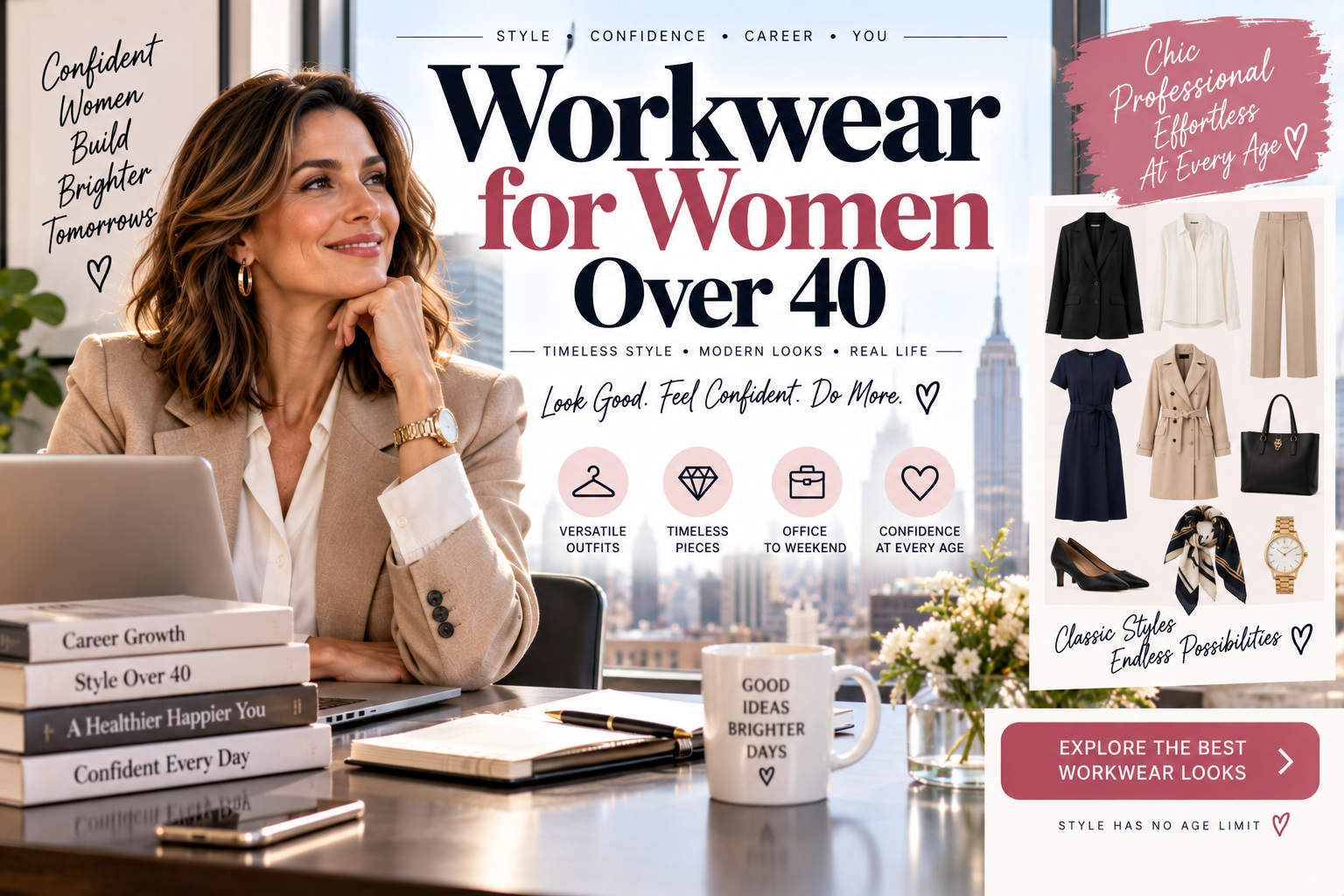
Here’s what nobody tells you about dressing for work in your 40s: you actually know more about what you want. The problem isn’t taste—it’s that most workwear is designed for someone else entirely. Either it’s chasing trends that belong in a college town, or it’s so aggressively conservative it could double as a costume. Getting dressed for work shouldn’t require that much negotiation with your own closet.
The real foundation of a workwear wardrobe that holds up isn’t volume. It’s precision. A handful of pieces that fit correctly, in fabrics that don’t betray you by noon, in colors that do more than one job each. I spent the better part of two years cycling through mediocre work trousers before accepting that cheap fabric bags at the knees by 2 p.m. and no amount of wishful thinking fixes that. Quality in the basics pays back faster than anything else you’ll buy.
Where to Start: Bottoms That Actually Hold Up
Work pants are where this whole thing lives or dies. You’ll wear them constantly, so the cost-per-wear math works out even on pricier options. What you’re looking for: mid-to-high rise (this is non-negotiable for most body types over 40), a straight or very slight bootcut leg, and fabric with just enough stretch that sitting through a two-hour meeting doesn’t become a structural event. Cheap fabric shows its hand fast. Structured fabric earns its keep every single day.

Foundation piece for professional office wear; mid-rise structure flatters women over 40
One neutral trouser in black, navy, or charcoal is your baseline. Then add a second pair in a warmer tone—camel, taupe, or deep olive—and suddenly your outfit combinations double without adding anything else to the closet. For business casual offices, ponte pants that look like proper trousers but feel like something you’d wear on a long flight are completely worth the investment. Your back will thank you. So will your mood by Thursday.

Comfort-forward alternative for business casual offices; structured appearance with stretch fabric
Lalipop Design, Women’s Neutrals Brick Color Cropped Pants Extra Small Lalipop… $378
Skirts haven’t gone anywhere—they’ve just gotten smarter. A knee-length pencil skirt in wool blend or structured cotton pairs with almost any top and reads as immediately put-together, which is exactly the impression you want to make without spending an hour thinking about it. Length is where most people go wrong: shorter than the knee reads as too casual for a lot of offices, and anything mid-calf needs very specific footwear to avoid veering into costume territory. The fit should skim, not cling. You chose it; it shouldn’t look like it chose you.

Classic office staple; knee-length silhouette is age-appropriate and universally flattering
BLANKNYC, Women’s Pencil Knee Length Skirt multi 25″ Waist female $33 (49% OFF — was $65)
Blouses That Don’t Fight You. Blazers That Work.
The gaping button problem. Every woman who has tried to buy a work blouse off the rack knows exactly what I mean—you’re a size 10 everywhere except across the chest, and suddenly you’re choosing between buttons that strain and a fit that looks like you borrowed someone else’s shirt. Sizing up one and having the waist taken in by a tailor costs about $20 and solves this permanently. Cotton blends and linen hold their structure better than synthetics, breathe in a warm office, and don’t do that depressing thing where they cling by mid-afternoon.

Office staple with breathable fabric; structured fit prevents gaping and unflattering cling
White and pale blue get all the attention, but soft neutrals do more work with less effort. Cream, warm gray, muted sage—these feel fresher than stark white and still pair with every bottom you own. One patterned blouse (subtle stripes, a small geometric, a quiet check—not a loud floral) earns its place by multiplying outfit options without requiring you to buy anything new to match it.

Pattern adds visual interest while maintaining professional appearance; subtle designs work across seasons
Uniqlo, Women’s Rayon Skipper Collar Blouse 3/4 Sleeve Striped $39.9
The blazer is what turns an outfit into a statement. Not a loud statement—just the quiet kind that says you showed up prepared. For the workwear foundation to function, you need two: a navy or charcoal workhorse for most days, and a camel for everything else, because camel blazers work with more colors than they have any right to and add warmth without reading as casual. Structured shoulders that don’t veer into boxy territory, a length that hits mid-hip, and a waist that actually follows the shape of a human body are your three requirements. (Actually, fit through the shoulders is the most important of those—sleeves and waist can be altered cheaply; shoulders usually can’t.) Budget $80–$150 and spend $20 on alterations if needed. That approach beats an expensive blazer worn straight off the rack every time.

Professional essential; structured shoulders and mid-hip length create polished silhouette for mature women
For creative offices, a deep burgundy or soft gray blazer adds enough personality to feel intentional without crossing into costume. These aren’t bold choices—they’re just slightly more interesting versions of the same neutral logic.

Versatile layering piece; lighter weight works across seasons and coordinates with multiple outfits
Madison / Savile, Women’s Neutrals The Estate Camel Pinstripe Blazer Xxs Madison /… $395
Can Your Shoes Actually Survive a Full Day?
This is the section where I tell you to stop punishing yourself. A heel that looked great at 9 a.m. and becomes an instrument of torture by 2 p.m. is not a professional asset—it’s a liability, and your face will eventually give you away in a meeting. The best work shoes for women over 40 have actual cushioning (memory foam insoles are a baseline, not a splurge), a heel between 1.5 and 2.5 inches if you want one at all, and a toe box that fits like a toe box rather than a compression device. A classic black or nude pump is still essential for more formal occasions—it goes with everything and communicates polish immediately—but your everyday shoe should be something you genuinely don’t mind wearing for eight hours straight.
Loafers have had their moment and earned it. Leather or leather-look options in black, tan, or cognac work in most corporate environments, pair with trousers and skirts equally well, and can be worn with socks in winter without looking like you lost a bet. Keep a pair of flats in your desk drawer. Not as a backup plan—as a strategy.
The Accessories That Actually Matter
Restraint is the whole point here. A structured leather bag in black, navy, or cognac—big enough to hold a laptop, a water bottle, and whatever else follows you through a workday, but shaped like a bag rather than a tote that’s given up on itself. A watch that looks clean and classic (price is irrelevant; proportion and simplicity matter). Small earrings, maybe a simple bracelet. That’s genuinely enough.
Professional essential; structured leather construction and neutral color coordinate with any outfit
One silk scarf—or a convincing silk-like fabric—is criminally underused as a workwear tool. Around your neck, looped through a bag handle, or draped loosely over your shoulders, it adds color and a sense of intention to any outfit without requiring you to buy anything new to build around it. This is where you’re allowed to pick something you actually like the look of, rather than something strategic. Buy one in a pattern or color that makes you happy and treat it like a utility piece, because that’s what it is.
Where to Shop Without Overpaying
Buy end-of-season. August blazers. January coats. This is not a secret but most people don’t do it, which means the sales are real and the inventory is still good. Banana Republic, J.Crew, and Everlane all run 40–50% off promotions multiple times per year, and their return policies are decent enough that buying pants online without trying them on isn’t a gamble. Sign up for one or two email lists—not seventeen, just the retailers you’d actually buy from—and you’ll catch the sales before the good sizes disappear.
Thrift stores in higher-income zip codes are worth your time. Brooks Brothers, Ann Taylor, Pendleton—these brands show up regularly, in good condition, at a fraction of retail. Check the seams, try things on, and don’t talk yourself into something that almost fits. Almost fits is the enemy of a functional wardrobe. It just takes up space and makes you feel slightly bad every time you look at it.
The whole point of building this foundation is that you stop thinking about it.
Once the right trousers, two blazers, a few blouses that actually fit, and shoes you can walk in are in place, getting dressed for work becomes automatic in the best possible way—not because you’ve suppressed your personality, but because you’ve solved the problem and can spend your mental energy on literally anything else. Fewer pieces, better fit, and a tailor’s phone number in your contacts will do more for your professional wardrobe than any trend guide ever will.
Some links on this page are affiliate links: if you buy through them we may earn a small commission at no extra cost to you. We only recommend products we would buy ourselves.
Frequently Asked Questions
What are the best pants for women over 40 in a professional office?
Mid-to-high rise trousers in a straight or slight bootcut leg are the most flattering cut for most body types over 40. Look for fabric with a small percentage of stretch—around 2-3%—so the fit holds through a full workday. Black, navy, and charcoal are your core neutrals, but a second pair in camel or deep olive dramatically expands what you can build around them.
How do I find work blouses that don’t gape at the buttons?
The gaping problem almost always comes down to two things: incorrect sizing across the bust and cheap fabric that lacks structure. Try sizing up one and having the waist taken in slightly—it costs very little at a tailor and solves the problem permanently. Cotton blends and quality linen hold their shape better than pure synthetics and are less likely to pull across the chest.
Are loafers appropriate for a professional office environment?
Yes, absolutely. A leather or leather-look loafer in black, tan, or cognac reads as polished in most office environments, including corporate ones. Pair with tailored trousers or a knee-length skirt and they look entirely intentional. The trend has been building for a few years now and shows no sign of going anywhere.
How much should I spend on a work blazer?
Fit matters more than price. An $80 blazer that fits correctly looks better than a $350 one that pulls at the shoulders or hangs wrong through the waist. Budget $80–$150 for a workhorse blazer in navy or charcoal, and factor in up to $30 for minor tailoring if needed. That combination will outperform most designer options worn straight off the rack.
What’s the best way to build a professional wardrobe on a budget?
Shop end-of-season sales for the following season—August is the best time to buy fall blazers, for example. Sign up for email lists from Banana Republic, J.Crew, and Nordstrom, which run 40-50% off sales several times a year. Thrift stores in affluent areas reliably stock quality pieces from Brooks Brothers, Ann Taylor, and Pendleton at a fraction of retail. Buy fewer pieces and spend slightly more on fit rather than collecting a closet full of things that almost work.
 No products in the cart.