

Quick note: if you buy something through our links, we may earn a small commission — no extra cost to you, and it helps us keep the lights on.
Here is the thing nobody tells you when you start working from home: your monitor is now your office. Not a metaphor. The quality of that rectangle you stare at for eight hours a day determines whether you finish work feeling fine or finish work feeling like your eyeballs have been gently microwaved. I know this because I spent the better part of last year hunched over a creaky 1080p panel that had me squinting by 3 PM and reaching for ibuprofen by 4. Upgrading changed everything — not just comfort, but how I actually felt about sitting down to work in the morning.
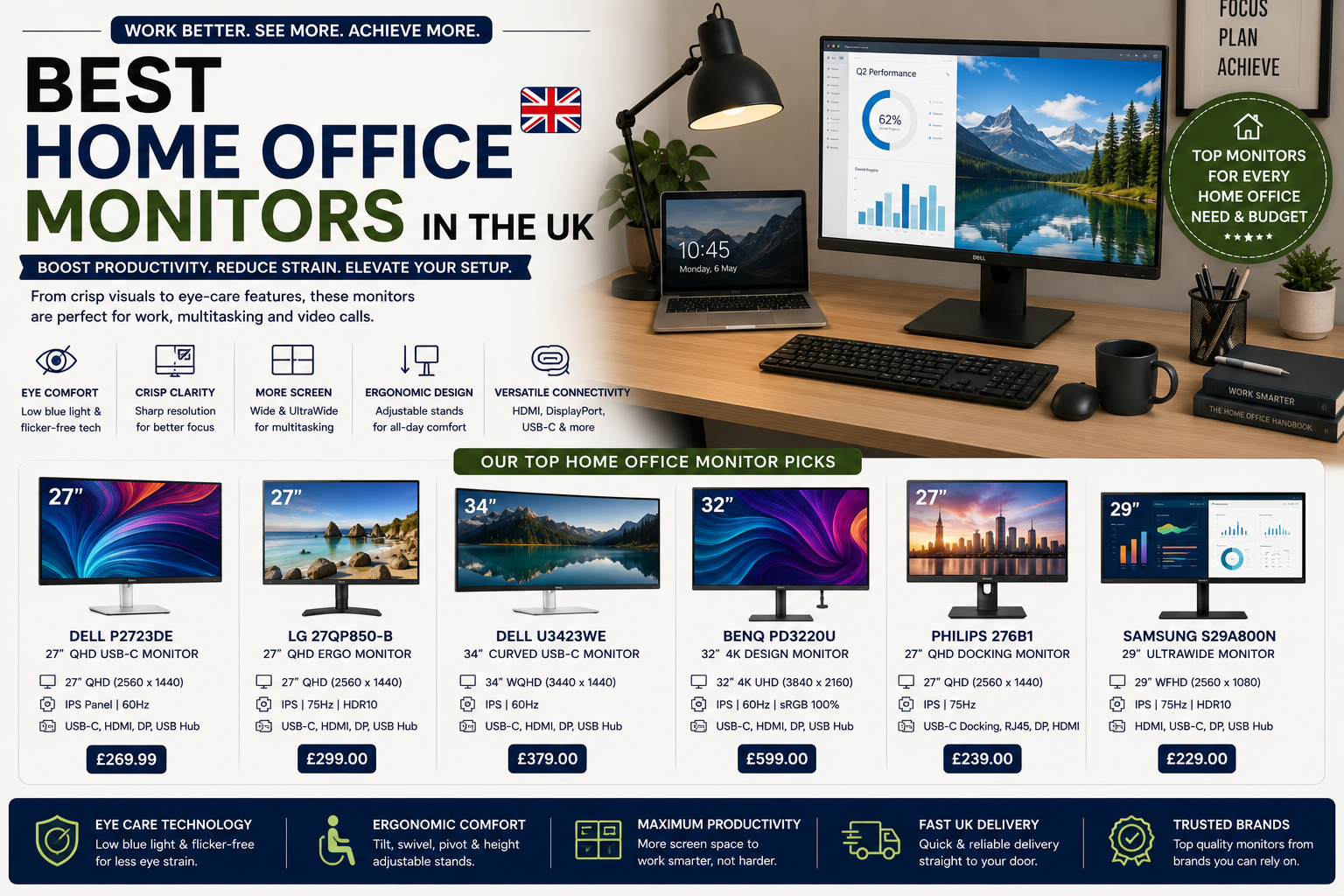
The good news? You don’t need to spend a fortune. The best monitors for home office use sit at every price point, and knowing what to look for means you won’t overpay for specs you’ll never use.
Hey, if you buy through our links, we earn a small commission at no extra cost to you.
Why Your Screen Matters More Than Your Chair
Working from home on a bad monitor is like reading in a moving car — technically possible, but you’ll feel it later. A quality display isn’t just about looking nice. It’s about spending eight hours a day not fighting your own workspace. When the screen is sharp and correctly positioned, text stops feeling like an obstacle. Colours don’t shift weirdly when you lean slightly to one side. You stop unconsciously hunching forward to make out small details in spreadsheets. There’s also something less tangible but genuinely real: a proper monitor makes a desk feel like a workspace rather than a temporary arrangement. Your brain notices. I noticed it within about three days of upgrading — suddenly sitting down to work felt intentional rather than reluctant.
For anyone doing creative work — photo editing, graphic design, video calls where facial expressions actually matter — a decent screen stops being a luxury and starts being a tool you can’t do without.

Entry-level home office displays offering solid value for basic tasks
What actually matters when you’re buying
Skip the spec sheet rabbit hole. You are almost certainly not buying this for gaming, so 240Hz refresh rates and RGB lighting are irrelevant to you. Four things actually matter for home office use: resolution, size, panel type, and ergonomic adjustability.
Resolution is where most people under-invest. 1080p is fine for email and browsing. The moment you’re working with detailed spreadsheets, editing images, or reading small text for hours on end, 1440p is noticeably better — sharper, easier on the eyes, less squinting. 4K is genuinely beautiful but mainly earns its cost if you’re in creative work professionally.
Size comes down to your desk and your habits. 24 inches feels fine until you’ve used 27 inches, at which point it feels slightly cramped. Most people land on 27 inches as the right balance — enough screen to run two windows properly side by side without the monitor eating your entire desk.
Panel type matters more than most budget guides admit. IPS panels have better colour accuracy and viewing angles than TN panels — you won’t get that odd washed-out look when you’re not sitting perfectly centred. VA panels offer deeper contrast but aren’t as good for colour-critical work. For home office use, IPS is almost always the right call.
Ergonomics is where people consistently skimp and consistently regret it. Height adjustment, tilt, and ideally swivel aren’t luxury features — they’re the difference between a monitor that works for your body and one that slowly ruins your neck. If you’re going to be at this desk for years, pay the extra £30–£50 for a stand that actually adjusts.

Mid-range monitors with ergonomic features for extended work sessions
LG, UltraGear 27G610A-B Quad HD 27″ IPS LCD Gaming Monitor £199
Five budget picks that won’t embarrass you
You do not need to spend £400 to get a genuinely good home office monitor. Not even close.
The 24-inch 1080p workhorse. Nothing fancy. Emails, browsing, video calls — these do the job without complaint. Look for an IPS panel even at the cheaper end; the viewing angle improvement alone is worth it over TN. Most come with basic tilt only, which isn’t ideal but is workable if you buy a separate stand later.

Ultra-affordable entry-level displays for basic office tasks
DELL, Pro 24 Plus P2425H 24 inch Monitor IPS Full HD DELL-P2425H £217.8
The 27-inch 1080p value play. More screen, same resolution — which sounds like a downgrade but genuinely isn’t for office work. You get proper space for two windows side by side. Text is slightly softer than on a 24-inch 1080p panel, but not enough to bother most people, and the extra real estate more than compensates. These usually land between £120 and £180.

Affordable larger displays for expanded workspace without premium pricing
DELL, P Series P2725HE 27 Inch Full HD LCD Monitor 1920×1080 Pixels £272.63
The 24-inch 1440p sweet spot. This is my favourite category at the budget end. 1440p on a 24-inch panel looks genuinely sharp — not ‘sharp for the price’, just sharp. Text is crisp, icons are clean, and you won’t be squinting at anything. Prices have dropped enough that you can find solid options for £150–£220, which feels almost unreasonably good value for what you get.

Sharp mid-resolution displays offering excellent text clarity for budget-conscious buyers
LG, Electronics Curved UltraWide Monitor 34WR55QK £272.78 (23% OFF — was £355)
The 27-inch 1440p productivity option. Three years ago this was a premium purchase. Now you can find decent versions for £200–£280, which is remarkable. More screen space than the 24-inch, sharper than 1080p, and genuinely comfortable for a full day of work. If I had to pick one size-and-resolution combination for a home office, this would probably be it.

Best-value larger displays combining size and resolution for productive home offices
LG, UltraGear G6 27″ Quad HD 200Hz Gaming Monitor with FreeSync™ Premium £179
The curved budget bonus. Curved monitors used to be a gimmick. Actually, that’s not quite right — they were always theoretically sound, just overpriced. Now that budget curved options (usually 27-inch 1080p or 1440p) cost only £20–£50 more than their flat equivalents, the question is whether the gentle screen wrap reduces eye strain enough to justify it. For most people who’ve tried both, the answer is yes.
Affordable curved displays offering ergonomic benefits for extended viewing
Spending more is sometimes just correct
Some budgets allow for something nicer. That’s not frivolous — it’s a reasonable response to the fact that you spend roughly 2,000 hours a year looking at your monitor. Here is where the extra money actually goes.
The 27-inch 4K professional. 4K at 27 inches is genuinely beautiful. Text looks like it was printed rather than displayed. Colours are rich. If you’re doing creative work professionally, the difference between this and a 1440p panel isn’t subtle — it’s immediately obvious. These sit around £300–£450. One caveat worth knowing: you need a graphics card capable of driving 4K smoothly, and some people find that at 27 inches, 4K scaling can make interface elements awkwardly small unless you adjust display settings.
Premium high-resolution displays for creative professionals and detail-focused work
LG, 27US500-W 4K Ultra HD 27″ IPS LCD Monitor £179 (28% OFF — was £249)
The 32-inch 1440p option. Bigger screen, same resolution as the 27-inch 1440p — so slightly lower pixel density, but massively more workspace. Spreadsheets stop requiring horizontal scrolling every thirty seconds. Running two browser windows side by side feels genuinely comfortable rather than slightly cramped. These land between £250 and £380. Measure your desk before ordering.

Spacious displays for expansive workspaces and multi-tasking professionals
LG, 32U631A-B 32″ QHD 100Hz IPS Monitor £179.99 (10% OFF — was £199.99)
The ultrawide. A 34-inch ultrawide at 3440×1440 is the closest thing to a genuine productivity upgrade you can buy. Two full windows running side by side, no bezel interrupting them, enough horizontal real estate that you stop wishing you had a second monitor. They start around £400 and climb steeply from there. The honest downsides: some video conferencing software handles ultrawide awkwardly, you need a reasonably capable GPU, and not all desks are deep enough to push one back far enough to see it comfortably.

Premium ultrawide displays for advanced multitasking and expanded workspace
LG, UltraWide 34U511A-B 34″ Monitor Black £205.99 (23% OFF — was £267.58)
The colour-accurate professional panel. If photo editing, graphic design, or video work pays your bills, colour accuracy isn’t optional. Look for 99% sRGB coverage or Adobe RGB certification. These panels cost £400–£800, and the reason matters: a cheaper monitor might look fine to you, but the colours it’s showing you aren’t accurate. You’ll grade something on your screen and it’ll look wrong on every other device. That’s not a minor issue if clients are paying for colour-accurate work.

Professional-grade displays for creative work requiring accurate colour reproduction
LG, 27U631A-B 27″ QHD IPS 100Hz Monitor £149.99 (12% OFF — was £169.99)
Is your monitor positioned correctly right now?
Probably not. Most people’s aren’t.
The top of your screen should sit at roughly eye level when you’re sitting up straight — not the middle of the screen, the top. If you’re looking down at your monitor right now, it’s too low. If you’re looking up, it’s too high. Either way, your neck will complain about it eventually, and by the time it does, it’s been complaining quietly for months already. Distance should be 50–70cm from your eyes, which is roughly arm’s length. Close enough to read without squinting, far enough that your eyes aren’t doing constant micro-focusing adjustments.
Glare is a separate problem that a lot of people tolerate when they don’t need to. Position the monitor so windows are to the side of it, not directly behind or in front. If you can’t rearrange the room, an anti-glare screen protector (around £15) solves most of it. A slight downward tilt of about 20 degrees on the screen itself also helps — which is exactly why monitors with tilt adjustment matter more than people initially think.
On the two-monitors-versus-one question: there is no universal right answer, but I’d say one large monitor beats two smaller ones for most people — less neck rotation, cleaner desk, simpler cable situation. Two monitors win if you’re constantly comparing documents or running persistent reference material alongside your main work.
The honest conclusion
The best monitors for home office use are not necessarily the most expensive ones. They’re the ones matched to what you actually do. Someone answering emails and joining calls all day doesn’t need a colour-calibrated 4K panel. Someone editing client photos on a budget 1080p screen is making their job harder than it needs to be. Figure out your two non-negotiables — whether that’s size, sharpness, ergonomics, or colour accuracy — and use those to cut through the options rather than trying to find the single ‘best’ monitor in the abstract.
Spending an extra £60–£100 over the absolute cheapest option to get something that fits your actual workflow is almost always worth it. You’ll notice the difference every single day. A bad monitor is one of those purchases where the regret compounds slowly — you don’t feel the full cost of it until you finally upgrade and realise how much easier work feels on a screen that isn’t fighting you.
Frequently Asked Questions
What resolution do I actually need for home office work?
For general office tasks, 1080p works fine. But if you spend serious time on spreadsheets, design work, or anything requiring fine detail, 1440p is worth the extra cost. Most people who make the jump from 1080p to 1440p say they’d never go back. 4K is brilliant but probably overkill unless you’re doing professional creative work.
Is 27 inches too big for a home office desk?
Not usually. The sweet spot for most home setups is 27 inches — big enough to comfortably run two windows side by side, small enough to fit most desks without dominating the space. If your desk is under 120cm wide, you might feel cramped. Anything larger than 32 inches and you’ll want to measure your desk first.
Do I need an IPS panel or will a cheaper VA panel do?
IPS panels give you better colour accuracy and wider viewing angles, which matters if you’re not sitting perfectly centred in front of your screen. VA panels have deeper blacks and better contrast, which is nice but less critical for office work. For most home office use, IPS is the safer bet — especially if you’re prone to eye strain.
Are ultrawide monitors worth it for home office work?
If you regularly work with multiple windows open at once, yes — genuinely. Running a spreadsheet and a browser side by side on a 34-inch ultrawide without any bezels in the way is a real productivity boost. The downsides are cost, desk space requirements, and the fact that some video conferencing software doesn’t handle ultrawide resolutions gracefully.
How far should my monitor be from my eyes?
Roughly an arm’s length — somewhere between 50 and 70cm. Too close and you’re straining to take in the whole screen; too far and you’re squinting at small text. The top of the screen should sit at or just below eye level when you’re seated upright. If you’re regularly leaning forward to read your screen, either your font sizes are too small or the monitor is too far away.



 No products in the cart.