

My earbuds hit the pavement mid-sprint on a wet Tuesday in November. I didn’t even notice until I heard them skitter across the tarmac behind me. That was the second time that week — and the moment I decided to actually figure out which running headphones are worth buying and which ones are just gym bag clutter.
Here’s what I learned after testing a pile of them: the difference between a good pair and a useless one has almost nothing to do with sound quality. It’s all about fit. A £20 pair that stays locked in your ear through a 10k is worth ten times more than a £200 pair that needs readjusting every five minutes. Everything else — battery life, ANC, touch controls — comes second to that one thing.
So What Actually Makes Headphones Work for Running?
Comfort is where most people get surprised. An earbud that feels fine in a shop will create a pressure point you can’t ignore after 25 minutes of running, and a too-tight over-ear band causes the kind of tension headache that ruins the second half of a long run. The sweet spot is a fit that feels almost weightless — ear tips or padding that adapt to your ear shape rather than fighting it, secure enough that you forget they’re there but never clamping so hard that blood flow becomes an issue during a 90-minute session in July when your head is already hot and your patience is already thin.
Sweat resistance is non-negotiable. Full stop.
Controls are trickier than you’d think. Touch surfaces become unreliable when your fingers are wet — I’ve accidentally ended calls, skipped backwards through three songs, and once managed to activate a voice assistant during a hill sprint, which was not helpful. Physical buttons are more predictable when you’re moving hard, though some earbuds have nailed touch sensitivity well enough that it’s not a problem. Know which type you prefer before you commit.
The Picks I’d Actually Buy
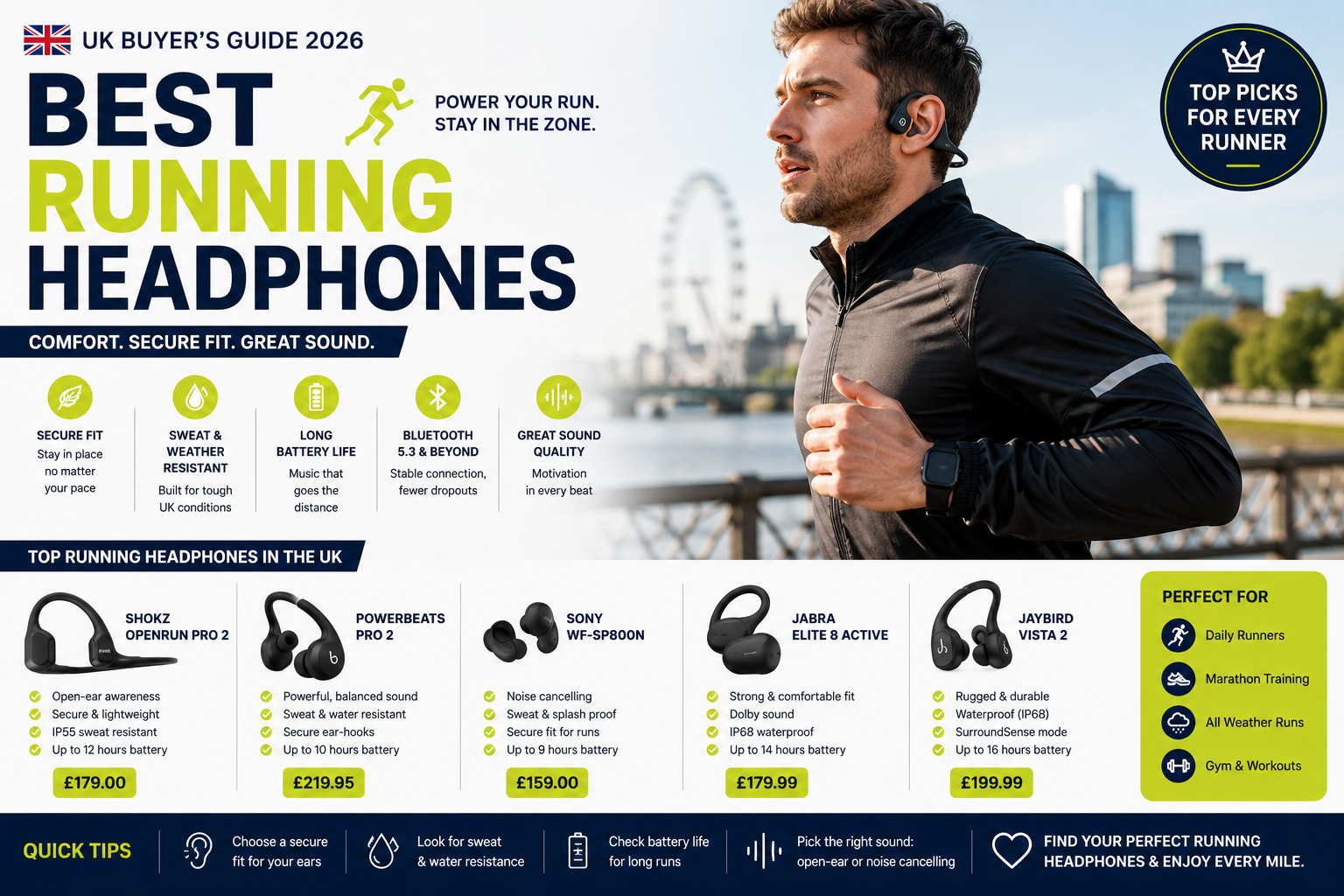
These are the running headphones that survived real testing — not a desk listen, but actual sweaty runs, gym sessions with lots of lateral movement, and at least one grim rainy day outing because this is Britain and pretending otherwise is pointless.

Entry-level sweatproof true wireless earbuds with secure fit for daily runners

Over-ear hook design for maximum security during intense workouts
ortizan, Tedelon F9 Open Earbuds True Wireless Open Ear Bluetooth 5.4… £18.69 (50% OFF — was £37.36)

Premium true wireless with ANC for focused training sessions
Samsung, Galaxy Buds4 Pro Wireless Noise Cancelling Earbuds £203

Over-ear option for runners preferring full headphone coverage

Affordable sweatproof option without sacrificing durability
These five cover different approaches to the same problem. Some use ear hooks. Others rely on a close-tolerance silicone tip fit. What they share is a genuine commitment to staying put, even when your form breaks down in the last kilometre and your head is bouncing more than it should be.
IPX Ratings Decoded
Not all “waterproof” claims mean the same thing, and manufacturers are not always straightforward about this. IPX4 handles sweat and drizzle — that covers the vast majority of UK running conditions without issue. IPX5 means you can get caught in a proper downpour or rinse them under a tap without worry. IPX7 is genuine submersion resistance, which is genuinely useful if you trail run through boggy ground or have a habit of dropping things in puddles. Actually, that’s not quite right — IPX7 is rated for submersion up to one metre for 30 minutes, so it’s not unlimited, but for any running scenario you’re likely to encounter, it’s more than enough. IPX8 exists, costs more, and is unnecessary unless you’re swimming with them, which you should not be doing anyway.
Does Spending More Actually Get You Better Running Headphones?
Under £40, you’re buying reliability without extras. The Anker Soundcore A25i sits here and delivers 28 hours of battery, IPX5 protection, and a fit that doesn’t embarrass itself. No ANC, nothing fancy, just a pair of earbuds that show up and do the job.

Budget-conscious runners wanting solid sweatproof performance under £100
Shokz, Original SHOKZ OpenMove S661 Bone Conduction Earphone IP55… £61.81 (67% OFF — was £186.86)

High-end option with advanced features like ANC and extended battery

Sweet spot between price and performance for serious amateur runners

Marathon-ready option with extended playtime for long-distance training

Practical option prioritising fast charging for busy UK schedules
Sony, WF-1000XM5 Wireless Noise Cancelling Earbuds £168.99 (23% OFF — was £219.99)
The £60–£130 range is where things get genuinely interesting. Battery life stretches past what you actually need for a long run. Build quality moves from “functional” to “nice to handle.” The Shokz OpenMove sits here and brings something different entirely — bone conduction means nothing sits inside your ear canal, which solves the fit problem in a completely different way and keeps you aware of road noise without sacrificing music quality. I tried four standard earbud options before landing on bone conduction for my longer runs, and I won’t be going back.
Premium options above £150 — the Sony WF-1000XM5 being the obvious one here — deliver noticeably better ANC, more refined sound, and materials that feel built for daily use over years rather than months. Whether that gap justifies the price is an honest question only you can answer based on how often you actually train.
How the Testing Worked
Every pair got a minimum of 10 hours across different real conditions: steady 5k runs, HIIT sessions involving a lot of jumping and direction changes, treadmill work, and at least one outdoor run in rain because that’s just going to happen if you run in the UK with any regularity. Battery claims were checked against actual workout use rather than the manufacturer’s quoted figures, which are always measured under ideal conditions that bear no resemblance to a humid gym. Controls were tested while moving — specifically, whether you could skip a track or adjust volume without slowing down or looking at your phone. The pairs that didn’t make the list either slipped, died faster than advertised, or had touch controls that stopped responding reliably once sweat was involved.
The ones that made it through all of that testing share one quality: I wanted to wear them again the next day.
Buy a pair with a solid return policy if you’re unsure about fit — no review can tell you how a specific ear tip size will feel on your particular ears after 45 minutes of running, and any decent retailer will let you exchange them. The best running headphones are the ones that disappear, and you’ll know immediately whether a pair has that quality or not. I’d take the Anker Soundcore A25i for everyday runs without hesitation, and the Sony WF-1000XM5 for anyone who trains hard enough to genuinely benefit from what premium ANC offers in a loud gym environment.
Hey savvy shoppers! When the items in our articles catch your eye and you decide to buy through our links, we may earn a small commission at no extra cost to you. Think of it as a way of supporting us in bringing you the best content!
Frequently Asked Questions
What IPX rating do I need for running headphones in the UK?
IPX4 handles sweat and light rain, which covers most UK runs. IPX5 is better if you train through heavy downpours or want to rinse them under a tap. IPX7 and above is overkill for running — you’re not swimming in them.
Are true wireless earbuds or over-ear headphones better for running?
It depends on your run type. True wireless earbuds are lighter and less intrusive for faster sessions. Over-ear headphones offer better noise isolation and often longer battery life, which suits long-distance training better. Neither is universally better — fit is what matters most.
How do I stop earbuds falling out when I run?
Try different ear tip sizes first — most earbuds ship with three or four options and most people use the wrong size. If that doesn’t help, look for earbuds with an ear hook or wing tip that anchors against the inner ear. Some runners also find bone conduction headphones solve the problem entirely.
Is active noise cancellation worth having on running headphones?
For treadmill or gym use, ANC is genuinely useful — it cuts engine noise and gym chatter so you can focus. For road or trail running, you might actually want to hear traffic, so a transparency or ambient mode matters more than ANC itself.
How much should I spend on running headphones?
Under £40 gets you reliable sweatproofing and decent sound — perfectly fine for most runners. The £60–£120 range is where build quality and battery life improve noticeably. Above £150, you’re paying for premium ANC and materials that make a real difference only if you run daily or for long distances.



 No products in the cart.