

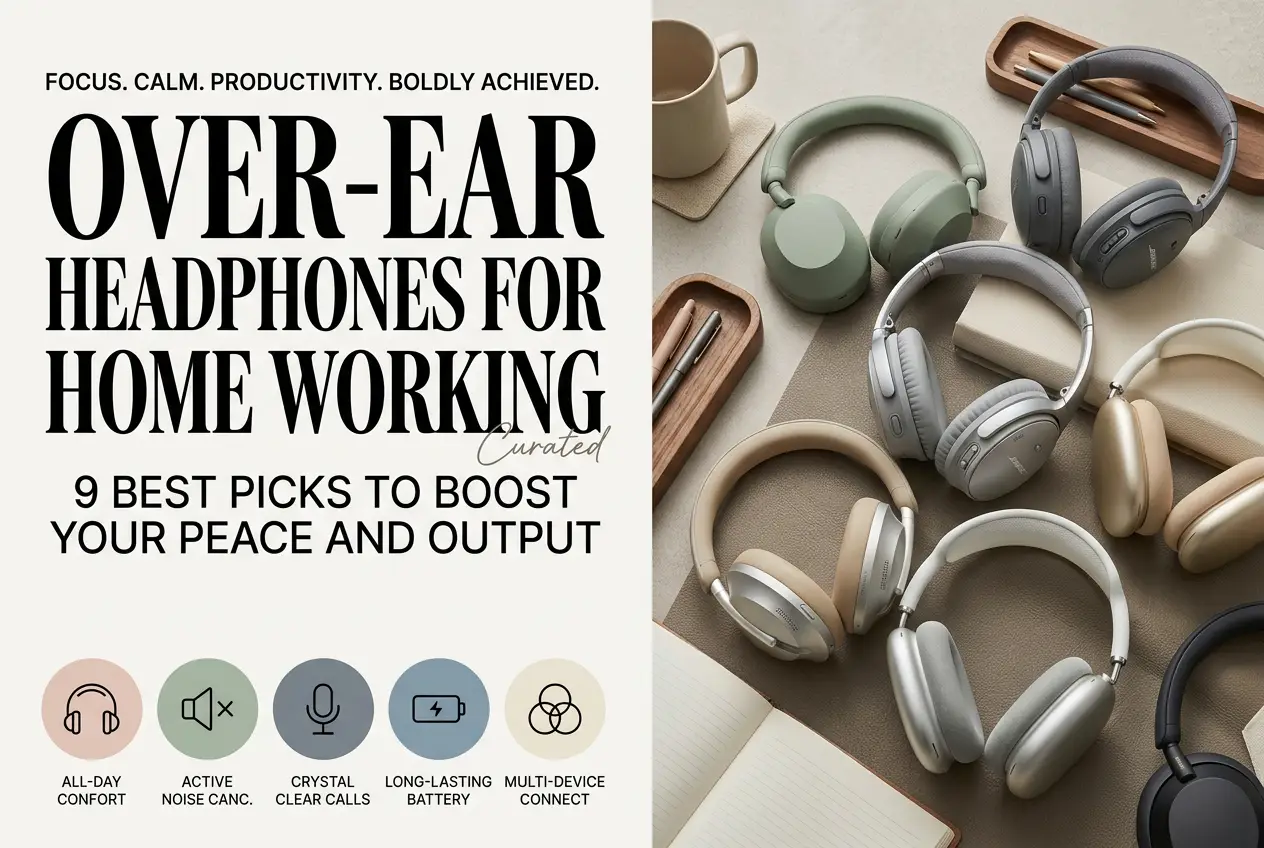
My first week working from home, I used cheap earbuds. By Friday afternoon my ears were raw, I’d missed half of a client call because my flatmate decided to hoover the hallway, and I’d spent most of Thursday in a low-level fog of ambient noise I couldn’t quite block out. That’s when I started taking over-ear headphones seriously.
Here’s what I’ve come to believe after testing a lot of these: the right pair of over-ear headphones isn’t just audio equipment — it’s the difference between a home office that actually functions and one that slowly wears you down. They create a physical and psychological barrier between you and whatever chaos is happening on the other side of the door. That matters more than most people expect before they try it.
We’ve rounded up nine of the best over-ear headphones for home working in the UK right now, covering everything from serious noise cancellation to all-day comfort, clear call microphones, and options across a wide range of budgets.
Why Your Home Office Needs Proper Headphones
Home working can feel genuinely chaotic. Your partner’s on a call in the next room, someone’s drilling outside, the postman knocks at the worst possible moment, and your brain is trying to hold a thought through all of it. Over-ear headphones solve this in ways earbuds simply can’t — partly through passive isolation (the physical seal of a padded cup around your ear), partly through active noise cancellation in models that have it, and partly through something harder to measure: the mental shift that happens when you put on a proper pair and signal to yourself, and everyone around you, that you’re actually working now.
Beyond focus, there’s the call quality issue. Your colleagues and clients are forming impressions based on how you sound. A microphone that picks up every keyboard click, or makes your voice sound hollow and distant, does real damage to how you come across professionally — regardless of what you’re actually saying.
They’re the grown-up choice for serious remote workers. Full stop.

Premium noise-cancelling option for serious focus and calls
Sony, WH-CH720N Wireless Noise Cancelling Over-ear Headphones £69

Ergonomic design for extended work sessions

Clear call quality for video meetings

Affordable option without sacrificing comfort
Does Noise Cancellation Actually Work?
Short answer: yes, when it’s done well.
Active noise cancellation works by using tiny microphones on the outside of the ear cup to pick up ambient sound, then generating an opposing audio signal that cancels it out before it reaches your ears. It sounds like something from a physics lecture, but in practice you notice it the moment you turn it on — a bus rumbling past goes quiet, a conversation two rooms away drops to a murmur, and you suddenly realise how much background noise you’d been tolerating without knowing it.
Where ANC earns its keep most for home workers is during calls. Without it, your brain is constantly doing low-level noise filtering, which is exhausting over a full day. With a solid ANC pair, you can run back-to-back video meetings and still feel reasonably human by 5pm. The trade-off with stronger ANC is usually weight — the headphones need to seal properly around your ears, which means more padding and a slightly firmer clamp. Most people adjust within a day or two, but if you’ve got a smaller head or you find tight headbands uncomfortable, it’s worth trying before you commit.

Premium ANC for maximum focus and distraction elimination
soundcore, Q21i Over-Ear Noise-Cancelling Wireless Headphones £69.99

Solid passive noise blocking without active tech
Sony, WH-1000XM6 Sand Pink Wireless Noise Cancelling Over-Ear Headphones £299 (9% OFF — was £329)

Long-lasting battery for all-week work sessions
Bose, QuietComfort Ultra Bluetooth Headphones (2nd Gen) £379 (5% OFF — was £399)

Quick awareness mode to hear your surroundings when needed
Apple, AirPods Max Wireless Over-Ear Headphones £423.99 (15% OFF — was £499.99)

High-fidelity audio for professionals who care about sound
Jbl, Tune 520 BT Wireless On-Ear Headphones with JBL Pure Bass Sound £19.32 (68% OFF — was £59.95)
Eight Hours In — Comfort Is Everything
Nobody warns you about this when you start working from home.
The best noise cancellation in the world is worthless if the headphones are digging into your skull by noon. Comfort when you’re wearing something for 8+ hours daily comes down to a handful of things that manufacturers don’t always shout about: how the weight is distributed across the headband, whether the ear pad foam actually breathes or just traps heat, how much clamping force the band exerts, and whether the cups swivel enough to follow natural head movements without fighting you. Some headphones feel fine in the shop and become genuinely unpleasant after two hours of real use — I’ve made that mistake more than once, unfortunately.
What separates genuinely comfortable all-day headphones from merely acceptable ones is often the ear pad material. Cheap synthetic leather looks the part but gets warm and sweaty fast. Fabric or protein leather alternatives breathe better and tend to stay softer longer before the foam underneath compresses flat.
When your ears are uncomfortable, you’re not working. You’re just suffering through it.

Plush padding that stays soft all day
Jbl, Tune 720BT Over-Ear Wireless Headphones £49 (30% OFF — was £69.99)

Featherweight design reduces neck strain
Apple, AirPods Max Wireless Over-Ear Headphones £319 (25% OFF — was £424.99)


Flexible design that adapts to your head shape

Durable, comfortable materials that won’t crack
Sony, Unisex WH-CH520 WIRELESS OVER EAR HEADPHONES in Black Black One Size… £49.99
Your Microphone Is Judging You on Every Call
A headphone with a poor mic is half a product. That’s not an exaggeration — on a typical work-from-home day with four or five video calls, the microphone gets nearly as much use as the speakers do, and yet most reviews spend about one paragraph on it.
What you want from a headphone mic is pretty specific: clear voice pickup without also catching every keystroke, good rejection of sounds coming from the sides and behind (so your flatmate’s TV doesn’t gate-crash your client calls), and consistent volume without you having to stay unnaturally still. Detachable boom mics, like the one on the JBL Quantum 100M2, solve a lot of these problems by getting the microphone closer to your mouth. Built-in mics have improved enormously over the last few years, but boom mics still have an edge for call clarity, especially in noisier rooms.
The platforms you use also matter, actually — Teams and Zoom both have their own noise suppression processing layered on top of whatever your headphones do, which means a middling mic can sound fine in Teams but expose its weaknesses in a raw recording situation. Worth keeping in mind if you do any podcasting or voice work alongside your regular calls.

Professional-grade mic for crystal-clear conference calls
Sony, WH-1000XM5 Hard Case Noise Cancelling Wireless Over-Ear Headphones in… £249.99
Flexible mic positioning for optimal voice capture
Apple, AirPods Max Wireless Over-Ear Headphones £348 (18% OFF — was £424.99)

Seamless plug-and-play for Zoom and Teams
Apple, AirPods Max Over-Ear Wireless Headphones USB-C Charging £389 (9% OFF — was £429)

Easy mute control for those accidental unmute moments
Sony, Unisex WH-1000XM5 Hard Case Noise Cancelling Wireless Over-Ear… £249.99

Advanced mic tech that filters out office and home noise
Spend More or Save More? The Real Headphone Price Breakdown
Expensive doesn’t automatically mean better for your situation. But cheap has real limits too.
Under £100, you can get over-ear headphones that do the job — passive noise isolation from the cups themselves, reasonable comfort for six-hour stretches, and microphones that colleagues won’t complain about. Battery life and build quality are usually where corners get cut. They’re worth considering if you’re not sure yet how much you’ll actually use them or if you work in a relatively quiet environment where you mainly need focus music rather than heavy-duty noise cancellation.
Between £100 and £250 is where the jump in quality is most noticeable. You get real ANC, noticeably better sound, touch controls, multi-device pairing so you can switch between your laptop and phone without faffing around, and padding that doesn’t flatten out after three months. This range covers most home workers well, and I’d point most people here before looking at anything pricier.
Above £250 — and we’re talking Bose QuietComfort Ultra, Sony WH-1000XM6, Apple AirPods Max territory — you’re paying for genuinely outstanding ANC performance, premium materials, and features like spatial audio or AI-assisted voice processing. They’re not overkill if you’re wearing them six days a week for years, because the cost-per-use drops considerably. But if you’re working part-time or your environment is already fairly quiet, the jump from £150 to £400 won’t transform your working day the way the jump from £40 to £150 will.

Entry-level option for casual home workers
Sony, WHULT900 Wireless Noise Cancelling Over-Ear Headphones £129

Best value sweet spot for most remote workers
vhbw, 2x Ear Pad Cups Cushion Covers Compatible With Sony Zx100 £10.46

Investment-grade headphones for the discerning home worker
Apple, AirPods Max Wireless Over-Ear Headphones ANC USB-C Midnight £389 (22% OFF — was £499)

Durable construction that justifies the investment
Bose, QuietComfort Wireless Noise Cancelling Over-Ear Headphones £219 (4% OFF — was £229)
What should you actually prioritise?
Start with your environment. Noisy flat, busy household, street-facing room? Prioritise ANC above everything else, even comfort, because the right noise cancellation will reduce fatigue more than any amount of extra padding. Quiet environment where you’re mainly doing solo focused work? Comfort and call quality matter more than ANC strength.
Then think honestly about how many hours you wear them. Under four hours a day, most decent headphones will be fine. Over six hours, the ear pad material, headband pressure, and weight distribution go from minor considerations to things you’ll notice every single day. Don’t skip that part of the spec sheet.
The best over-ear headphones for home working aren’t the ones with the longest feature list. They’re the ones you stop noticing after the first hour because they fit well, sound clear, and stay out of your way — and that combination is worth paying a little more to find.
Hey savvy shoppers! When the items in our articles catch your eye and you decide to buy through our links, we may earn a small commission at no extra cost to you. Think of it as a way of supporting us in bringing you the best content!
Frequently Asked Questions
Are over-ear headphones better than earbuds for working from home?
For most people, yes. Over-ear headphones sit around your ears rather than inside them, which means they’re far more comfortable during long work days. They also tend to have better microphones, stronger passive noise isolation, and they don’t cause that aching pressure you get from earbuds after a few hours.
Do I really need active noise cancellation for home working?
It depends on your environment. If you’re in a quiet flat with no flatmates or family around, passive isolation from a well-padded over-ear design might be enough. But if you’re dealing with traffic noise, a busy household, or you live near a building site, ANC makes a genuine difference to your focus and your stress levels.
How much should I spend on over-ear headphones for my home office?
You can get something genuinely good from around £80-£150. That range covers solid ANC, decent call microphones, and all-day comfort. Sub-£50 options work fine for occasional use but tend to feel cheap after a few months. Premium options above £300 are excellent but probably overkill unless you’re doing audio work or you just want the best.
Which over-ear headphones work best with Zoom and Microsoft Teams?
Most Bluetooth headphones work with both platforms without any setup. What matters more is microphone quality — look for headphones that mention beam-forming microphones or voice pickup features. Sony’s WH-1000XM5 and the Bose QuietComfort range both perform well on calls specifically.
How long should over-ear headphones last before the padding wears out?
With daily use, ear pad foam typically starts degrading after 18-24 months. Cheaper synthetic leather peels and cracks sooner. Some brands sell replacement pads, which extends the lifespan considerably. It’s worth checking whether spare parts are available before you buy, especially if you’re spending over £150.


 No products in the cart.